




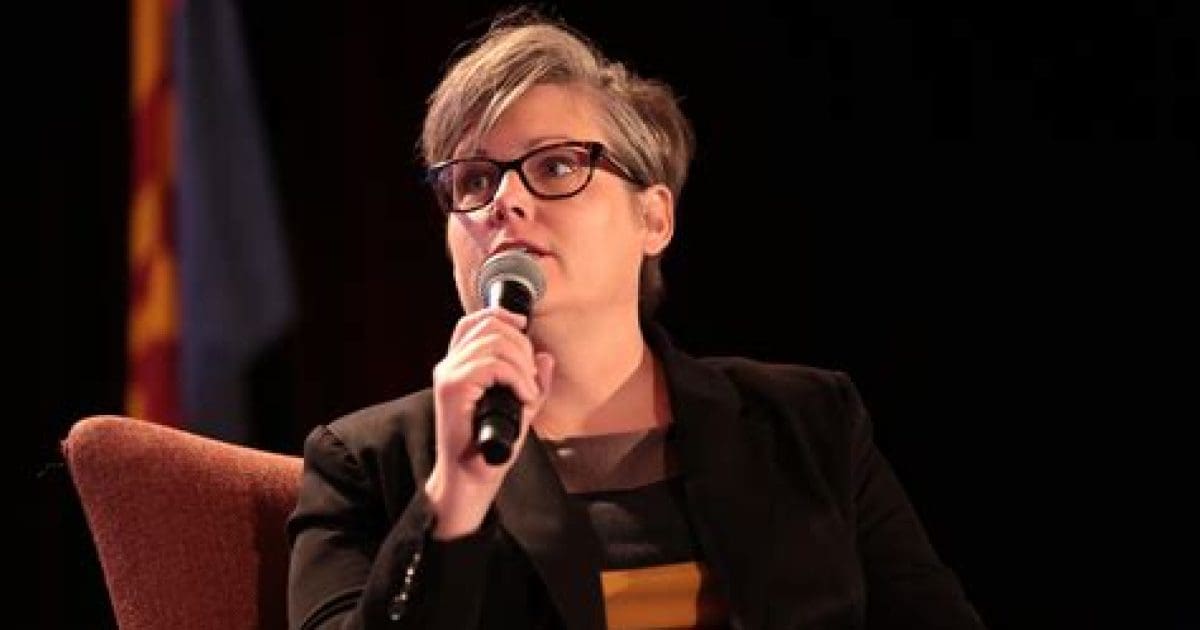
From Burger King to the Governor’s Office – Katie Hobbs Takes Control
Vetoes, Appointments, Contracts — and the Expanding Reach of Executive Power
THE THREE MUSKETEERS: THE KATIE HOBBS FILE – PART 2
Guest post by Linda Brickman
SECTION 1. THE GOVERNOR ARRIVES WITH A PEN
Katie Hobbs did not enter the Governor’s Office quietly.
She arrived promising cooperation, moderation, and a willingness to work across party lines. Arizona voters had elected a Democratic governor and a Republican-controlled Legislature. That arrangement seemed to require negotiation.
But Hobbs found another instrument…
The VETO PEN.
During her first year in office, Hobbs vetoed 143 bills — more than any Arizona governor had rejected in a single legislative session. In 2024, she vetoed another 73. By the end of her first two years, **216 bills had died beneath her signature.**
Some deserved serious scrutiny. Some raised constitutional questions. Others reflected genuine policy differences between a Democratic governor and Republican legislators.
But the sheer volume told its own story…
Hobbs was not merely rejecting occasional legislation she considered flawed. The veto had become one of the Central Governing Tools of her administration.
When Republican lawmakers sent her a package of thirteen budget bills in February 2023, Hobbs rejected all thirteen. She dismissed the legislation as offering Arizona “false choices” and insisted that the budget should be negotiated as a complete agreement.
That position was politically indefensible.
It was also revealing.
The governor who had campaigned as a bipartisan problem-solver was making clear that cooperation would occur largely on her terms — or not at all.
The pattern extended beyond the budget. Election legislation, border-security measures, housing reforms, education bills, and restrictions on executive authority repeatedly reached her desk and repeatedly returned to the Legislature stamped:
VETOED.
Supporters called it a necessary defense against Republican overreach.
Critics called her the Veto Queen.
Both descriptions avoided the larger question:
Was Katie Hobbs preventing bad legislation — or intentionally using gridlock to expand the power of the Governor’s Office?
The answer would not be found in the veto record alone.
It would also emerge through appointments that avoided Senate confirmation, agency leadership disputes, government contracts, public money, political contributors, and an administration that increasingly asked Arizonans to trust decisions made beyond public view.
The Burger King employee who had quickly climbed Arizona’s political ladder had finally reached the top.
Now Arizona was about to learn how she intended to rule from it.
SECTION 2. APPOINTMENTS WITHOUT PERMISSION
- A veto allows a governor to stop someone else’s decision.
- An appointment allows her to make one of her own.
Arizona law requires the Governor’s choices for major agency directorships to undergo Senate review and confirmation. The arrangement is intentionally inconvenient. The Governor selects. The Senate examines. Neither branch receives complete control.
Katie Hobbs soon decided the process was not merely inconvenient. She called it a “political circus.”
During 2023, the Republican-controlled Senate created a special committee to examine Hobbs’s nominees. Some were subjected to aggressive questioning. Several were rejected. Others waited months without receiving confirmation hearings or final votes.
Hobbs accused Senate Republicans of abusing the confirmation process and deliberately obstructing her administration.
Republicans argued that scrutiny was precisely what confirmation required.
Then Hobbs changed the act.
In September 2023, she withdrew thirteen pending agency-director nominations from Senate consideration. But the nominees did not necessarily leave their agencies. Instead, members of her administration were redesignated as “executive deputy directors” and continued leading the same departments without Senate confirmation.
Same agencies. Same authority. Different Titles.
The Governor portrayed the maneuver as necessary to keep Arizona government functioning. Her office argued that Senate leaders had transformed legitimate vetting into partisan warfare and that agencies could not remain leaderless while politicians fought.
Senate President Warren Petersen saw something else: A Governor attempting to erase the Senate from a process Arizona law required it to perform.
The dispute moved from the Capitol to the courtroom. On June 5, 2024, Maricopa County Superior Court Judge Scott Blaney ruled that Hobbs had acted illegally. The so-called executive deputy directors were functioning as de facto agency directors, the court concluded, and the arrangement unlawfully circumvented the Senate-confirmation process.
Hobbs appealed. Her administration warned that allowing the Senate to dictate who could manage executive agencies would permit legislators to “shackle” the executive branch.
But by August 2024, the maneuver had reached the end of the runway. Hobbs agreed to resume submitting agency-director nominees to the Senate, and the court formally ordered her to restore the legally required confirmation process.
The agreement resolved the immediate standoff. It did not erase what the episode revealed…
Katie Hobbs had campaigned as an experienced leader who could work across party lines. Yet when the Legislature exercised its authority over appointments, her administration did not merely negotiate harder. It attempted to redesign the positions.
The Governor’s defense deserves consideration. Senate hearings had become intensely partisan. Nominees were questioned about subjects far beyond their professional résumés. Some waited months while agencies needed leadership. Even critics of Hobbs could reasonably question whether the process had become more political than productive.
But obstruction by one branch does not automatically transfer its constitutional or statutory authority to another. That is the purpose of checks and balances. They are most important when both sides find them unbearable.
The veto record showed how Katie Hobbs used power to put the law clearly placed in her hands.
The appointment battle showed what happened when the law required her to share it.
When the door to confirmation would not open, the Hobbs administration did not wait outside. It changed the name on the office and walked around the building.
And appointments were only the beginning…
The next questions would involve government contracts, political relationships — and one expensive Arizona logo whose family connections proved considerably more interesting than its design.
SECTION 3 The Expensive Logo and Its Fascinating Family Tree
Government contracts rarely arrive wearing warning labels. Sometimes they arrive as LOGOS.
In August 2024, Hobbs proudly unveiled “Vibrant Arizona,” a new statewide brand intended to promote tourism and create a common identity for state agencies. The Arizona Office of Tourism described a year-long process involving dozens of communities, more than 2,000 participants, a statewide survey, marketing strategy, a brand playbook, videos, templates — and a colorful new Arizona logo.
The total reported cost was approximately $700,000. That figure was not merely the price of drawing a logo, as critics sometimes suggested. It covered the broader branding project.
But the logo contained something the promotional campaign had not advertised: A remarkably interesting family connection.
The Office of Tourism was headed by Lisa Urias, a Hobbs appointee who continued to own the communications company bearing her name, although she said she had separated herself financially from its daily operations.
Heart & Soul Marketing received the state branding work. Artist Kevin Coochwytewa was then paid a reported $27,500 to help create the design appearing inside the logo’s sun.
Kevin Coochwytewa’s brother, Jason Coochwytewa, was the chief executive officer of Urias Communications — the company founded and owned by Tourism Director Lisa Urias. Lisa Urias acknowledged recommending Kevin for the project, although she maintained that Heart & Soul selected and paid him and that neither she nor Urias Communications profited from the arrangement.
No public finding established that Hobbs personally directed the payment or that Urias received money from it.
But Government Ethics are not measured only by whether someone ultimately deposits the check.
They are also measured by disclosure, distance, oversight — and whether the public has reason to wonder why a state contract begins resembling an organizational chart at a family reunion.
When the relationships became public in November 2024, Republican legislators demanded an investigation. Urias denounced the allegations as false and politically motivated, but submitted her resignation. Hobbs accepted it.
“Anyone who has the privilege of serving the public needs to be above reproach,” the Governor said. “This appearance of conflict is not acceptable.”
The statement was decisive. It also raised an uncomfortable question. The branding initiative had begun under Hobbs’s administration. Her appointee had overseen it. Hobbs had publicly celebrated its unveiling. Yet the appearance of conflict apparently became unacceptable only after reporters exposed the relationships and legislators began demanding answers.
The project remained.
The logo remained.
The tourism director did not.
And while Arizona debated the price of its new image, another state agency had already sent $2 million to people who had no right to receive it.
SECTION 4. WHEN TWO MILLION DOLLARS DISAPPEARED
The tourism controversy involved an appearance of conflict. The Arizona Department of Housing presented something considerably less theoretical: Two million dollars disappeared.
In June 2023, the department wired $2 million in affordable-housing funds to criminals impersonating the intended nonprofit recipient and title company. The legitimate recipient did not receive the money. By the time the fraud was discovered months later, the funds had reportedly traveled overseas.
The loss was not caused by a complicated policy disagreement or a hostile Legislature. It resulted from a fraudulent request that should have been verified before the money left Arizona’s control.
A 2024 Arizona Auditor General report found that the Housing Department lacked adequate written procedures for confirming wire-transfer instructions and had failed to establish sufficient safeguards to prevent the fraud. The report identified weaknesses in oversight that allowed a request involving millions of public dollars to proceed without the independent verification such a transaction demanded.
There is no evidence that Katie Hobbs personally approved the wire transfer or knew that fraud was occurring. But governors rarely enter banking information themselves. They appoint agency leaders, establish expectations, oversee executive departments, and accept responsibility when government systems fail.
That is the Difference between Personal Participation and Executive Accountability.
Hobbs’s administration could properly argue that sophisticated fraud can strike governments under either political party and that responsibility rested primarily with agency personnel who handled the transaction.
But Arizona taxpayers could properly ask a simpler question:
How does an administration that demanded control over its agencies lose $2 million because no one made the necessary telephone call before pressing “send”?
The money vanished.
The audit remained.
And another agency under the Governor’s control had supplied critics with a new definition of executive management.
SECTION 5. THE PATTERN TAKES SHAPE
By the end of 2024, Katie Hobbs had completed the first half of her term. She had vetoed 216 bills.
She had withdrawn agency nominees and attempted to keep them in control under different titles — a maneuver a court ruled unlawful.
Her administration had celebrated a $700,000 tourism-branding project whose connections later produced an “appearance of conflict” serious enough to cost the tourism director her position.
And a state housing agency had transferred $2 million to criminals because basic verification safeguards were missing.
Each episode came with an explanation:
- The Legislature was obstructing her.
- The agencies needed functioning leadership.
- The branding project was broader than one logo.
- The tourism director denied profiting.
- The wire fraud occurred inside an agency, not at the Governor’s desk.
Some of those explanations were reasonable. Together, however, the episodes revealed a disturbing governing pattern:
Katie Hobbs repeatedly demanded the authority to control Arizona’s executive branch — but when controversy followed, responsibility became remarkably difficult to locate.
Meanwhile, another name was beginning to enter Arizona’s political conversation: Sunshine Residential Homes.
The foster-care provider had political and financial connections to Hobbs’s orbit and later received a substantial state rate increase. Hobbs has denied influencing the agency’s decision, and the early facts did not by themselves prove wrongdoing.
But the contributions, meetings, contracts, and rate decisions would eventually attract investigators — and lead Arizona back to the question that opened this series:
What followed Katie Hobbs up the ladder?
*************************************************
KATIE HOBBS HAD TAKEN CONTROL.
NOW THE RECORD WAS COMING DUE.
Part I examined how she reached the Governor’s Office.
Part II revealed how she exercised its power.
Part III will examine what happened when the money trails, agency decisions, investigations, and election-year consequences finally began arriving at the same destination.
By Linda Brickman
©2026 Linda Brickman. All Rights Reserved.

Coming NEXT IN THE KATIE HOBBS FILE…
PART III: THE RECORD COMES DUE
Campaign Money, Investigations, Agency Failures — and the Questions That Followed Katie Hobbs into the 2026 Election
Read the full article here


