







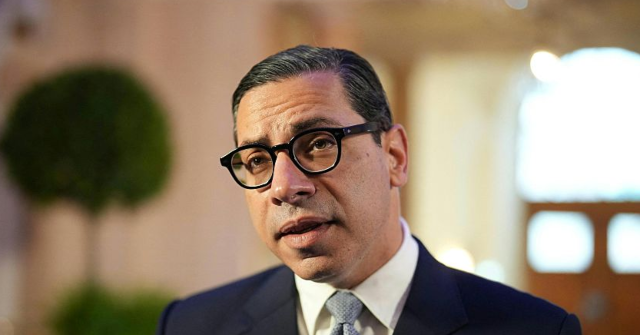
WASHINGTON — Cyprus’s Foreign Minister Constantinos Kombos told Breitbart News exclusively that President Donald Trump is in a “unique position” to restructure the “global order” and shape world affairs in a way that an American president has not in generations.
“The President is in a unique position to define the global order and developments, and you have seen that throughout the year — the last year since he assumed he assumed duties,” Kombos told Breitbart News exclusively. “So at the same time, it’s clear, I think, that there is more room, more space for more dialogue. And I’m sure I have the impression that the President is willing to engage — he’s willing to engage with his own approach — which is about reaching an outcome. It’s not about discussing for the sake of discussion or conversation. So my message is, it’s very clear that the EU cannot and should not be seen as an adversary. On the contrary, we see that there is great potential for making the relation grow in terms of trade and in terms of the various things that affect us both from migration, from a number of files, connectivity, and so on. So Cyprus has now this role. Cyprus is a country that has made this foreign policy focused on both the EU and the U.S., and having extremely useful regional role with the Arab world and with Israel. So we are willing to play the role, to act as a point of entry, a point of contact, someone with which, with whom you can have this kind of conversations, depending on the file, and it’s a country that doesn’t have any skin in the game in relation to the big issues, on the contrary.”
“So why Cyprus? For all these reasons,” Kombos explained, “for its orientation of foreign policy, for its network of relations, for its positioning geographically, for its economic and trade potential, for the way it operates as a connectivity point with an area region for which the U.S. is extremely interested about. This is where technology is taking place, AI, energy resources — all is in that part of the world, and we are in the unique position of being a bridge between the Middle East, the wider Middle East, and Europe. And having the membership of the EU is not a disadvantage in this case. On the contrary, it is a way of doing business with the Middle East at the same time.”
Kombos was in Washington for the Delphi Forum in D.C., a Washington outshoot of the annual forum held in the Greek mountains in ancient Delphi called the Delphi Forum. He joined a number of other Greek and Cypriot politicians in the defense, intelligence, foreign affairs, and economic portfolios for discussions with American and other officials and influential figures. Kombos sat down with Breitbart News for a lengthy exclusive interview to discuss the state of American relations specifically with Cyprus, as well as more broadly with Europe. Cyprus is currently for the first half of 2026 leading the European Union’s Council presidency — a position that rotates between the EU’s member states for half-year terms — allowing the small island nation to shift focus onto matters it cares about. Given the geographical proximity of Cyprus to the Middle East, much of what Cyprus is focused on is being a bridge or connector between the eastern and the western worlds. Kombos said that Cyprus leading the EU Council Presidency for this year’s first half can be extremely beneficial to those who want western civilization to succeed.
“So for us, the opportunity to have the rotating Presidency of the Council of the EU is something extremely important,” Kombos said. “It’s offering to us a chance to make Cyprus more visible at the international scene, without being overly ambitious or ambitious to a point where it’s unrealistic but by being consistent, predictable, and expand — extending this clear message that we are here to act as an honest broker. There are so many things happening around us that I think the world can use as much as possible. Anyone who is willing to contribute to a smaller or to a bigger extent, depending on the fight for our case, for Cyprus — geopolitically, geographically, politically — we have excellent relations, with all the countries in our region. This is very rare these times, especially as regards to the relation with Israel, the Arab world, with the Gulf, with everyone. We also have a strategic relation right now with India, with UAE, with the United States, with the United Kingdom, with France, with Bahrain — all these are very specific, targeted relations. For us, it’s creating a network on the basis of which we are able to build so during our presidency we aspire to make maximum use of these relations for the benefit of the European Union respecting our institutional role in that capacity. We are not heading the diplomacy of the EU — we are not doing that — but we are on the table with a role that is more advanced, if you like. It enables us to be the part of the coordination team. This is now becoming extremely important with the situation in Iran, with the situation as regards to the transatlantic relation. We believe that we are bringing to the table a very clear approach as regards the relation with the United States, as I have explained just before. It’s about reaching out, creating positive agendas, dialogue, intensified dialogue, and having a clear address as to who is doing what in each case. So we’re available to do that. We are willing to do that to the extent that it’s possible and useful. It’s better to have options — put this offering, this option to the table rather than taking them. There is a solution. There is a way out of just being an observer and waiting for the six months the term to just pass. This is not how we approach it.”
Kombos also said he is advocating more European engagement with the United States under Trump, not less like some other Europeans are pushing for, and that specifically he sees a very clear plan from President Trump for the United States and the world. He argued those who wish to go back to the days before Trump are misreading the room, and misunderstanding where American voters are now. He said Trump made it extremely clear what he was campaigning on when he ran for reelection in 2024, and that his decisive comeback victory also makes it clear where the American people are. Kombos however also said that he believes there is a lot of room to work with the Americans under Trump and beyond, and is pushing his fellow Europeans to join the cause. He argued more dialogue and engagement is the answer to finding common ground.
“I mean, it’s clear that there is a vision, there is a plan in place. It’s not something that should be surprising us. It’s been documented in public and stated in public during the election campaign, and it’s building up on the first Trump term,” Kombos said. “So naturally, things are very different, and one of the misconceptions that third parties have been doing, we have been doing, relates to thinking that this is going to be like Trump one. It’s completely different because the situation is different. So it started with a very clear approach as regards to foreign affairs. There are things happening all the time, and there is initiative on behalf of the American administration or a number of files now. Trade, and being able to leverage trade for the benefit of the American economy, is a clearly declared priority. So how do we respond to that as interlocutors? I think that we have to be very realistic as to economic expectations from our side, economic capacity from our side. I’m talking about Europe now. Europe has the space, the ability, to be a partner in trade with the United States but also look into other markets as well because it’s not something that’s excluding the United States. On the contrary, by building up free trade arrangements, whether that’s with India, with UAE and the ASEAN countries, it’s also providing a freer space for doing business, and that’s something that at the same time it’s for the benefit of global economy by definition, of all the private entities and companies in the U.S. as well. So President Trump has a very clear line as regards foreign policy. Yes, sometimes it’s surprising to us things that are happening, but we strongly believe that because of the unpredictability of the approach, we need to engage more. We need to find those files for which there is a positive convergence, and work with the American counterparts, reach out, have the dialogue. There will be differences. But that doesn’t necessarily mean that we shouldn’t be communicating even more. It’s actually at these times of difficulty, of unpredictability, that we should be engaging even more so this is how we see the situation, and we believe that this is not going to be a temporary state of affairs. This is a world order that has been changing, and the U.S. is leading the way in relation to that change. We can hope, or that is wishful thinking of things going back to the way we want them or the way they used to be done. But this is not the reality. So we take the world as we find it and not like as we would like it to be, and part of that is the transatlantic relation, which we should be working together to make it stronger. And I run out any kind of differences that from time to time might arise.”
Interestingly, while Kombos was in Washington, Trump announced a trade agreement between the U.S. and India — the two largest democracies in the world joining forces — ending for now a monthlong spat between the parties. The deal came on the heels of a major EU trade pact with India as well, essentially linking the far east with the west. He said the hope among many is that these pacts will lead to more advancement in the way of things like IMEC, or India-Middle East-Europe-Economic-Corridor, a proposal that would bridge India and the United States through the Middle East and Europe and act as a counterweight of sorts to the Chinese Communist Party’s Belt and Road Initiative.
“It’s a very good example of what I was saying earlier, which is that the free trade agreement basically that was concluded between the European Union and India just a few days ago in a way operated as an incentive or a catalyst for concluding the India-U.S. deal as well,” Kombos told Breitbart News when asked about it. “So it’s not something that is excluding anyone but at the same time if you are opening pathways this automatically is creating space for expanding that. This is what happened. I had the opportunity to be in India, and I’m in close contact with with Indian leadership. It was obvious to us, to me, that a deal was forthcoming with the United States. I made the comment yesterday that this is something that one should be trusting the pragmatism of the two parties, and by chance, it was actually transpiring and happening at the same time we were making that specific statement. But it’s huge. India is the number one country in terms of population. It’s the fourth largest economy in the world. It has enormous potential, and it has a foreign policy that is very pragmatic and very clear in the way they approach things. At the same time, it’s a major partner for Europe, and a major partner for Cyprus. Bilaterally, there is a lot of investment taking place between Cyprus and India at all levels. For some time now, there is very close political ties between the two countries and the IMEC project, the IMEC concept that we hope will become a project. We believe that it’s been to our advantage that we have this kind of relation, and more importantly, that we now have the EU and the U.S. having this strategic trade partnership with with India. India is a consumer. India is also a net producer. India has a capacity to grow even more, and it’s acting as a counterbalance and counterweight to other big countries in that wider region. So strategically, it made sense, and it’s positive news that you have this development.”
Asked later in the interview if he thinks there is growing concern about China worldwide and particularly in Europe, Kombos said he thinks that dealing with China is an area where the United States and Europe can work closely together.
“Well, I think this is a file that could be a very good example of convergence between Europe and the United States,” Kombos said. “China is a global superpower. It’s a permanent member of the Security Council. In terms of trade, development, the growth size in all the fields have a crucial role to play. So in Europe, we have seen this relationship through the lens of strategic analysis. We have used terms like the coupling, the risking, it’s a competitor, it’s not a competitor. But at the end of the day, there is no clear line as to how we approach this global phenomenon. That is China. So a lot of these concerns are similar with Washington, with the United States, and at some point, one is safe to predict that all these issues will come to the surface in a way that is much more visible than it is right now or at this moment. So we need to find a way of ensuring that global trade continues to take place in a way that is beneficial for everyone involved, that the dominance in relation to global trade — or the basic materials that drive the economies of the world. This is done in a way that is equitable, balanced, and in accordance with the principle that you need to have a win-win situation, not a double win for someone. So this is something that I believe there is plenty of room, plenty of space for working together. It’s not about isolating anyone. On the contrary, it’s about trying to find the right answer to this situation. And we haven’t been able to do that for all of this time. The free trade agreements that we have from the U.S. side with a number of countries, but also from the European side — these are very important indicators and policy drivers as well. They are showing that we are not abandoning global trade. On the contrary, there is this effort to recalibrate the rules of the game in a way, by benefiting the economies internally rather than outsourcing a big part of the profitable enterprises that go along with with growing economies.”
No American president has ever visited Cyprus while in office, but Kombos said that Trump would be welcomed with open arms in the country if he were to visit.
“He would be the first American president,” Kombos said. “We had Vice Presidents visit in the past, but that’s the maximum we had. The president, I think, is not only welcome, I think it would be a great opportunity to see how things have been done in our part of the world, and also visit to a country that is very friendly to the United States. At the same time, one can appreciate how busy he is. So of course, he’s very busy. But landing in Cyprus, you can realize the proximity to all the countries around us. It’s about a few minutes — a matter of minutes. So that gives you a clear impression that this is a geopolitically, strategically positioned country that has a global reputation of being a service center of setting up business. Through us, you can have business activity globally, but especially in that part of the world, in countries where it’s more difficult to set up business, we facilitate access to those markets and at the same time, it’s about leveraging the excellent bilateral relations we have with the main players in the region. So Cyprus makes sense. We are part of the possible solutions to a number of problems. We are not exclusively the solution, but it’s a country when to contribute and perform its duties if you like towards international community and our regional stability at the same time.”
It’s unclear if the president will visit there, but it’s possible he could on the way to or from a Middle Eastern country. Breitbart News actually accompanied then-Secretary of State Mike Pompeo to the island back in Trump’s first term in September 2020 when he stopped there on the way back from Doha, Qatar, where he met with Taliban leaders to try to negotiate an end to the then-still-raging war in Afghanistan.
Kombos told Breitbart News that Cyprus’s place as a predominantly Christian nation so close to the Middle East and also as part of the European Union — Cyprus is particularly close with Greece culturally, politically, and geographically — that Cyprus can serve as a connector of sorts between the two worlds in a way that is advantageous to the president’s vision here in the United States.
“Our national profile is very much attractive to the political mindset that is now dominating in Washington, DC,” Kombos said. “It’s a Christian country. We care very much about the Christian populations around us, especially in countries where there are minorities like for example Syria. We have been active on this front, or we have tried, and we are financing projects of support of these Christian communities. And this is an example where we could be partnering up with the United States, not in terms of co-financing, but with the United States bringing its clout, its leverage and bandwidth to these kind of projects. So that’s one point. Secondly, it’s a very close relation with Abraham Accords countries — with Israel, with UAE, both are strategic partners of ours. So this is something that we also think it’s extremely important and valuable in terms of looking at the future of the region. And the region has great potential, whether that’s energy resources, whether that’s connectivity. At the end of the day, it’s about being able to facilitate this progress so we are able to help, at least in this direction. The EU membership is adding another layer to this in the sense that the regulatory framework, the free movement of capital, of human capital, the freedom of establishment — these are important drivers for the economies. And Cyprus being a service center, Cyprus having a very strong maritime sector, a very strong technological sector. All these are useful tools for countries that are willing to have presence, and the U.S. has presence in the region and that is not going to change. On the contrary, we are saying that it’s being solidified — the presence of the United States in the region — exactly because of the value and importance of our neighborhood. So we are using all these parameters of our profile in a way that could be useful for anyone who is willing to have presence in Cyprus, and that extends from security, defense, intelligence sharing, trade, investment.”
Greeks and Cypriots, dating back to ancient times and continuing to the present day, are known for their shipping industries. Kombos argues that that the “maritime lanes will be the future” for world economic and geopolitical power, determining which nations thrive and which civilizations do not. Specifically, back in Trump’s first term, a geopolitical framework that unites the U.S. with Greece, Cyprus, and Israel — called the 3+1 framework — was formalized through legislation in Congress. A big part of what Greeks and Cypriots are focused on now is further exploring and formalizing this framework beyond the already-vibrant energy sector — flourishing thanks to American oil companies like Chevron and ExxonMobil being active in the region — and then expanding it to broader international geopolitical and trade frameworks like the proposed IMEC that Trump and other leaders have spoken so highly of.
“We have to realize this. It’s about building up infrastructure capacity for maritime lanes,” Kombos said. “It’s about facilitating trade. All these free trade agreements are excellent, but they need to be implemented. How do you implement this agreement? You go back to the basics. The basics of world trade is the maritime sector. So Cyprus has a lot to offer in relation to that. It’s a huge part of our economic mix — 11th largest commercial fleet globally, over 20 percent of third party shift management takes place to us. So the basic elements are there: geography, maritime sector, technology sector, which is double the size of the maritime sector in our case, a service center, great political relations with the interested parties. So for the United States, the 3+1 format and the presence of the U.S. in the region. For us, this is something we need to make sure that we take full advantage of all of the countries involved. The 3+1 at the level of foreign policy is something that we need to make sure it happens and it happens soon. We need to make sure that we project this alliance that exists. We need to make sure that we make this alliance work for the good of our peoples, for our economies, for our energy, economy, trade, investment. The political will is there. We need to make sure that it’s being fully implemented and even further expanded. So we need to reactivate the strategic dialogue with the United States. We have the first round. We need to keep going at it. We are looking for a strategic dialogue about the region at the technical level. Of course, I think there is a lot there that we could share and work together in relation to these things — the maritime sector, I think it’s a fertile ground which we haven’t explored bilaterally let alone within the 3+1 format. Energy is more advanced. Energy is a sector where the 3+1, and the American presence, is practically there because you have the American companies like ExxonMobil and Chevron in our exclusive economic zone, in the wider region. So again, this is a driver.”
Kombos said that with Trump in the White House, Cyprus has lots of room to work with the American government to advance mutual interests — but he noted he has been pushing for Cyprus to be entered into the Visa Waiver Program for instance. He argued that Cyprus makes much more sense for entrance into that than even some current nations included in it because Cyprus does not have lots of people trying to immigrate to the United States — it is an island nation of about a million or so people — but instead folks trying to more easily do business with the United States.
“So this is a relationship that makes sense,” Kombos said. “This a relationship that has great potential and even greater future. Cyprus does not cost anything to the Americans, to the United States. We are not one of these countries that we are looking to gain something in terms of financing. No. What we want is to leverage our political relation to a point where it’s useful to its maximum possible extent. And there are low hanging fruits for doing that. The visa waiver program, we have completed every kind of technical requirements. We’ve passed through with flying colors. The rejection rate just a few weeks ago, 2.55 percent — fourth lowest in the world, and we are not in and there are countries that are in that have nothing to do with these numbers. But also it’s about the migration approach. Our migration approach is very, very solid and tough. We have excellent results in the last few years, results that we have shared with the American administration. So if someone looks at the Visa Waiver Program, it’s a migration tool, then we take that box. If one looks at the technical aspects of it, we take that box, if we look at the political dimension of it, the same plus. At the end of the day, no one I think would be in danger of flooding the U.S. with Cypriot citizens. The numbers do not support this. So this is one good example of how we could very easily reach a point where I can go back to my people and say, ‘This is not a relation that is a one way highway.’ It’s something that we can keep building on, and that would, of course, increase the business-to-business contacts, the people-to-people contacts. So this is how we see the situation, and we understand that the world is changing. The U.S. is changing the world, but the U.S. is changing as well. So we need to be aware of these facts and be constructive and engaging, because time will not be waiting for us for things to settle down.”
Another place where Cyprus has been critical in helping the west is in dealing with tensions in the Middle East. Cyprus has close relations with Israel, but also with Arab nations in the region and even with the Palestinians and being a Christian nation gives it impartiality in helping to broker peace accords across the region. Cypriots are watching Syria closely and tracking threats to religious freedom there — the president of Cyprus has as Breitbart News previously reported exclusively appointed a special representative to focus on such matters, and this representative joined Kombos in Washington for the trip here for his meetings including with Breitbart News. They are also closely tracking the latest developments in Gaza as Trump’s plan enters phase two. He noted that Trump’s “Board of Peace,” which has drawn some blowback from other nations, is a good concept and that the hope is while initially it may have been rolled out too quickly for the procedures of some nations to join that it has made it easy for others to join down the road.
“Syria is remaining a very, very worrying file for us, especially because of what we are saying in relation to minorities,” Kombos said. “We also have been extending a hand of friendship to Syria in relation to good neighborly relations. We are waiting, and we are expecting that to be reciprocated, but we are too close to ignore the situation in Syria. If we fail as international community in Syria, this will have repercussions for everyone starting with us that are in the geographical proximity of the country. Now we don’t — I will not advocate an approach of hope and see, an approach of opening up everything and expecting that things will go the way we want them to go. We need to be monitoring very carefully. There needs to be some conditionality in place, especially as regards issues relating to minorities. So Syria is something that it’s too complicated, but at the same time, we should not approach it in a very simplistic way. About Gaza, we are now into phase two of President Trump’s plan. Cyprus has been very active on the Gaza file. For us, it’s an example of us engaging with the region and leveraging our excellent relations with Israel. We have been able to send humanitarian aid in Gaza, more than 32,000 tons, through the maritime corridor in various phases, in various ways. It’s still happening. We are possibly the only country that has the green light to send in medical equipment into Gaza. Again, it’s about geography. It’s about setting up base in a business friendly environment. That Cyprus is about being able to ship material for reconstruction. You need to ship them from somewhere. Cyprus is a starting point in relation to that. We are not competing with anyone. We are supplementing what already exists in terms of land routes. What we have and the others do not have to the same extent is an excellent relation with Israel which is not at the expense of our relations with our Arab partners. About the Board of Peace, this is something that we need to collectively try and find a way and have a conversation with the U.S. administration. It all happened too quickly, too fast. There are many questions. Everyone nationally has procedures, constitutional procedures, and so on and so forth. But as relates to the Board of Peace in Gaza, we think that we should be trying to find a way of making it easier for states to be able to sign up and contribute. You can, in a way, opt in, in relation to that and leave the Board on questions about the international, multilateral order and the Board of Peace. Gaza is a very specific project. Gaza is a project that we cannot afford the international community to just leave it on its own hoping that it will get better. We have an opportunity right now with the President’s plan of moving into a phase where there could be a future, and the cost of not succeeding it will be dear for everyone. The situation right now is a fertile ground for radicalism, for exporting radicalism, for further instability that will affect economies, trade, investment, energy prices, security. So we do not have the luxury of failing, and we should be a lot more active, both as an international community, as European Union, and at the bilateral level. So we have been trying to find the pathway into being able to be useful in all that and this is an excellent example of how Cyprus and its presidency could be an intermediary into these conversations that we need to have. I’m afraid we are not having the conversations, at least to the extent and the depth that is required by the nature of this fight.”
Read the full article here


