


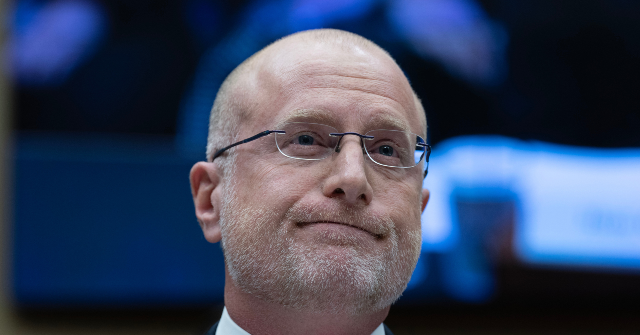
The Federal Communications Commission (FCC) is expected to vote next month on eliminating a rule that caps how many television stations one entity may own — a move FCC Chairman Brendan Carr said would help local news outlets fight back against being swallowed whole by large national media conglomerates.
Carr wrote in an op-ed published exclusively to Breitbart News on Wednesday that the agency will vote on August 6 to eliminate ownership caps on local television stations in favor of operating on a “case-by-case approach” to approve deals that would “promote the public interest.”
“Repealing the national cap will provide essential relief for local broadcasters by restoring a healthy counterbalance to the growing leverage of national programmers. Increased scale will enable broadcasters to attract the capital and advertising revenue needed to sustain and produce trusted and community-focused news and programming,” Carr wrote.
“If the FCC does not act, we do not need to imagine the bleak media future ahead. Just look at local newspapers. Much like the national cap, the FCC maintained an outdated rule for more than 40 years that limited investment in local newspapers,” he continued. “The FCC kept that rule in place until 2017, long after the economics of local journalism had shifted. Meanwhile, local newspapers shut down by the dozen, and many Americans are now left to choose from a small number of national papers. We can’t let local broadcast TV follow the same path.”
Decades ago, the FCC adopted the national ownership cap to prevent any one entity from owning so many television stations that they could broadcast programming to more than 39 percent of households with TVs, Carr explained. The original purpose of the cap was “to restrain the power of national programmers and their New York and Hollywood interests.”
“The FCC wanted to deny national programmers the outsized power that could come from operating as both a national programmer and as an owner of TV stations with significant national reach,” he wrote. For a long time, the cap worked. It operated to check the power of national programmers and helped ensure a healthy relationship between them and the owners of local TV stations.”
“But the broadcast and broader media industry has transformed dramatically in recent years. And the cap no longer constrains the power of national programmers. Instead, it prevents local broadcasters from competing on a level playing field,” he continued. “This is because national programmers no longer rely in the same way on local broadcast TV stations to distribute their programming.
“Today, national programmers can distribute their programming to 100 percent of the country — either through their own streaming services or through deals they cut with nationwide ‘virtual cable companies,’ like YouTubeTV,” he wrote. “The cap no longer constrains their control over distribution in this respect. Nor does the cap limit other players in today’s media market. Cable channels like MSNOW can reach 100 percent of the country. Social media sites from Bluesky to X can reach 100 percent of the country. Netflix can reach 100 percent too. Same with podcasts and all other forms of digital content.”
However, the 39 percent cap still applies to the owners of local broadcast television stations, which is “forcing the market out of balance,” Carr wrote.
“Today, the cap is not protecting local broadcasters, it is preventing them from gaining the same scale that their competitors are free to enjoy. In other words, the national cap is now doing the exact opposite of what the FCC intended,” he wrote.
“The results speak for themselves. Local TV stations today lack the power to preempt or refuse to air national programming that does not fit their communities’ values. National programmers are now charging local TV more and more for the privilege of airing their shows. Local TV stations are struggling to find the resources to produce live, trusted, and local news programming. Many local broadcast TV stations are getting hollowed out as a result and turning into little more than mouthpieces for programming produced in New York and Hollywood. That is not what Congress or the FCC intended,” he added.
“It’s time to restore balance to the broadcast airwaves,” he said.
Katherine Hamilton is a political reporter for Breitbart News. You can follow her on X @thekat_hamilton.
Read the full article here