






The animal rights group Humane World for Animals has treated hundreds of animals in Venezuela following the deadly June 24 twin earthquakes that struck the South American nation, the group told Breitbart News this week.
Venezuela was struck by back-to-back magnitude 7.2 and 7.5 earthquakes in the evening hours of June 24, causing widespread devastation, especially in the northern state of La Guaira (formerly known as Vargas). At press time, the most recent death toll disclosed by the Venezuelan socialist regime indicates that at least 4,829 people died and 16,740 were injured.
The earthquakes, which left 190 collapsed building and potentially upwards of 60,000 damaged buildings, also left at least 20,857 individuals homeless, currently housed in temporarily shelters and camps.
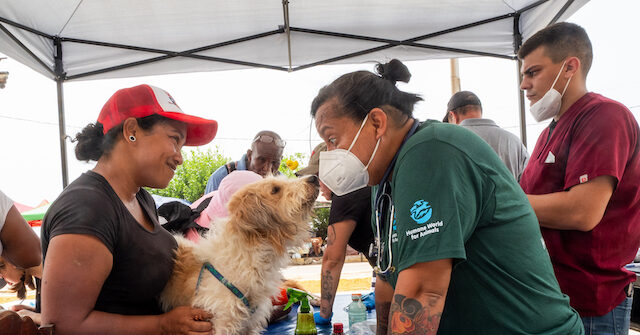
Humane World for Animals explained to Breitbart News that it sent a disaster relief team to Venezuela to provide help for the hundreds of animals affected by the devastating earthquakes. As of this week, Humane World for Animals responders from the U.S., Mexico, and Costa Rica have treated about 550 animals in La Guaira, including dogs, cats, turtles, rabbits, birds, and other species.
Some of the attention provided by the organization to the animals in need in La Guaira include vaccinations, deworming, and other preventive care. Skin and ear issues, wounds, fractures and other injuries, and other conditions are being treated by the organization’s veterinarians.
A dog waits to be vaccinated at a mobile clinic at the polideportivo camp for displaced people in La Guaira, Venezuela. (Marco Salustro / For Humane World for Animals)

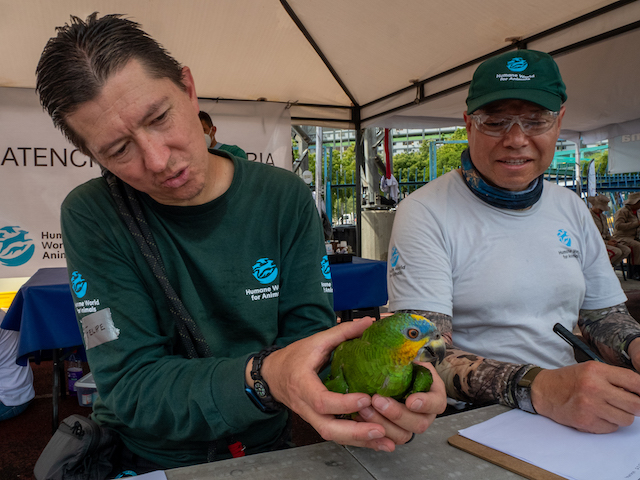
Felipe Marquez of Human World for Animals holds a parrot that has been brought to be checked at a mobile clinic at the polideportivo camp for displaced people in La Guaira, Venezuela. (Marco Salustro / For Humane World for Animals)
The responders are providing care for animals at emergency camps setup across La Guaira, including the José María Vargas sports complex and the state’s baseball stadium. Both locations, the organization detailed, are collectively sheltering more than 3,000 people. Additionally, treatment is being provided at informal displacement sites, with a Humane World for Animals field team operation from an out-of-service fast food restaurant that has become a “hub” for community veterinary care. Reports published this month indicate that a McDonald’s restaurant in the La Guaira town of Caraballeda is serving as a veterinary attention center after the earthquakes left the restaurant out of order.
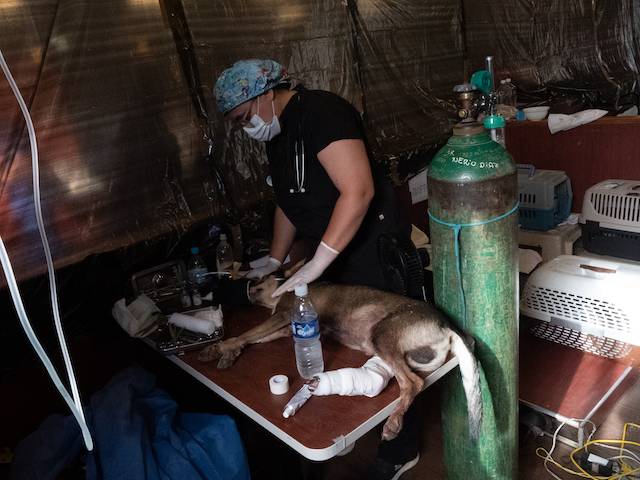
Dr. Maria Daniela Gomez checks Campesino, a dog with a broken leg, after surgery at an emergency veterinary clinic inside the McDonald’s in La Guaira, Venezuela. (Marco Salustro / For Humane World for Animals)
Humane World for Animals explained that its experts do not believe there is a possibility of new animal rescues from collapsed buildings, as the organization pointed out that it is now beyond the point where animals are being pulled alive from the rubble.
“Most of the animals we are treating are being brought in by their families, although we are still seeing unclaimed animals found and brought to the clinics,” Felipe Marquez, Humane World for Animals’ disaster response manager for Latin America, told Breitbart News.
“It’s impossible to say whether the injuries and fracture cases we’re seeing were directly caused by the earthquakes or by subsequent vehicle accidents or something else, but every animal brought in is receiving care,” he added. “We are also seeing more families bringing their animals back to the camps for treatment now that they know our veterinary team is here to help. These people have lost so much in these earthquakes, but it’s clear to see what huge comfort it brings them to know that their beloved animal companions are safe and looked after.”
Breitbart News asked Humane World for Animals what logistical challenges the responders in La Guaira have faced in light of the devastation caused by the earthquakes and the already pre-existing issues that have plagued Venezuela for years, such as shortages of running water and frequent blackouts. The organization explained that, while it was able to source most of what it needed from the nearby capital city of Caracas and locally, what it could not find did not prevent animal care.
“Thankfully logistics have been relatively simple to navigate on this response thanks to having a local partner and because we coordinated with the United Nations to provide vet services in each of the managed displacement camps. This kept logistics streamlined and complementary to local capacity,” the organization told Breitbart News.
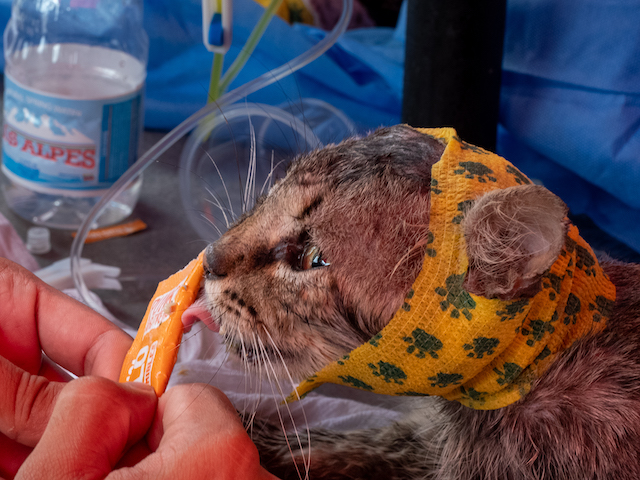
A cat is fed therapeutic food after surgery at an emergency veterinary clinic inside the McDonald’s in La Guaira, Venezuela. (Marco Salustro / For Humane World for Animals)
Humane World for Animals emphasized the importance of providing adequate veterinary care to animals amid the ongoing relief efforts in Venezuela, as it complements the aid being provided to the victims of the earthquake. The organization explained to Breitbart News that animals in communities that lack access to veterinary care are often “disproportionately impacted” by the effects of a disaster in the likes of the June 24 earthquakes.
The healthier and more protected by vaccines and preventative meds before a disaster, the more resilient they are when a disaster occurs,” the organization said. “When we provide veterinary care to communities impacted by disasters it always includes vaccination and preventative medicines to protect animals and humans from the spread of disease.”
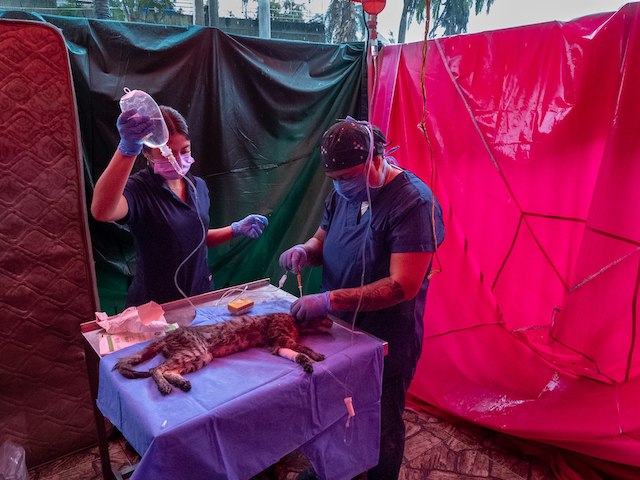
Dr. Lluvia Iris Diaz performs surgery to cat at an emergency veterinary clinic inside the McDonald’s in La Guaira, Venezuela. (Marco Salustro / For Humane World for Animals)
In a statement to Breitbart News this month, the Pan American Health Organization (PAHO) explained Venezuela’s severely weakened health system, major shortages of medicines and supplies, and lack of essential services have all compounded into severe challenges for the ongoing earthquake relief efforts and the management of the bodies of the deceased.
PAHO explained that while some of the victims may carry chronic infections, there is no risk of epidemic spread from poor body management, as most pathogens do not survive longer than 48 hours after death, with some exceptions.
“The country also faces ongoing risks from vaccine-preventable and vector-borne diseases due to low immunization coverage and fragile public health infrastructure,” PAHO told Breitbart News. “Given this context, the earthquake increases needs for emergency medical supplies, trauma care, and coordination support.”
Christian K. Caruzo is a Venezuelan writer and documents life under socialism. You can follow him on Twitter here.
Read the full article here


