




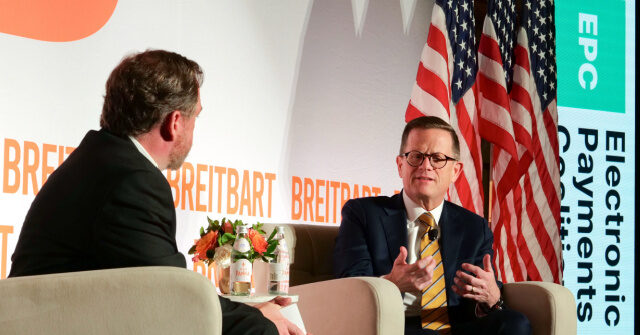
The trade association America’s Credit Unions is sounding the alarm about a bill that Sens. Dick Durbin (D-IL) and Roger Marshall (R-KS) are trying to pass, with president and CEO Scott Simpson warning that payment systems with weak security may be used as a result.
The Credit Card Competition Act (CCCA) was first proposed by Durbin and Marshall in 2022 before they reintroduced it in January, arguing that it would “increase competition in the credit card market and put an end to the Visa-Mastercard duopoly.” Originally, the legislation was cosponsored by then-Sen. JD Vance (R-OH), and Sens. Peter Welch (D-VT), Josh Hawley (R-MO), and Jack Reed (D-RI).
Under the current system, merchants who accept credit cards get locked into whatever payment system that card runs on, and pays whatever fee that network charges. Visa and Mastercard dominate over 80 percent of the market.
If passed, the CCCA would require banks with more than $100 billion in assets to offer merchants a choice of at least two networks over which a credit transaction can be processed, including one that is neither Mastercard nor Visa.
While proponents argue that the legislation would benefit merchants by lowering operational costs associated with accepting Visa or Mastercard so they could pass on those savings to consumers, opponents of the bill say that those stores will just keep those savings for themselves, and that credit cards companies may take away rewards to make up for their lost revenue.
On top of that, critics of the CCCA have also raised concerns about security risks that consumers could face if merchants use cheaper payment systems.
Speaking with Breitbart News economy columnist John Carney during a Tuesday policy event in Washington, D.C. with Treasury Secretary Scott Bessent, Simpson highlighted vulnerabilities in payment systems that could harm consumers as a result of the bill.
“A lot of people are worried about fraud and cybersecurity, and this could impact the ability of issuers to be able to, especially I think credit unions, but all issuers to be able to deal with fraud and cybersecurity,” Carney said
Simpson replied, “Yeah, that’s what the interchange system is built for — is to establish contracts with the American consumers and reliable protection. Well, that protection comes at the expense of the issuer”
“We look at the biggest data breaches in the history of our country and they tend to come from retailers because they don’t have incentives,” Simpson continued. “They’re not incentivized by the system to protect that data, and so it gives us zero confidence as issuers.”
Olivia Rondeau is a politics reporter for Breitbart News based in Washington, DC. Find her on X/Twitter and Instagram.
Read the full article here


