




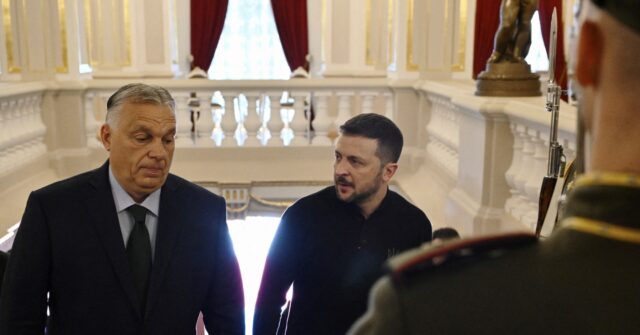
European Union ambassadors in Brussels agreed on Wednesday to approve a 90 billion-euro loan to Ukraine and a further round of sanctions against Russia, after outgoing Hungarian Prime Minister Viktor Orbán lifted his threat of a veto.
The funding, which was initially approved in December, had been held up from reaching Kyiv over objections from Budapest, which argued under Prime Minsiter Orbán that the EU should focus their efforts on achieving a peace settlement between Russia and Ukraine rather than plunging the bloc deeper into the conflict in his country’s Eastern neighbour.
The final formal approval of the money will come on Thursday as heads of state meet in Cyprus. According to France’s Le Monde newspaper, Mr Orbán is not expected to make the trip, effectively skipping his final meeting with fellow EU leaders with whom he long battled before leaving office. The formal handover of power to the next Hungarian government is expected in early May when the country’s Parliament reconvenes.
The Parisian Berliner paper noted that the decision by the outgoing Hungarian PM to lift his objection to the funding came in the wake of Ukraine agreeing to help restore service to the Druzhba oil pipeline, through which countries like Hungary and Slovakia receive energy supplies from Russia, a key bone of contention between Budapest and Kyiv.
Ukrainian President Volodymyr Zelensky said on Tuesday evening that Ukrainian forces have “repaired” the pipeline and therefore, there should be “no grounds for blocking” the loan and sanctions package.
After Orbán announced his plans to drop Hungary’s veto, Zelensky said that he expects Brussels to not only swiftly implement the financial package, but also that the “European side” should now move on to “advancing Ukraine’s full European integration.”

The issue of Ukraine joining the European Union has been deeply contentious, with opponents such as Orbán claiming that it would put the entire bloc on the path toward war with Russia. Critics have also noted that Ukraine would likely need special dispensation to forgo the typical requirements for member states, particularly on issues like political corruption, which remains rampant in Ukraine.
Orbán accused his opponent in this month’s parliamentary elections and now likely successor Péter Magyar of backing a fast-tracked accession of Ukraine into the European Union.
Magyar has so far denied that he would support such a measure; however, his incoming government was backed in large part on the promise of unlocking EU COVID recovery funds long held up by Brussels over conservative policies implemented in Hungary by Orbán’s government, thus giving Eurocrats a key point of leverage over the new leader in Budapest.
One of Magyar’s first tests of his independence will likely come with the EU Court of Justice’s ruling this week that a 2021 law in Hungary, which barred LGBTQIA+ content from appearing on children’s television programmes or books, is unlawful. The globalist court ruled the law — which the EU Commission had cited as justification for withholding the funds from Hungary — “stigmatises and marginalises” LGBTQI+ people and was therefore in violation of the EU ban against sexual orientation discrimination.
While Magyar has yet to respond, Orbán said of the ruling: “The Brusselian steamroller is already in motion. Our patriotic government protected Hungarian children from aggressive LGBTQ propaganda. Now the Brusselian empire strikes back. We will not give up the fight for the soul of Europe!”
A looming fight over nation-state veto power is also likely to come to the fore with Orbán’s impending departure, as figures like EU chief Ursula von der Leyen argue it should be abolished for Brussels’ foreign policy decisions. Proponents of the veto — which serves to protect the interests of smaller EU states similar to the Senate or Electoral College in the United States — have warned that eliminating the power could result in a European country being dragged into war, even if its citizens directly vote against it.
Follow Kurt Zindulka on X: Follow @KurtZindulka or e-mail to: kzindulka@breitbart.com
Read the full article here


