


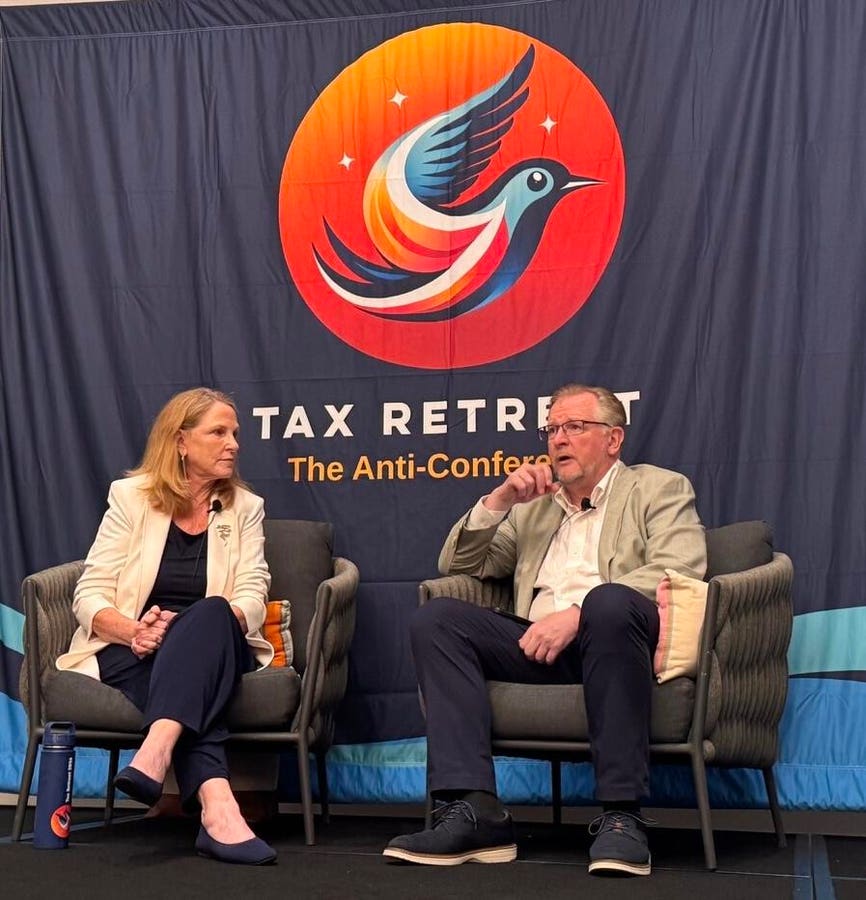
Erin Collins and Terry Lemons on stage in San Antonio, Texas.
Courtesy of Adam Watson, Tax Retreat
When Erin Collins sat down with Terry Lemons, former IRS Chief of Communications and Liaison, at The Tax Retreat in San Antonio on Thursday, June 4, the room got something tax professionals do not always get from Washington: a candid conversation about what is working, what is not, and what taxpayers experience when the system breaks down.
Who TAS Is and What It Does
Collins is the National Taxpayer Advocate (NTA), which means she leads the Taxpayer Advocate Service, or TAS, an independent organization within the IRS. TAS is often described as the “voice of the taxpayer” inside the agency and before Congress.
TAS serves two core functions. First, it helps individual taxpayers and businesses resolve serious problems with the IRS when the ordinary channels are not working. Second, it identifies systemic problems in tax administration and calls for changes to improve the tax system.
That second role is easy to overlook, especially for taxpayers who know TAS only as the place to call when a refund is delayed, or a collection action threatens financial hardship. But Collins made clear that the NTA’s office is not simply an emergency room for individual cases. TAS also oversees the Low Income Taxpayer Clinic grant program, supports the Taxpayer Advocacy Panel, works with Congress, and issues reports identifying the most serious problems taxpayers face.
Staffing Losses and a Strained Organization
Collins told the audience that TAS has seen a significant spike in cases coming into the office and that inventory continues to climb. At the same time, TAS has lost roughly a quarter of its case advocates. Many of those employees were retirement-eligible but had not planned to retire. When the opportunity arose amid broader federal workforce cuts, Collins said, they “raised their hands.”
The result is a strained organization trying to do high-touch work with fewer experienced people who are carrying, on average, about 250 open cases. TAS’s goal has been to maintain regular contact with taxpayers, but high caseloads make that difficult. Collins acknowledged the pressure and said TAS is working to improve response times.
Making that challenging? TAS cases are not usually simple. They often involve taxpayers who have already tried the ordinary IRS process and failed to get relief. They may be facing financial hardship. They may be stuck in an IRS system delay. They may be dealing with identity theft, refund freezes, collection problems, or correspondence that does not clearly explain what happened or what to do next.
And, as Collins noted, the IRS processes roughly 200 million tax returns each year. Controversy—when things go wrong, or taxpayers disagree with the IRS—is a small piece of that universe, but for the taxpayers caught in it, the problem is anything but small.
The Heart of the IRS
A recurring theme in the discussion was that TAS is made up of people who care deeply about taxpayers. Collins described her employees as having “compassion” and referred to them as the “heart of the IRS.”
The problem, she explains, is not that everyone inside the IRS is indifferent. The problem is that systems, staffing, technology, and statutory constraints can prevent good people from delivering good service. That is where TAS’s independence becomes crucial.
Collins emphasized, “We take our independence very seriously.” TAS sits within the IRS, but it is independent of the agency in important ways. The NTA reports to Congress and makes recommendations on behalf of taxpayers, including through the annual Purple Book, which compiles legislative recommendations to strengthen taxpayer rights and improve tax administration.
But independence has limits. Collins noted that TAS does not have delegated authority to force the IRS to take a particular action. That means Collins often has to bring the IRS along, persuade leadership, and make the case that a taxpayer-centered solution is also good tax administration.
That approach has produced wins.
Legislative Progress: Math-Error Notices and More
One example Collins referenced was math-error notices. For years, the NTA criticized those notices as confusing and, in some cases, insufficient to protect taxpayers’ rights. Math-error authority allows the IRS to immediately assess additional tax without using the normal deficiency procedures, but taxpayers generally have only 60 days to ask the IRS to reverse the adjustment. If they miss the deadline, they may lose the chance to go to Tax Court and may have to pay the amount, file a refund claim, and litigate later if necessary.
That’s a significant consequence. But historically, math-error notices have not always made clear what the IRS changed, why it made the change, or how the taxpayer could contest it.
The IRS Math and Taxpayer Help Act addresses those concerns. The law requires clearer, more specific math-error notices, including information about the type of error, the relevant Code provision, the affected line or schedule, the adjustment made, and the taxpayer’s right to challenge the action. Collins has championed that reform as a taxpayer-rights issue, not merely a notice-design issue. Taxpayers cannot exercise rights they do not understand.
Collins also pointed to broader taxpayer-service legislation moving through Congress. The Taxpayer Assistance and Service Act (TAS Act), introduced by Senate Finance Committee Chairman Mike Crapo (R-Idaho) and Ranking Member Ron Wyden (D-Ore.), contains dozens of taxpayer-favorable provisions. The bill draws heavily on the National Taxpayer Advocate’s recommendations and would make changes across a wide range of IRS procedures, including dispute resolution, taxpayer communications, digital tools, penalty administration, and taxpayer rights.
Collins seemed encouraged by the bipartisan interest in taxpayer service reform. That point stood out in this political climate. Tax administration is not usually the issue that brings everyone to the table, but taxpayer service has a way of cutting across party lines. Every member of Congress has constituents who have received confusing IRS notices, waited too long for refunds, struggled to reach the agency by phone, or felt trapped by the process.
Practitioners Can Help Identify Systemic Problems
Still, legislation is only part of the picture. Collins urged practitioners to use TAS’s Systemic Advocacy Management System (SAMS) to report systemic problems. SAMS is designed for issues that affect more than one taxpayer and involve IRS systems, policies, procedures, taxpayer rights, burden, fairness, or essential taxpayer service.
Tax professionals often see patterns before policymakers do, she explains, including repeated notice defects or procedures that create unnecessary burdens. SAMS gives them a way to flag those issues to TAS.
Fairness, Fraud, and the Limits of What TAS Can Do
Voluntary compliance depends on taxpayers believing the system is fair, or at least that it is trying to be fair. Fairness was a thread throughout, and it surfaced again when the conversation turned to recent cases.
Collins referenced Kwong v. United States, a Court of Federal Claims case involving the application of section 7508A during the COVID-19 disaster period. In Kwong, the court concluded that certain tax deadlines were automatically postponed for the duration of the federally declared disaster plus 60 days. That interpretation, if it stands, could affect refund and abatement claims for penalties and interest assessed during the pandemic period. Collins suggested that Kwong could affect tens of millions of taxpayers.
The case remains unsettled, and the government has appealed. But the potential stakes are significant. Many taxpayers and practitioners are considering whether to file protective refund claims to preserve rights as the litigation plays out.
Kwong also fits into a larger post-Loper Bright moment, with courts looking more closely at statutory text and less reflexively deferring to agency interpretations.
The discussion also touched on first-time penalty abatement (FTA). FTA, which allows qualifying taxpayers to remove certain penalties for a single year, has existed since 2001—but you had to ask for it. Collins noted that, beginning in 2026, the IRS will automatically provide FTA to eligible taxpayers. That is no small thing. About a million taxpayers may qualify each year but have not traditionally received relief because they did not know to ask for it. Automatic relief is an example of a taxpayer-service improvement that does not require taxpayers to have sophisticated representation or insider knowledge.
Q&A: Murrin, Voluntary Compliance, and the Role of the Tax Community
During the audience Q&A, tax attorney Greg Zbylut asked about Murrin, a case now before the Supreme Court. The issue is whether the fraud exception to the statute of limitations can apply when a return preparer, rather than the taxpayer, intended to evade tax. Collins did not offer a legal opinion but agreed that the stakes are significant.
In Murrin, the taxpayer underpaid tax for years in the 1990s because her preparer made false entries on her returns without her knowledge or involvement. The IRS issued a notice of deficiency more than twenty years after the returns were filed, and both the Tax Court and the Third Circuit held that the fraud exception to the statute of limitations applied even though Murrin herself had no fraudulent intent. The practical consequence is stark: An innocent taxpayer may face tax, penalties and decades of interest because of her preparer’s wrongdoing.
The question of voluntary compliance also came up — specifically, how the system maintains taxpayer trust when enforcement and fairness seem at odds. If voluntary compliance is tied to a sense of fairness and equity, how do you keep taxpayers believing that the system is fair?
Collins’ answer put some responsibility back on the tax community. It will be up to practitioners, she suggested, to spread the word. The IRS and TAS can issue reports and recommend legislation, but taxpayers often hear about these developments from their advisors. If taxpayers are going to understand that reforms are happening—or that relief may be available—tax professionals have to communicate that information.
The same is true for taxpayers harmed by scams and fraud. Collins noted that resolving related tax issues will likely require congressional action. That is especially true in situations where the Code produces harsh results even when a taxpayer was victimized. Scam-related retirement distributions are one example: A taxpayer may lose the money to fraud and still face income tax, penalties, and interest. Those outcomes do not inspire confidence in fairness, even if the IRS is simply applying the law as written.
Collins also distinguished TAS from the Treasury Inspector General for Tax Administration. TIGTA and TAS are completely separate. TIGTA focuses on fraud, waste, abuse, and oversight, while TAS focuses on taxpayer rights and taxpayer problems. That distinction is important because taxpayers and practitioners sometimes conflate the roles.
Strain, Progress, and What Comes Next
It’s true that TAS is under pressure. Inventory is high. Staffing losses have hurt. Case advocates are carrying heavy loads. And, practitioners and taxpayers remain frustrated by delays.
But Collins also pointed to improvements, thanks to TAS. None of this will fix the IRS overnight. But it is moving towards making things better for taxpayers.
That may have been the most important message from Collins’ conversation with Lemons. Tax administration is not just about processing returns, collecting revenue, or enforcing rules. It is about maintaining public trust in a system that depends on voluntary compliance.
Most taxpayers, Collins said, are trying to do the right thing. The challenge for the IRS, TAS, Congress, and the tax community is to ensure the system gives them a fair chance to do so.
Read the full article here