



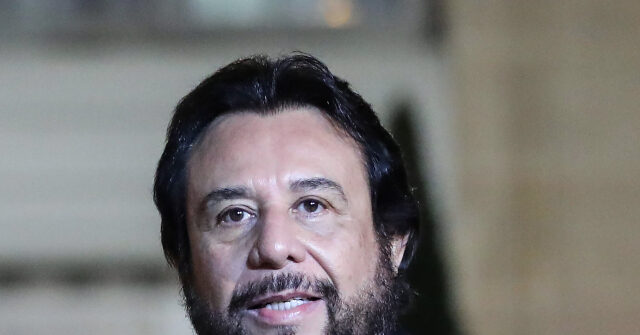
Salvadoran Vice President Félix Ulloa is proposing the creation of a “Central American Union” similar to the European Union, local outlets reported on Thursday.

Ulloa’s proposal reportedly aims to allow nationals of Central American countries the ability to move and work freely in other countries in the region.

The Salvadoran newspaper La Prensa Gráfica reported that the proposal for a “Central American Union” calls for a significant reform of the 1991 Protocol of Tegucigalpa, which established the foundational legal framework of the Central American Integration System (SICA) regional economic and political cooperation bloc. SICA is presently formed by Belize, Costa Rica, the Dominican Republic, El Salvador, Guatemala, Honduras, Panama, and Nicaragua and boasts a large list of regional and extra-regional observer nations.

La Prensa Gráfica explained that one of the main objectives of the planned reforms is the creation of a regional “Central American Union citizenship,” a complementary nationality that would not substitute that of Central American countries, but would instead be a “supplementary” nationality.

The prospective “Central American Union” citizenship would grant nationals of Central American countries the right to freely move and work in other signatory Central American nations, as well the right to freely exercise “university or technical professions” without the currently existing legal limitations. The existing 1991 Protocol of Tegucigalpa that led to the creation of SICA does not contemplate a regional citizenship.

“In addition, the project contemplates the free movement of goods, services and capital, as well as the right to develop economic and business activities throughout the region under a common legal framework,” La Prensa Gráfica reported.

“The proposal also incorporates guarantees of equality regarding the protection of consumer rights and access to mechanisms for administrative and judicial redress at the community level,” the newspaper continued.

The proposal reportedly presented by Salvadoran Vice President Ulloa appears to be similar to EU citizenship, which allows nationals of a European Union member state the right to freely move and work in another EU member state. Presently, the only regional bloc in Latin America with comparable rights for its citizens is South America’s Mercosur trade bloc, made up of Argentina, Brazil, Paraguay, and Uruguay. Venezuela became a member of Mercosur in 2012 but remains suspended since 2016 in response to the actions committed by the repressive socialist regime led by now-deposed dictator Nicolás Maduro. Bolivia is presently going through a years-long adhesion protocol into Mercosur.

Although Nicaragua is a founding member of SICA, the actions of the communist regime led by dictatorial husband-and-wife couple Daniel Ortega and Rosario Murillo have reportedly left Nicaragua “isolated” within the bloc. Over the past five years, the Ortega regime has unsuccessfully attempted to nominate regime loyalists as SICA’s next secretary general, leading to an impasse that left the bloc’s top position vacant from 2023 and until this year, when the group reformed its own electoral laws.

The changes eliminated the need for unanimous consensus among the bloc’s members, allowing a Nicaragua-excluding majority to appoint Costa Rican ambassador Lina Ajoy Rojas as the bloc’s newest secretary general.

“We in El Salvador view the current crisis facing the [SICA] system as an opportunity to overcome obstacles and take a significant step forward through a comprehensive review of the 1991 Tegucigalpa Protocol,” Vice President Ulloa told Diario el Salvador this week.

“In this regard, El Salvador has submitted a proposal for a comprehensive review of the protocol, in which we reengineer the entire institutional framework of the treaty with a 21st-century vision,” he continued.

La Prensa Gráfica further explained that Ulloa’s proposal calls to replace SICA’s secretary general with a “Union Commission” that can carry out certain decisions among the proposed union through a majority vote instead of through consensus. Additionally, the proposal seeks the establishment of “primacy of Union law” over national legislation matters, and the creation of mechanisms to impose economic sanctions on member states that fail to comply with regional regulations.

Vice President Ulloa has reportedly presented the proposal to other regional representatives and, according to the Salvadoran newspaper, is hoping to count with the support of SICA Secretary-General Ajoy Rojas, with whom he has already met to discuss the subject, according to Salvadoran outlets.

Christian K. Caruzo is a Venezuelan writer and documents life under socialism. You can follow him on Twitter here.


Read the full article here

Share.
Leave A Reply

Exit mobile version