





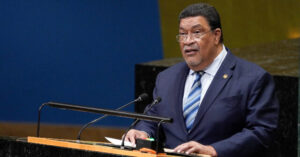


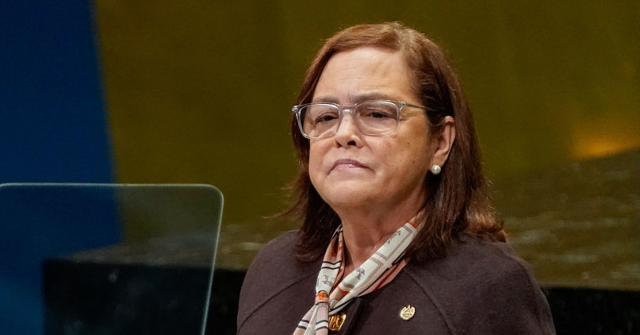
Foreign Minister of El Salvador Alexandra Hill Tinoco on Monday affirmed during her U.N. General Assembly speech that no country should be forced to accept collapse as its fate.
The minister emphasized that it is “actions, not resolutions” that can transform a country.
Monday marked El Salvador’s return to the U.N. General Assembly debates after a year-long absence. President Nayib Bukele, who criticized the U.N. in 2024 and 2023, skipped the 2025 high-level debates and sent no representative — deeming the assembly “pointless” in a social media post but nevertheless inviting people to watch a clip of his 2024 speech if they felt like “wasting time the way I did.”
Foreign Minister Hill Tinoco opened her speech by pointing out that thousands die as victims of war, hunger, violence, disease, and injustice while the United Nations speaks of peace, security, and international cooperation — presenting before her audience the question, “Where are the United Nations?”
“That question, perhaps more than any other, is the reason why we are here. And that is why I would like to ask those of us gathered in this Assembly: Do we have an organization today that remains relevant and has the conviction to face the challenges facing humanity?” she further asked.
Hill Tinoco pointed out to the United Nations that it can regain its damaged credibility not through resolutions, but once it is capable of preserving and guaranteeing a “worthy future” for people.
“And that is something that El Salvador knows very well,” she affirmed.

Hill Tinoco expanded upon her statement by referring to the near eradication of gang violence in El Salvador, a country known for decades as one of the world’s most violent. She stated that, after taking office in 2019, President Nayib Bukele “dared, like no one else before” to tackle the country’s rampant violence. The foreign minister said that, although the International Monetary Fund (IMF) has highlighted El Salvador’s rise in trust and economic activity since then, this is something that would be a “mistake” to reduce to a single number.
“Because behind every number there are faces. There is a mother who no longer fears for her son’s return home. There is a shopkeeper who can open his business,” she said. “There is a worker who can walk through his city. There is a child who can play on a street that didn’t belong to him before.”
“And there is something even deeper. A society that has regained hope, grounded in the possibility of imagining a different future,” she continued. “That is what regaining a sense of security truly means. It doesn’t just mean reducing crime. It means giving freedom back its place.”
The Salvadoran foreign minister stated that her country’s path is not something that can be mechanically copied by others, as there is no universal recipe and every nation has their own store. She, however, stressed that El Salvador believes there is one lesson that can be universal: “no nation should be forced to accept government collapse and mismanagement as its fate.”
Hill Tinoco said that to say that El Salvador has solved all of its problems would be false but, rather, she affirmed that with determination, her country has demonstrated that a problem that seemed “irreversible” is being tackled. Solving the matter of security is not the end goal of El Salvador, she affirmed, but rather, the starting point to transform the nation, emphasizing the importance of education to transform lives. The minister said that the changes her country has experienced have taught them that security, development, and human dignity are not separated compartments.
“Without security, development becomes fragile. Without development, security can hardly be sustainable,” she said. “And without dignity, neither of the two has real meaning.”
Speaking on behalf of her country, Hill Tinoco stressed that El Salvador believes that the United Nations must undergo reforms that go beyond the reorganization of its structures — instead, the U.N. must become an “agile organization, representative, effective, and transparent” that can solve modern problems.
“Enough with conformity. Enough with personal and national interests taking precedence over global needs and crises. Enough with bureaucracy,” she said, adding that El Salvador expects those commitments from whoever becomes the next U.N. Secretary-General.
Towards the end of her speech, the foreign minister stated that El Salvador wished to leave “four fundamental lessons” before the U.N. General Assembly.
“That nations are not doomed to repeat their past forever. That difficult problems are not necessarily insurmountable,” she said. “That a country’s size does not determine the extent of its responsibility. And that the future does not necessarily belong to those who have the most power — it also belongs to those who dare to bring about change with determination.”
“El Salvador has already made a decision about its own future, and I don’t say this lightly,” she stressed. “Today we are here to say it loud and clear: not with words, but with actions. Change is possible. We are making it happen, and we will not back down.”
Christian K. Caruzo is a Venezuelan writer and documents life under socialism. You can follow him on Twitter here.
Read the full article here


