







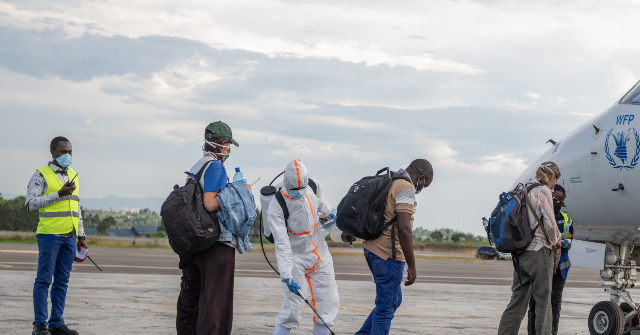
Roger Kamba, Minister of Public Health for the Democratic Republic of the Congo (DRC), complained on Friday that travel restrictions against his country due to the Ebola outbreak are “discriminatory” and cannot be justified by science or medicine.
The United States imposed travel restrictions in May, announcing that travelers from the DRC, Uganda, and South Sudan would not be allowed into the United States if they lack U.S. passports.
American passport holders, green card holders, and service members inbound from the Ebola outbreak region were required to “undergo enhanced public health screening” and were required to enter the U.S. at one of four airports equipped to conduct those tests, including Washington-Dulles, Hartsfield-Jackson in Atlanta, George Bush Intercontinental in Houston, and JFK International in New York.
The U.S. Centers for Disease Control and Prevention (CDC) said the travel ban would remain in place for at least 30 days, and could be extended if necessary.
Several other countries, including Canada and the Bahamas, have banned or restricted travel from the outbreak region. Some nations, like Thailand, will accept travelers from the DRC and neighboring countries, but require extensive quarantine periods for them.
Kamba expressed indignation at the travel bans, interpreting them as a sign of insulting mistrust in the DRC’s ability to contain the outbreak. Appearing at a press briefing with Kamba, DRC communications minister Patrick Muyaya said his government is negotiating with the United States to demonstrate the “evolution” of the DRC’s admittedly inadequate initial response, seeking to get the travel ban lifted early.
The DRC’s entreaties enjoy support from the World Health Organization (W.H.O.), which is generally opposed to travel bans.
W.H.O. regional director Mohamed Janabi told a press briefing on Thursday that flight restrictions and border closures, like the one Uganda imposed against the DRC early in the outbreak, were counterproductive because they “disrupt supply chains, weaken surveillance, and discourage transparency.”
“Ebola is not an airborne disease. Blanket travel bans do not stop Ebola,” Janabi said. He stressed W.H.O.’s preferred alternative of tight border screening instead of travel bans that might push infected people to use “informal routes” where they cannot be tested at all.
“I call on countries that have imposed travel bans or border closures to reconsider. These measures make the response harder and they discourage transparency and trust that saves lives,” W.H.O. Director-General Tedros Adhanom Ghebreyesus said last weekend.
Read the full article here


