
Close Menu
The Politic ReviewThe Politic Review
  • News
  • U.S.
  • World
  • Politics
  • Congress
  • Business
  • Economy
  • Money
  • Tech
  • More Articles
Trending

Microsoft Xbox CEO Asha Sharma Appointed to Federal Reserve Jobs Advisory Role After Mass Layoffs

July 10, 2026

Peter Schweizer: SCOTUS Ruling on Campaign Spending Will Make American Politics More Transparent

July 10, 2026

The reason House GOP leaders are holding a vote to stop the changing of the clocks

July 10, 2026
Facebook X (Twitter) Instagram
  • Donald Trump
  • Kamala Harris
  • Elections 2024
  • Elon Musk
  • Israel War
  • Ukraine War
  • Policy
  • Immigration
Facebook X (Twitter) Instagram
The Politic ReviewThe Politic Review
Newsletter
Friday, July 10
  • News
  • U.S.
  • World
  • Politics
  • Congress
  • Business
  • Economy
  • Money
  • Tech
  • More Articles
The Politic ReviewThe Politic Review
  • United States
  • World
  • Politics
  • Elections
  • Congress
  • Business
  • Economy
  • Money
  • Tech
Home»Economy»Doug Casey on the Private Equity Takeover Nobody Is Talking About
Economy

Doug Casey on the Private Equity Takeover Nobody Is Talking About

Press RoomBy Press RoomJuly 10, 2026No Comments6 Mins Read
Share Facebook Twitter Pinterest Copy Link LinkedIn Tumblr Email VKontakte Telegram

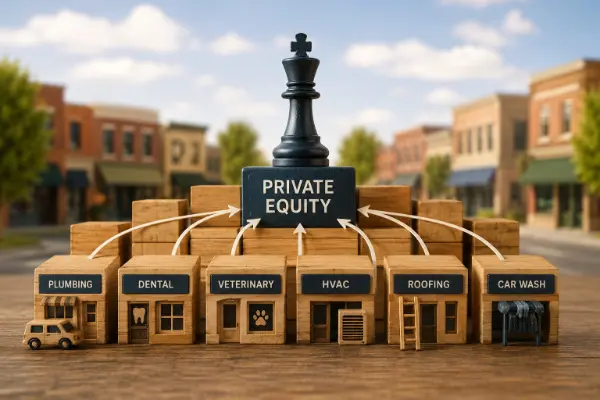
International Man: Private equity firms used to be associated with big corporate deals, but now they’re buying up plumbing companies, HVAC businesses, roofers, dental practices, veterinary clinics, car washes, and other small, boring, cash-flowing businesses all over the US.

What do you make of this trend?

Doug Casey: It’s not a sign of healthy capital allocation. Brokers are packaging all manner of cats and dogs to generate fees and commissions. It seems they’re scraping the bottom of the barrel now. Meanwhile, the hoi polloi—I hesitate to call them investors—are desperate for ways to maintain their standard of living in the face of serious currency debasement.

The public is reaching for high yield wherever they can find it. They don’t realize that high yield is usually a sign of high risk.

Brokers and investment banks want to take everything public, to generate fees and get papered up with cheap stock. The public thinks these deals will make them rich. That’s why margin debt has about doubled over the last year.

Owners of perfectly ordinary businesses are led to believe the market will make them wealthy overnight, too, something their business itself could never do.

A lot of small businesses are owned by people getting ready to retire. They’re looking for a way out. But, assuming a buyer can be found, the typical small business can only be sold for three to five times earnings. Hardly enough to fund a retirement.

However, if it becomes publicly traded or merged with a bigger business, it can magically sell for 10 or 20 times earnings.

These are signs of how over-financialized the US economy is.

International Man: A lot of these small businesses used to be locally owned and relationship-driven. Now they’re increasingly being rolled up by private equity firms, professionalized, leveraged, and managed for financial returns. What happens to customers, employees, and local communities when Main Street businesses become financial assets inside a Wall Street portfolio?

Doug Casey: Certain efficiencies can be realized by making a small business part of a large business. Inventory can be bought more cheaply. Accounting and legal costs might be lowered.

The founder of the business is replaced by a corporate manager. But managers don’t have the same interests or incentives as owners.

If the owner sticks around, he’s turned into an employee and starts thinking and acting like one. Distant corporate management is impersonal and necessarily bureaucratic. It’s hard for them to deal in local realities. One thing is certain: the suits at the top will be very well paid.

Rolling up a bunch of small businesses, or franchising them, may be efficient in some ways, but it doesn’t generate the kind of loyalty or quality that a locally owned business would. You might be loyal to your local greasy spoon, but nobody is loyal to McDonald’s.

The horrible Klaus Schwab was right when he said, “You’ll own nothing, and you’ll be happy.” In his ideal world, everybody would be an employee, easy to monitor and control. The elite tend to hate independents and entrepreneurs as a matter of principle.

International Man: Private credit firms like Blue Owl have grown rapidly by lending directly to private businesses, often including businesses backed by private equity. Blue Owl and firms like it offer investors access to high-yield private loans that sit outside the traditional banking system. What’s your take on this?

Doug Casey: There are essentially two approaches to financial engineering: Equity and debt.

The equity model usually depends on buying fragmented small businesses at low valuations, combining them into a larger platform, cutting costs, raising prices, and eventually blowing out the package at a higher multiple. Sometimes it’s just a matter of putting lipstick on a pig. The original shareholders and the investment bankers walk away with a bunch of the public’s money in their pockets. In a good economy, everybody wins, even Mom and Pop Buggins, who are buying retail, hoping for a greater fool to materialize. But the retail buyer is always a low man on the totem pole.

The debt model amounts to promising high interest rates to investors to draw in their capital. Then lending it to marginal businesses at a premium.

Blue Owl (OBDC, US$11.25) and similar firms are acting as shadow banks; they borrow money (analogous to traditional banks taking deposits) and lend it out to businesses at a higher interest rate. The problem is that many of the business borrowers are risky. They go to Blue Owl because a bank won’t give them a loan.

Blue Owl loans money to marginal companies at interest rates that are high enough to make the loans attractive to yield-starved investors. They might make a loan at 12% and pay the investors 10%. The marginal company gets a loan, the investors get 10% instead of the 3% a bank might pay them, and Blue Owl captures the spread, with little of its own money at risk. It looks like everybody’s happy. Until a company cannot make its loan repayment.

It appears that hundreds of billions of dollars are now involved. My guess—permabear that I am—is that both the borrowers and the lenders will wind up as losers because the borrowers can’t repay the debt.

International Man: Blue Owl recently capped withdrawals from some of its private credit funds after a surge in redemption requests, raising concerns about whether investors understood the liquidity risks. What does this reveal about the private credit boom—and the danger of selling illiquid loans to investors who may think they own something much more liquid?

Doug Casey: Withdrawals are capped because the funds are illiquid—even if we assume they could eventually be repaid. Borrowing short while lending long is a classic problem of unsound banking. A sound bank will strictly match the maturity date of its loans to the redemption dates of its depositors.

There’s a suspicion that Blue Owl is solving the problem by taking in new deposits to pay off old depositors. That’s the classic definition of a Ponzi scheme. The fact that this one is due to incompetence, as opposed to intentional fraud, doesn’t make much difference.

The bottom line is that hundreds of billions of capital is at risk. When the economy turns down in earnest, borrowers and lenders will both go bust. As will intermediaries like Blue Owl.

The root cause is the Fed’s almost unlimited creation of credit and manipulation of interest rates. This will not end well.

The takeaway is to avoid the general stock market, and don’t chase high-yield products. I remain confident that resource stocks are still the place to be.

Editor’s Note: As Doug Casey explains, the private equity and private credit boom is another symptom of an over-financialized economy—one where investors are pushed into increasingly risky paper promises in search of yield.

That is why Doug believes the best opportunities are not in the general stock market or high-yield financial products, but in real assets—especially select resource stocks.

In this urgent video, Doug reveals what he believes is the world’s #1 investment opportunity and what the mainstream media won’t tell you about gold.

Watch the video here.


Read the full article here
Share. Facebook Twitter Pinterest LinkedIn Tumblr Email Telegram Copy Link

Related Articles

Economy

Microsoft Xbox CEO Asha Sharma Appointed to Federal Reserve Jobs Advisory Role After Mass Layoffs

July 10, 2026
Economy

Open Borders Contributed to Real Estate Inflation

July 10, 2026
Economy

Breitbart Business Digest: The First Half of 2026 Saw Lowest Level of Jobless Claims Since 1969

July 10, 2026
Economy

Migration Poll: Jobs, Housing Spur Most Opposition

July 9, 2026
Economy

Net Zero-Obsessed Britain Faces Down Unspoken Energy Crisis Amid Accusations of Coverup

July 9, 2026
Economy

Nolte: Iconic Television City May Be Sold as L.A. Production Hits All-Time Lows

July 9, 2026
Add A Comment
Leave A Reply Cancel Reply

Editors Picks

Peter Schweizer: SCOTUS Ruling on Campaign Spending Will Make American Politics More Transparent

July 10, 2026

The reason House GOP leaders are holding a vote to stop the changing of the clocks

July 10, 2026

Israel responds to viral PHOTO of tortured Palestinian

July 10, 2026

Netflix Considering Live TV to Retain Dwindling Viewership

July 10, 2026
Latest News

Iran Expands Terrorist Bombings to Jordan and Qatar

July 10, 2026

Kentucky Gov. Andy Beshear Requests Update on Mitch McConnell’s Health After Rumors He Is ‘Brain Dead’

July 10, 2026

Drug-driving overtakes drunk-driving in UK

July 10, 2026

Subscribe to News

Get the latest politics news and updates directly to your inbox.

The Politic Review is your one-stop website for the latest politics news and updates, follow us now to get the news that matters to you.

Facebook X (Twitter) Instagram Pinterest YouTube
Latest Articles

Microsoft Xbox CEO Asha Sharma Appointed to Federal Reserve Jobs Advisory Role After Mass Layoffs

July 10, 2026

Peter Schweizer: SCOTUS Ruling on Campaign Spending Will Make American Politics More Transparent

July 10, 2026

The reason House GOP leaders are holding a vote to stop the changing of the clocks

July 10, 2026

Subscribe to Updates

Get the latest politics news and updates directly to your inbox.

© 2026 Prices.com LLC. All Rights Reserved.
  • Privacy Policy
  • Terms of use
  • For Advertisers
  • Contact

Type above and press Enter to search. Press Esc to cancel.