




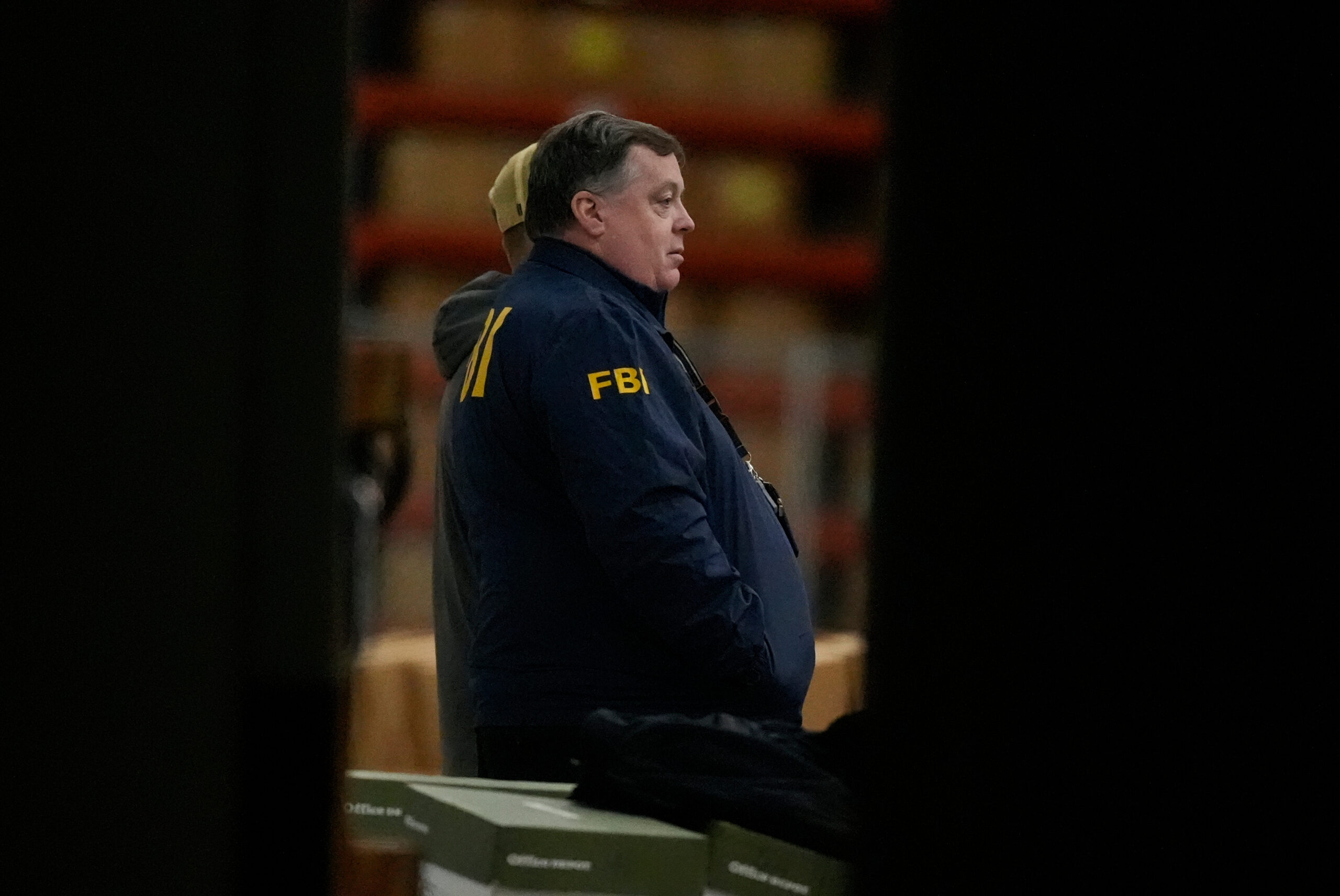
The Justice Department can retain 600 boxes of election records that prosecutors seized from Fulton County, a federal judge in Georgia ruled Wednesday, enabling investigators to continue pursuing a probe that dovetails with President Donald Trump’s grievances over his defeat in the 2020 election.
U.S. District Judge J.P. Boulee ruled Wednesday that despite flaws in the Justice Department’s basis for the search warrants — and its execution of the search itself — Fulton County fell short of a stringent standard to demand the return of the seized materials, which included ballots from the 2020 election. The Democratic-controlled county had sued to block federal prosecutors from using the materials and to have them returned to the county, arguing they were improperly seized under a search warrant that was based on false and misleading allegations.
“The seizure in this case was certainly not perfect,” the Trump-appointed judge concluded, but Fulton County officials “did not establish that their rights were callously disregarded.”
Boulee repeatedly emphasized that at this early phase of the Trump administration’s probe, the standard to short-circuit a criminal investigation is extraordinarily high. Though Fulton officials said the FBI affidavit justifying the seizure was riddled with disproved conspiracy theories, distortions of evidence and omissions of facts that would have undermined the case, Boulee said their claims — while sometimes “troubling” — still fell short of the standard.
Democratic state Rep. Saira Draper said the ruling was “unfortunate but not surprising” given the high bar to prove a blatant violation of county officials’ rights, but underscored that the DOJ’s access to the county’s 2020 ballots makes pushing back against the “narrative of fraud” that much more difficult.
In January, the FBI executed two search warrants at a warehouse used by the Fulton County elections office, a move that drew sharp condemnation from state and national Democrats and election experts concerned over Trump’s continued focus on the 2020 election. Republicans were quick to celebrate the raid shortly thereafter, reinjecting the 2020 election back into the state’s GOP politics as a MAGA litmus test.
Georgia has long been at the center of the Trump administration’s efforts to challenge the 2020 election results. Trump was criminally charged both by special counsel Jack Smith and local prosecutors in Georgia for his effort to pressure Secretary of State Brad Raffensperger to “find” enough votes to reverse his narrow defeat in the state. Those cases were dismissed soon after Trump won election to his second term.
Last month, the Justice Department requested the names of every election worker involved in Fulton County’s 2020 election operation — including poll workers and employees — according to court records, a move that election officials warned could exacerbate fear and distrust among voters and election workers.
Trump has used his return to power to relitigate the 2020 election and seek retribution against those he has falsely accused of rigging the election or resisting his efforts to overturn it. Just one week before the FBI raid in Fulton County, Trump said that “people will soon be prosecuted for what they did” regarding the 2020 presidential election.
The Trump administration in March subpoenaed 2020 election records in Maricopa County, Arizona’s largest county.
Boulee acknowledged that the events at the heart of the Fulton County seizure were “unprecedented,” but he emphasized that his decision was in keeping with another extraordinary case: Trump’s own criminal prosecution for allegedly hoarding classified information at his Mar-a-Lago estate in Florida. Trump similarly tried to reclaim the materials the FBI seized from his home — and the 11th Circuit Court of Appeals, which oversees both Florida and Georgia, ultimately sided with investigators.
Josh Gerstein contributed to this report.
Read the full article here


