
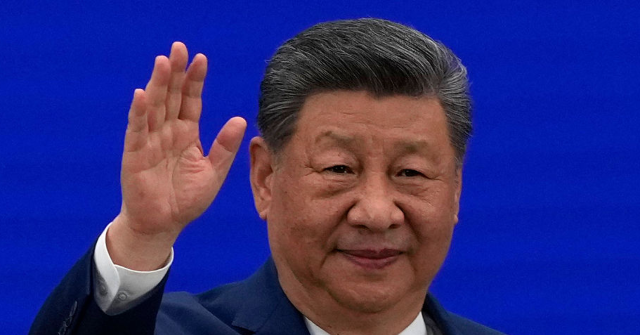
In his address to the opening ceremony of the World Artificial Intelligence Conference (WAIC) in Shanghai on Friday, Chinese dictator Xi Jinping touted his authoritarian country as the global leader of the AI revolution, challenging the U.S. effort to develop rules and ethical standards for the new technology.
The WAIC is an annual event that has been held in Shanghai since 2018. This year’s event featured the debut of the World Artificial Intelligence Cooperation Organization (WAICO), an entity created by China that included Russia, Cuba, Brazil, Pakistan, and Venezuela among its founding members.
Xi’s speech cast China as the champion of AI technology for developing nations, or the “Global South.” Although he refrained from challenging the United States by name, his vision of a China-led global AI order directly contradicted the Trump administration’s “Pax Silica” initiative launched in 2025 to create secure supply chains of critical minerals for the free world, and protect AI from abuse by malevolent powers.
The Chinese dictator peppered his speech with numerous negative allusions to American dominance in artificial intelligence, such as a call for the rest of the world to stand against “overstretching the national security concept in the field of AI, or placing one country’s security over that of others.”
Xi also boasted of China’s alleged commitment to “open-source” AI and technology sharing, despite companies like Nvidia complaining that China has locked them out of its markets with protectionist regulations.
“We must carry out extensive international cooperation and help Global South countries with capacity building to bridge the AI and digital divides, promote sustainable development, and prevent creating new historical injustice in AI,” Xi said.
A major theme of Xi’s speech was that AI has been unfairly hoarded by the Western nations that created it, and China will lead the effort to redistribute that technological wealth — along with the United Nations, which he wanted to have a greater role in AI governance.
Xi also pledged to support greater influence for Global South organizations like the Association of Southeast Asian Nations (ASEAN), the African Union, and BRICS — the economic collective China co-founded and dominates. Xi said China would provide support for opening thousands of AI training centers in the countries that comprise those blocs and associations.
“China is willing to work with all parties to seize and address the opportunities and challenges of artificial intelligence development with a more open attitude, more pragmatic actions, and a longer-term vision,” he said.
Reuters noted on Friday that Chinese state media laid the groundwork for Xi’s speech by portraying America’s Pax Silica initiative to the Soviet Union’s Iron Curtain, while Beijing is supposedly the freedom-loving revolutionary trying to create “another order” by “pooling the strength of all humanity and all countries to build an open-source, all-factor AI ecosystem.”
And yet, at the same time Xi’s carefully controlled media is pushing this propaganda, Reuters pointed out that China is “weighing restrictions on overseas access to some of China’s leading AI models, highlighting the growing tension between its promotion of open-source AI and an increasingly stringent national security agenda.”
Although industry analysts warned not to underestimate China’s influence, the current scorecard shows WAICO with 29 members to the 35 who have signed up for America’s AI initiative, with a significant wealth and technology disparity in favor of the U.S. alliance. Only one country has signed up for both attempts to build a global AI structure, namely Kazakhstan.
Chinese startup company Moonshot timed the release of its new Kimi K3 artificial intelligence model to coincide with Xi’s address to the WAIC in Shanghai. Moonshot billed its new product as “the world’s largest open-weight AI system” and claimed it significantly closed the performance gap between Chinese systems and the top American AI offerings.
Moonshot also took advantage of an opportunity to grab the spotlight away from American AI after the rocky launches of Anthropic’s latest products, Claude Fable 5 and Claude Mythos 5.
The Commerce Department issued an order to delay the rollout due to national security concerns, but lifted that order on June 30. Secretary of Commerce Howard Lutnick said the restrictions were lifted because Anthropic addressed the government’s security concerns, while some observers speculated the two-week delay was part of a larger feud between the company and the Trump administration.
Read the full article here