




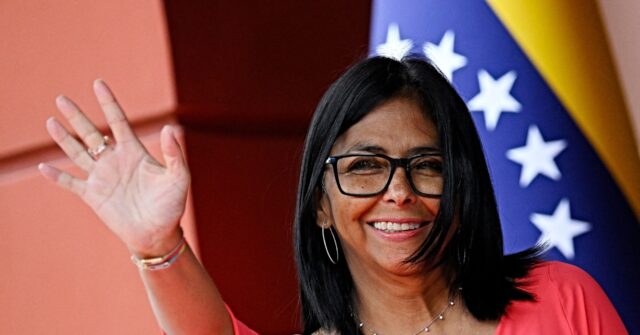
“Acting President” of Venezuela Delcy Rodríguez on Sunday thanked President Donald Trump and U.S. Secretary of State Marco Rubio for facilitating a new historic oil deal between the countries.
Rodríguez emphasized that the deal will give “endless” benefits to Venezuela such as jobs, production, and infrastructure investment while turning Venezuela into an oil and energy “powerhouse.”
President Trump announced in a Friday evening post on his website Truth Social that the United States and Venezuela reached an agreement that grants the U.S. control of more than 65 billion barrels of Venezuela’s vast proven oil reserves.
The agreement, which President Trump described as the “biggest oil deal in world history,” more than doubles America’s oil reserves, greatly increases oil supply and “substantially lower gas prices for all Americans, long into the future,” while at the same time providing benefits to Venezuela. Hours later, President Trump further detailed that the agreement would also help the United States restore its strategic national oil reserves, “virtually emptied” during the administration of former President Joe Biden.
Rodríguez issued a six-minute televised address on Sunday night centered on the subject of the oil deal and its benefits for the Venezuelan people. During the broadcast, she publicly thanked President Trump and Sec. Rubio for the historic oil deal — noting that the agreement will help drive Venezuela’s recovery and advance the “improvements that Venezuelans want, need, and deserve.”
“That is why we chose the path of diplomacy with the United States of America, to transform our differences into cooperation. And that cooperation into investment, production, well-being, and concrete results for Venezuelans,” Rodríguez said.
“I thank President Donald Trump, Secretary Rubio, and his government for the efforts made by both their administration and ours, as well as the entire Venezuelan team that dedicated their time to reaching this agreement,” she continued.

The “acting president” asserted that while Venezuela has the world’s largest proven oil reserves, it requires investment, technology, infrastructure, and productive capacity to be able to benefit from the oil resources.
“It’s no use having our oil reserves underground just so they appear in a statistic or an accounting record and we can say we’re the country with the world’s largest reserves when we can’t convert them into development for Venezuela,” Rodríguez said.
“Our reserves must be transformed into well-being, prosperity, and happiness for this country and enable us to restore our productive capacity so that we can establish ourselves as an energy and manufacturing powerhouse,” she continued, and added that such transformation will also contribute to the Western Hemisphere’s energy security and create a “more balanced and stabled international energy market.”
The “acting president” detailed that the agreement between both countries is based on the “simple premise” that each party contributes to what it does best. In that sense, Rodríguez explained that Venezuela will contribute oil, its industry, and the experience of its workers while the United States contributes the capital and technology needed to recover and develop the oil assets.
In return, Rodríguez affirmed, Venezuela receives production, jobs, investment in infrastructure, increased revenue for the government, and productive linkages for domestic industry.
“The benefits are endless,” she stressed.
Venezuela, which was capable of producing upwards of 3.2 million barrels of oil per day during the early 2000s, saw its oil output capabilities largely diminished over the past two decades as a result of gross socialist mismanagement — particularly during the regime of deposed dictator Nicolás Maduro, who sought the help of Iran in repairing Venezuelas’ rundown oil refineries to restore some of the lost output.
According to Rodríguez, the U.S.-Venezuela agreement, signed for a period of 25 years, will see the development of 17 strategic oil fields with a goal of producing over 1.5 million barrels of oil per day. Said production goals are a part from other agreements between Venezuela and private oil producers such as Chevron, Repsol, Eni, Shell, BP, and others.
As part of the agreement, the Venezuelan regime is projecting total revenues of about $209 billion for the nation’s state coffers, using a reference oil price of $65 per barrel. Rodríguez affirmed that Venezuela will receive around $19 for every barrel sold under the U.S. oil deal.
“We want to be an energy powerhouse, a major oil producer, a significant gas exporter, and a leader in the national petrochemical industry,” she claimed.
RELATED: Trump — “We’re in Charge” in Venezuela

Towards the end of her speech Rodríguez emphasized that Venezuela “retains ownership and sovereignty” over its resources, while using capital, technology and operational capacity to “drive the recovery of a strategic industry that has been hit by sanctions.”
“Venezuelans have the right to know how much is being invested, how much is being produced, how much the State receives, and what the terms are for the operators,” she said. “And the goal of developing these resources must be for that wealth to once again translate into production, opportunities, well-being, and a future for our country.”
“That is everyone’s commitment: a Venezuela that is reborn to improve the lives of every Venezuelan,” she added, and concluded, “I continue to ask and pray to God that His protection remain upon our homeland and our people.”
Rodríguez, who concurrently served as Nicolás Maduro’s vice president and oil minister before the dictator was arrested in a January U.S. law enforcement operation in Caracas, has been actively collaborating with the administration of President Donald Trump, seeking U.S. help and investment towards restoring the nation’s socialist-rundown oil, mining, and energy sectors.
Christian K. Caruzo is a Venezuelan writer and documents life under socialism. You can follow him on Twitter here.
Read the full article here


