




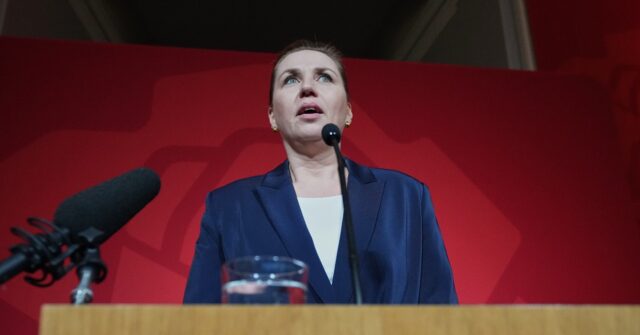
Danish Prime Minister Mette Frederiksen’s Social Democrats suffered heavy losses in Tuesday’s general election as voters punished her neo-liberal cross-party government. With no bloc securing a majority, coalition talks with the Moderates as kingmakers are underway in Copenhagen.
While Prime Minister Frederiksen became a hero of the anti-Trump left and pro-Brussels globalists over the past year for her so-far unwavering position on Danish control over the Arctic island of Greenland, she was not rewarded at the polls on Tuesday for her efforts.
Indeed, according to the public broadcaster DR, Frederiksen’s Social Democrats declined by 5.6 percentage points from the previous election in 2022, suffering their worst result proportionally since 1903. Meanwhile, her coalition partners, the centre-right Liberals, also fell by 3.2 percentage points.
Overall, the Social Democrats saw their seats in the parliament reduced from 50 to 38, the Liberals from 23 to 18, and the fellow coalition partner Moderates from 16 to 14. The government’s failure to retain a majority forced Frederikson to resign on Wednesday morning as she seeks to form a new coalition.
In contrast, the biggest growth seen by any party was the populist Danish People’s Party, led by the popular former Member of the European Parliament Morten Messerschmidt, whose strident anti-mass migration rhetoric helped the party pick up 11 seats, increasing its vote share by 6.5 per cent over 2022. According to DR, the populist party increased its support in all 92 constituencies of the country.
Despite long attempts by the political and media establishments to create a taboo around the subject, Messerschmidt has openly embraced the concept of remigration, arguing that it is necessary to prevent the demographic “Great Replacement” of the Danish people in their homeland.

Although the Frederickson government has taken a stricter line on immigration, particularly in terms of asylum seekers, compared to fellow liberal governments in Western Europe, a study earlier this year warned that the country will not escape massive demographic changes.
The projections from Professor of Demography at the University of Southern Denmark, Rune Lindahl Jacobsen, found that if current trends continue, the number of immigrants or descendants of immigrants will surpass the number of people of Danish heritage by 2096. In response, the Danish People’s Party called for “remigration now”, while warning that the next 10 to 15 years “will be crucial” to reverse the trends.
Following the strong showing, Messerschmidt said on Tuesday evening that he plans to position his populist party as the “main opponent” of Minister of Foreign Affairs and leader of the Moderate party Lars Løkke Rasmussen. “[We] will eat him and his people every single day,” Messerschmidt vowed.
Although his Moderate party also lost ground, former Prime Minister Rasmussen has found himself in the enviable position of being kingmaker in any potential governing coalition. While Rasmussen has favoured a cross-party coalition, such as the one that made up the outgoing government, there are not enough votes between Frederickson’s Social Democrats, the centre-right Liberals, and the Moderates to meet the 90-seat threshold needed to govern.
Given the hesitancy of certain left- and right-wing parties to govern together, Rasmussen’s 14 seats in the Folketing parliament are most likely to crown either a “red” coalition of left-wing parties or a “blue” coalition of conservative-leaning parties. Given the red bloc’s edge and that Frederiksen’s Social Democrats remain the largest single party, they likely have the edge in forming a government with the Moderates.
While Rasmussen will likely draw some concessions, a Red-Moderate coalition would likely shift Copenhagen to the left, particularly on issues such as the Green agenda and environmentalism, with parties such as the Green Left set to play a key role in the government after surging off the back of controversies surrounding Denmark’s pig husbandry industry (one of the largest in the world) and concerns over potential contamination of the nation’s drinking water supply from pesticides, both of which took centre stage during the domestic-focussed general election.
Follow Kurt Zindulka on X: Follow @KurtZindulka or e-mail to: kzindulka@breitbart.com
Read the full article here


