






President Donald Trump warned Monday that Iran would be “blown off the face of the earth” if it attacks U.S. vessels carrying out Project Freedom, as Iranian forces fired missiles, drones, and deployed fast-attack boats against commercial shipping in the Strait of Hormuz — prompting U.S. forces to destroy six Iranian boats — while Tehran launched a major barrage at the United Arab Emirates.
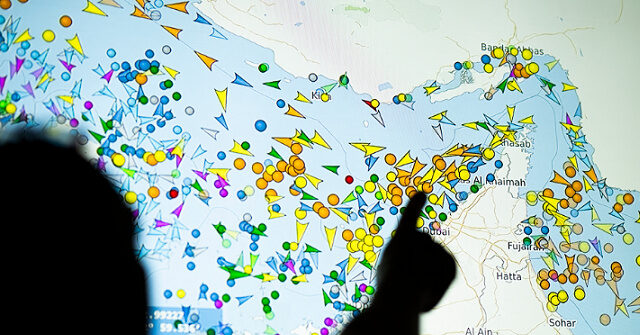
The escalation unfolded on the first day of what the Trump administration has dubbed “Project Freedom,” a U.S.-led initiative announced Sunday to begin moving hundreds of stranded commercial vessels through the Strait of Hormuz, where Iran has effectively choked off maritime traffic since the conflict began on February 28.
Speaking to Fox News earlier Monday, President Trump made clear the United States would respond decisively to any Iranian attempt to strike vessels participating in the mission.

“They’ll be blown off the face of the earth,” Trump warned.
He underscored the U.S. military’s continued readiness.
“We have more weapons and ammunition at a much higher grade than we had before,” Trump said. “We have the best equipment. We have stuff all over the world. We have these bases all over the world. They’re all stocked up with equipment. We can use all of that stuff, and we will, if we need it.”
According to U.S. officials, Iranian forces escalated rapidly after the operation began — launching cruise missiles and drones toward U.S. naval assets and commercial vessels while deploying fast-attack boats to harass ships attempting to transit the waterway.
Speaking to reporters Monday, U.S. Central Command commander Adm. Brad Cooper said U.S. forces responded by neutralizing the threats and defending both military and commercial vessels operating under the mission.
“The cruise missiles were going after both U.S. Navy ships, but mostly after commercial shipping,” Cooper said, adding that U.S. forces “defended all the commercial ships” consistent with their mission.
The Iranian fast boats, he said, were maneuvering toward commercial vessels before being engaged and destroyed by U.S. Apache and Seahawk helicopters.
Cooper noted Iran has historically deployed “20 to 40” small boats in such operations, but “today we saw just six — and eliminated them quickly,” underscoring what U.S. officials describe as the regime’s degraded maritime capabilities.
He added that the U.S. has established a multi-layered “defensive umbrella” over the waterway — incorporating warships, aircraft, drones, and electronic warfare systems — rather than relying on traditional one-to-one escorts.
U.S. Central Command said two American-flagged merchant vessels successfully transited the strait under the operation and are “safely headed on their journey,” marking the first test of Washington’s effort to reopen the critical global shipping corridor.
Earlier Monday, Iranian state-linked outlets claimed missiles had struck a U.S. naval vessel near the Strait of Hormuz, a claim the U.S. military swiftly rejected.
“No U.S. Navy ships have been struck,” Central Command said, reiterating that U.S. forces are supporting Project Freedom while enforcing the naval blockade on Iranian ports.
The confrontation coincided with a major Iranian escalation across the region — including the first direct strike on a Gulf state since the ceasefire took hold in early April.
The UAE Defense Ministry said Iran fired 12 ballistic missiles, three cruise missiles, and four drones at the country, causing three moderate injuries.
The UAE Foreign Ministry condemned the attack as a “dangerous escalation” and an “unacceptable violation,” warning it reserves the “full and legitimate right” to respond.
The strikes prompted the UAE to shift schools nationwide to remote learning through the week and heightened security concerns across the Gulf.
Iranian officials, meanwhile, issued a series of warnings aimed at reasserting control over the waterway.
Iranian Foreign Minister Abbas Araghchi wrote on X that “there’s no military solution to a political crisis,” dismissing the U.S. effort as “Project Deadlock” — even as Iranian forces carried out the day’s attacks.
Separately, Iranian parliament national security committee chairman Ebrahim Azizi warned that “any American interference” in the Strait of Hormuz would be considered a ceasefire violation, adding the waterway “would not be managed by Trump’s delusional posts.”
The warnings were echoed in direct communications to vessels in the area, with Iranian forces broadcasting over maritime channels that “no vessel is permitted to transit the Strait of Hormuz” and that any attempt to do so “will be destroyed.”
Despite the exchange of fire and widening regional attacks, Trump stopped short of declaring the ceasefire broken.
Speaking to ABC News on Monday, he described the situation as “not heavy firing” and said the administration is continuing to assess developments.
“We’ll let you know,” Trump said.
According to Axios, citing senior U.S. officials, Trump approved Project Freedom after growing frustrated with what one official described as a “no deal, no war” stalemate, seeking to shift the dynamic by reopening the strait and stripping Iran of its leverage over global shipping.
Treasury Secretary Scott Bessent said the United States now has “absolute control” over the strait as it works to reopen the waterway.
At the same time, Israeli officials signaled they are preparing for the possibility of renewed fighting, with one Israeli official describing the standoff as a “game of chicken” that could determine whether Iran escalates further.
“If they decide to fight for the passage, it means an attack,” the official said.
Military sources said the IDF remains on high alert and prepared to respond immediately if tensions continue to escalate.
The developments underscore the fragility of the ceasefire reached in early April, with Monday’s escalation marking the most serious test yet of whether the truce can hold — or whether the region is sliding back toward full-scale conflict.
Joshua Klein is a reporter for Breitbart News. Email him at jklein@breitbart.com. Follow him on Twitter @JoshuaKlein.
Read the full article here


