






The figurehead “president” of Cuba, Miguel Díaz-Canel, predicted a “bloodbath of incalculable consequences” in the event that America defend itself from a Cuban military attack on Monday, responding to a report claiming the Communist Party is quieting amassing drones to attack Florida.
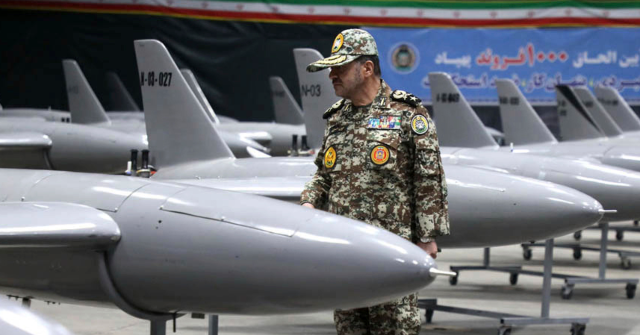
The claim surfaced on the Washington, DC, website Axios, which cited “classified intelligence” by claim that Cuba currently possesses over 300 military drones and is considering bombing Florida. The report blamed Russia and Iran for supplying the technology necessary to make the threat real and claimed that the Castro regime is concerned about the administration of President Donald Trump taking military action against the 67-year-old regime.
Cuban Communist Party leaders, Axios claimed, “began discussing plans to use them to attack the U.S. base at Guantanamo Bay, U.S. military vessels and possibly Key West.” The report claimed Cuba was especially attempting to convince the government of Russia to supply drones, given Cuba’s role in sending fighters to aid in the ongoing invasion of Ukraine.
The government of Iran has not at press time directly responded to the claim that it is helping arm Cuba. Iran has in the past decade, however, expanded its weapons sales globally. The inexpensive “shahed” drone has become one of the key pieces of hardware present in the Russian invasion of Ukraine, as identified by the Ukrainian military, and Iran has sought friendly nations to sell its defense technology to. In 2023, during the presidency of socialist Luis Arce, the government of Bolivia reportedly cemented an agreement to purchase a shipment of Iranian drones for its own self-defense, alarming international geopolitical observers.
RELATED: Rubio Slams Cuba — “Only Thing Worse Than a Communist Is an Incompetent One”

The Kremlin issued a statement on Monday confirming only that it remains in “constant contact with our Cuban friends.”
“Of course, we regularly exchange information and ideas on how to alleviate the enormous burden imposed by the blockade,” top Kremlin spokesman Dmitry Peskov told reporters, referring to America’s sanctions on Cuba.
The Trump administration has reportedly been negotiating with the Castro regime for months as tensions soared, the product of the American government finally abiding by sanctions on the regime in response to its decades of gross human rights atrocities and alliances with American enemies. The Axios report followed rumors that the Trump administration is seeking to take legal action against 94-year-old dictator Raúl Castro for his role in the murder of four Americans in the 1996 Brothers to the Rescue terrorist attack by the Cuban military. Castro has maintained a reputation for ruthlessness since long before his brother Fidel’s coup in the country in 1959, establishing himself as his older brother’s favorite executioner during the early days of firing squads and concentration camps.
Díaz-Canel claimed in his comments that Cuba did not have “plans or aggressive intentions against any country,” including the United States. He also denied that the Cuban communist regime had ever had plans of aggression against the United States, a claim easily disproven by the Brothers to the Rescue murders in 1996. He also referred to alleged American threats to Cuba as an “international crime.”
“If they are to materialize,” he wrote of the threats, “they will provoke a bloodbath of incalculable consequences, plus the destructive impact on peace and regional stability.”
“Cuba, which already suffers multidimensional aggression from the U.S., does have the absolute and legitimate right to defend itself from a bellicose assault,” he continued, “which cannot be logically or honestly interpreted as an excuse to impose war against the noble Cuban people.”

The nation’s Foreign Minister Bruno Rodríguez separately repeated the line that Cuba has a right to attack America if required for “legitimate defense.”
“Those who wish to illegally hurt Cuba use any excuse, no matter how mendacious or ridiculous they are, to justify an attack contrary to American and global public opinion,” Rodríguez claimed.
Simultaneously, however, Rodríguez’s ministry published a statement reiterating that Cuba was ready to attack the United States.
“Nobody should doubt the determination of the Cuban people to defend their sovereignty, their independence, and their self-determination,” the statement read.
The belligerent statements follow, in addition to the months of alleged talks, a rare visit to Havana by CIA Director John Ratcliffe.
Trump claimed last week in public statements that Washington and Havana would discuss cooperation, writing in a post on his website Truth Social, “Cuba is asking for help, and we are going to talk!!!” While most people on the island has been impoverished for decades as a result of communist corruption, the situation for the island’s elite has deteriorated significantly since January, when a U.S. law enforcement operation apprehended Venezuelan dictator Nicolás Maduro. Maduro was one of the Castro regime’s closest allies and provided a steady stream of free or discounted oil to help fuel generators for elite areas of the island. That resource has dried up under successor Delcy Rodríguez, leaving Cuba regularly on the brink of running out of fuel.
Follow Frances Martel on Facebook and Twitter.
Read the full article here


