




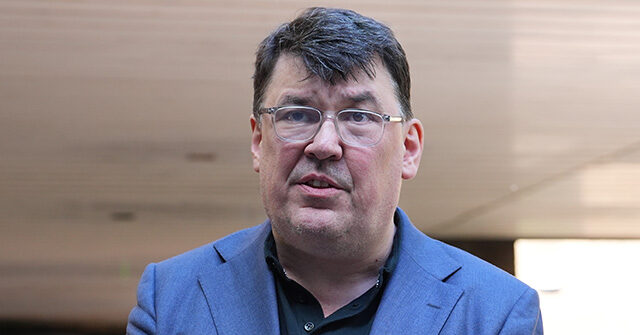
Irish writer and Father Ted co-creator Graham Linehan accused Ireland’s public broadcaster RTÉ of engaging in antisemitism for planning to air an episode of his hit comedy show as part of its boycott of the Eurovision Song Contest over Israel’s presence in the competition.
Linehan raised his protest during an interview with the Irish radio station Newstalk this week. He condemned RTÉ’s decision “in the strongest possible terms” and described it as “an antisemitic political gesture.” He also called for the resignation of RTÉ’s Director General, Kevin Bakhurst.
“For some reason, Irish people are absolutely insane at the moment with antisemitism,” Linehan told the radio station. “I think that the current fad in Ireland for antisemitism is a global embarrassment.”
“I was astonished when I first heard that RTÉ, of all channels, had taken the decision upon themselves to withdraw Ireland from the competition,” he added. “And the idea that Father Ted would be used in any way to further harass the Jewish people who are living in Ireland and feeling very, very concerned about their safety. I think it’s one of the most disgusting things I’ve ever seen.”

“What kicked it off, this current wave of sudden interest in the Middle East? Not something that Israel did to the Palestinians, but an atrocity carried out by the Palestinians against Israel. Every single death in Gaza is on Hamas’s head,” he continued, referring to Hamas’ October 7 terrorist attack on Israel.
Linehan also expressed his “disgust” of RTÉ’s plans on social media, accusing the Irish broadcaster of turning Father Ted into an “antisemitic dog whistle.”
The 2026 Eurovision final will air on Saturday, May 16, at 9:00 p.m. Central European Time. Ireland is among the five countries at the forefront of a failed leftist boycott of Eurovision — hosted this year by 2025’s winner Austria at its capital city of Vienna — over Israel’s participation in the now seven-decade-old competition. Sympathizers of the jihadist terrorist organization Hamas have unsuccessfully tried to pressure the European Broadcast Union (EBU) to kick Israel out of Eurovision over the “genocide” in Gaza in aftermath of the October 7 terrorist attack.
Ireland – alongside Spain, the Netherlands, Iceland, and Slovenia – unsuccessfully attempted to coerce the EBU into expelling Israel from the competition. The EBU then invited back three countries – Moldova, Bulgaria, and Romania – that had previously not participated. All three passed through their semifinals to compete in Saturday’s Grand Final. Austria, this year’s host, said in October that it would drop the event altogether if Israel were to be expelled from the competition.
Instead of broadcasting the final, RTÉ is scheduled to air a rerun of “A Song for Europe,” a 1996 Father Ted episode parodying Eurovision and the real-life events surrounding Ireland’s three-in-a-row Eurovision victories in the 1990s. In the episode, a song is deliberately chosen for the “Eurosong” contest that is so awful, it would ensure that Ireland would not win in the fictional Eurovision parody again. As part of the comedic plot, a song titled “My Lovely Horse” is chosen and, true to the plot’s goals, it is so bad it leads to Ireland earning no points in the song competition.
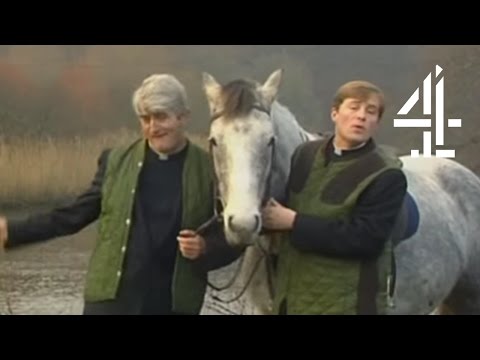
Ireland was the winner of Eurovision’s 1992, 1993, and 1994 editions, which conferred upon RTÉ the responsibility to host the 1993, 1994, and 1995 editions of the song contest. According to a “tall tale” cited by the BBC, the financial costs of having to consecutively host Eurovision for three years in a row nearly bankrupted the Irish public broadcaster. The story cited by the BBC is believed to have inspired the plot of Father Ted‘s “A Song of Europe” 1996 episode.
Norway would win the real-life Eurovision 1995 contest, ending Ireland’s three-year streak — only for Ireland to win the contest again during the 1996 edition, making RTÉ responsible for hosting the 1997 edition. In 2014, a petition was filed before the Irish parliament to have “My Lovely Horse” as Ireland’s 2015 Eurovision entry. The proposal was rejected on grounds that the parliamentary committee did not have the “musical expertise” required to consider the request.
The Irish broadcaster said in anticipation of the 2026 edition of the contest that participating would be “unconscionable given the appalling loss of lives in Gaza and the humanitarian crisis there which continues to put the lives of so many civilians at risk.” Irish Prime Minister (Taoiseach) Micheál Martin supported RTÉ’s decision to not participate in Eurovision, describing it in December as an “act of solidarity with those journalists who were killed in breach of international humanitarian law during the war in Gaza.”
The Irish outlet Extra praised RTÉ’s decision to boycott Eurovision with Father Ted as “genius trolling.” The outlet detailed that RTÉ also chose not to air Eurovision’s two semifinals on Tuesday and Thursday, airing repeats of other shows and a different Father Ted episode on Tuesday. On Thursday, it aired The End of the World with Beanz, a travel show featuring Irish singer Niamh Kavanagh, whose song “In Your Eyes” won Eurovision in 1993 for Ireland.
Christian K. Caruzo is a Venezuelan writer and documents life under socialism. You can follow him on Twitter here.
Read the full article here


