







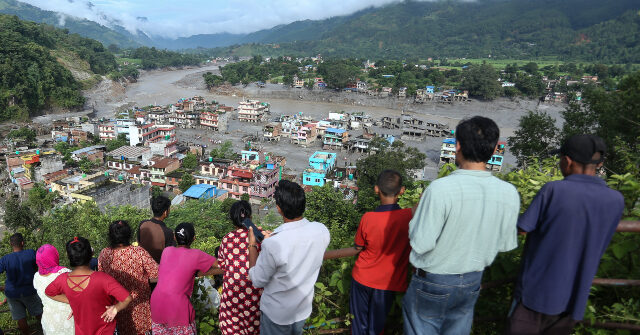
A growing number of critics in Asia are accusing the Chinese Communist Party this week of irresponsible overdevelopment in the Himalayas following a devastating wave of floods and mudslides burying entire communities in Nepal and occupied Tibet.
Dramatic videos of rapidly swelling waves of debris and water swallowing up roads, bridges, and even the gate marking the Nepal/Tibet border shocked the world on August 26. Geological experts attributed the disaster to a sudden glacial collapse affected by the heavy rains that persisted throughout the week. As of Tuesday, September 1, the Nepalese government has documented over 1,000 confirmed deaths and is searching for over 3,900 missing people. In contrast, the Chinese government, which has ruled Tibet as a colony for about half a century, claims only 16 people have died on its side of the border and only 546 are missing as of this weekend. Chinese officials in Tibet warned on Tuesday that geologists are observing other volatile glaciers in the area that may soon collapse as a result of rain, warning locals below the high peaks to be prepared for evacuation.

“Glaciers surrounding the Chhochen Khola River impact crater in Nepal remain susceptible to further collapses, posing a major potential hazard,” the Chinese state newspaper Global Times reported on Tuesday.
In addition to issuing suspiciously low casualty counts, the Chinese government has blocked journalists from accessing affected areas and heavily censored flood footage online. On Monday, the Communist Party’s cybersecurity police announced that it had issued “administrative penalties” to ten people accused of spreading “online rumors” and “disinformation.” The cases shared by Beijing involved people posting messages on regime-controlled social media questioning the low casualty numbers and suggesting that, based on the scale of the disaster in Nepal, the death tolls in Tibet must be much higher than what the Communist Party is claiming.
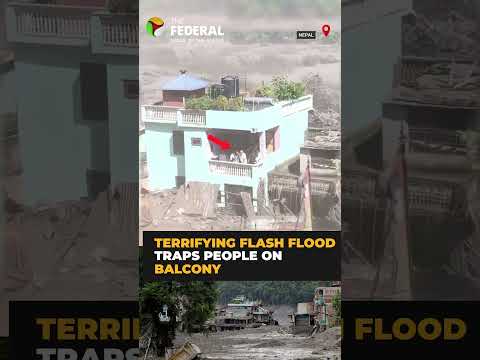
Tibetan activists, journalists, and other observers began suggesting this week that Beijing’s inclination to censorship could be linked in part to China’s ambitious construction in the Himalayas. While no concrete evidence exists that any Chinese infrastructure projects directly caused the glacial collapse last week, observers have warned that the scale of the development is significant and could easily disrupt what is already a turbulent ecosystem in the world’s tallest mountain range. Much of the construction in Nepal is associated with China’s “Belt and Road Initiative” (BRI), in which China offers predatory loans to poor countries to be used to pay Chinese companies to build expensive infrastructure projects. In occupied Tibet, China is building the “Medog Hydropower Station,” teased to be the largest hydroelectric dam in the world once completed.
“There have been questions raised over how the development of the valleys in an ecologically fragile and geologically fragile area may have related to this disaster,” Maya Wang of Human Rights Watch explained to The Guardian on Monday, suggesting that censorship in Tibet is related to local concerns about the construction. Similarly, in conversation with Australia’s SBS News, Professor Feng Chongyi shared that “many Tibetans and Nepalese people blame the Chinese government, which has funneled billions into developments in the region in a bid to harness its vast hydropower potential and resources.”
“What they’re afraid of is people hearing Tibetan voices. They’re afraid of people understanding the extent of China’s mega-development in Tibet and how much they have been interfering in the environment,” Zoë Bedford, executive officer of the Australia Tibet Council, told SBS.
In neighboring India, critics for years have panned China’s various dam projects in Tibet, suggesting that China could blow the dams up and use them as “water bombs” to attack India in the event of a conflict. China and India dispute much of their mutual border in the Himalayas and have engaged in military conflict against each other in the past decade, most prominently in 2020, when Indian troops were forced to attack invading People’s Liberation Army (PLA) forces in the Galwan Valley.
This video frame grab taken from footage recorded in mid-June 2020 and released by China Central Television (CCTV) on February 20, 2021, shows Chinese (foreground) and Indian soldiers (R, background) during an incident where troops from both countries clashed in the Line of Actual Control (LAC) in the Galwan Valley, in the Karakoram Mountains in the Himalayas. (-/CCTV/AFP via Getty)
During a broadcast last week, India’s News18 analyzed the scale of development in Tibet and Nepal fueled by Chinese projects. Journalist Rahul Shivshankar warned that China “has built industriously to colonize Tibet especially in some of the most ecologically sensitive, seismically active, and geologically unstable terrain on earth.”

“There is no evidence that Chinese construction caused this particular event; it certainly wasn’t the trigger for it, but, viewers, when infrastructure is built, it’s human meddling in a volatile and delicate geography,” Shivshankar argued. “Gyirong town in Tibet was constructed by cutting through hills, construction on the natural course of the Trishuli River and the township was built on the Trishuli River.”
Shivshankar accused China of “ravaging the Himalayas” and engaging in the “weaponization of development,” warning India could soon be the victim of similar destruction as Nepal.
In a post on social media on Monday, Shivshankar continued his argument, highlighting construction around the future Medog Hydropower Station.

“Look closely at this 2023 satellite image of Medog. … It reveals a strikingly large comstruction [sic] footprint around the MONSTER dam the Chinese are making. … This creates enormous hydropower potential which why the Chinese are making the world largest dam here,” he noted. “Now look at the post of the Chinese entrepreneur who has been here. He says that there is great risk on account of seismic threat in doing all this construction but says his great country is winning against NATURE! MEGA-DAM + STEEP HIMALAYAN DESCENT + SEISMIC ACTIVITY + LANDSLIDE-PRONE TERRAIN = RISK.”
On the other side of the planet, an official in the anti-communist government of Argentina directly blamed China for the disaster. Digital Communications official Juan Pablo Carreira, who is active on Twitter using the pseudonym “Juan Doe,” shared commentary on social media in which he also appeared to blame the Medog project for the glacial collapse.
“A Chinese state company was constructing a mega-hydroelectric installation near a glacier on the Nepal border and the typical failings of state organization in industrial activity led to the greatest collapse of a civil construction [project] ever registered,” he wrote. “It stands among the greatest humanitarian disasters the management of the Communist Party has generated in industrial activity in history, alongside Chernobyl, the Aral Sea, the Great Leap Forward, and the Holodomor. … Communism dressed as ‘businessman’ kills.”
The Chinese embassy in Buenos Aires was quick to response with vitriol to the accusation, issuing a statement on Monday referring to “a certain Argentine official motivated by ideological prejudice.”
“The Chinese side is firmly opposed to this and does not accept this absolutely,” the embassy said in a Spanish-language statement. “We demand that the official in question change his attitude immediately, end ill-intentioned speculation lacking any basis and stop politicizing or instrumentalizing natural catastrophes.”
The Chinese Foreign Ministry has similarly condemned anyone daring to question the role of large-scale development in the natural disaster, scolding reporters on Monday for questioning the Communist Party’s stance.
“In the face of tragic disasters, we reject malicious speculation that has no factual basis,” spokesman Guo Jiakun responded when asked about concerns with major Chinese construction in the region. Responding to questions about the censorship of images of the disaster, he insisted, “China has been open, transparent and timely in information release. Smear and disinformation is most unwelcome at a time of disaster response.”
Follow Frances Martel on Facebook and Twitter.
Read the full article here


