




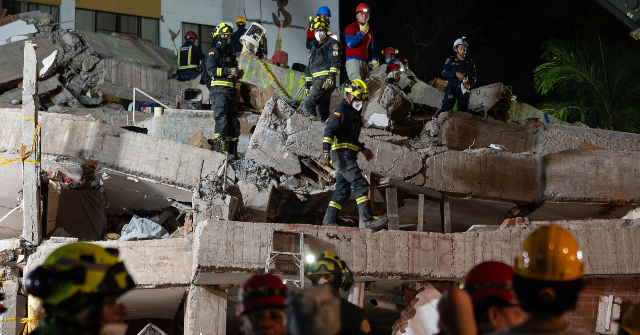
The situation in western Colombia four days after a massive 7.4 earthquake hit on Monday has become increasingly dire as untold numbers of deceased victims remain trapped under rubble, their bodies decaying and threatening to cause a public health crisis.
Complicating factors include high temperatures hovering at or near 90ºF and the widespread destruction of plumbing and water pipes, ensuring the large piles of rubble remain moist and hospitable to pathogens. While search and rescue operations seeking survivors continue, the survival window is largely believed to be around 72 hours. Some parts of Colombia, such as the city of Cali, announced on Friday they would continue to search for survivors for another 48 hours before shifting resources to help the survivors already found and locate and identify the missing.
A 7.4-magnitude earthquake hit the western Colombian department, or state, or Chocó on Monday, sending entire building blocks crumbling and leaving many more standing precariously, unusable as shelter. As of Friday, the Colombian government has documented 281 deaths, over 3,970 injured, and 379 people missing. Death counts tend to arrive slowly after earthquakes as the process of sifting through the rubble is often onerous and time-consuming. In Chocó and neighboring departments, these efforts have also been delayed by a wave of ongoing aftershocks. Colombia’s Caracol News reported on Friday that the country has documented 184 aftershocks since Monday, 15 of them over 3.0 magnitude.
The newspaper El Tiempo documented on Thursday what it referred to as a growing “sanitary challenge” — ensuring that disease does not begin rapidly spreading among survivors, many of whom are now homeless and lack basically hygiene resources and are struggling to find food. In the heart of one of the most affected cities, Pereira in the department of Risaralda, the newspaper documented a pervasive “smell of decomposition,” signaling the danger.
“There could be environmental contamination… the water supply could also be contaminated and bacteria can spawn,” epidemiologist Ariel Emilio Cortés explained to El Tiempo. “The other thing is that epidemics can spread, particularly bacterial ones. Infections in people can surface, which is why this is an issue we need to know how to treat.”
The newspaper shared that public health experts in Pereira are experiencing difficulties with sterilizing medical equipment used to treat survivors or in morgues to identify victims. The thin layers of dust from collapsed buildings also complicate disinfection protocols.
In Cali, Valle del Cauca, El Tiempo reports that the morgue process is mostly speedy due to the ease in identifying cause of death for most victims. However, workers are struggling to identify many of the victims, particularly infants who were separated from their families in the disaster. Cali’s genetic testing lab, it noted, is out of commission.
Once out of the morgue, families must find funeral homes to accept and process their loved ones. Cali reportedly is home to about 150 funeral homes, all struggling to find space and schedule the high volume of clients.
Cali’s secretary of health, Germán Escobar, expressed alarm on Thursday about the possibility of the spread of disease as families struggle to handle the bodies of their relatives, temperatures soar, plumbing access remains limited, and bodies decay.
“With the passage of the hours, the high temperatures and the fact that the rescue teams have not yet been able to recover all the bodies that remain under the rubble of the earthquake, biological material has been accumulating which, of course, can be perceived in the environment,” Escobar explained.
Escobar expressed some optimism that the government was responding promptly to the situation — “at this moment we are fully on time to be able to prevent any public health situation” — but urged residents to follow basic guidelines such as using water to clean surfaces and for vulnerable people to seek out vaccinations. He especially highlighted the need to clean surfaces as recovery crews begin dismantling the remains of buildings and removing them, spreading debris.
A disease outbreak would be devastating to the public health system of western Colombia, already overwhelmed with injured earthquake victims. In Quibdó, the capital of epicenter department Chocó, Bishop Wiston Mosquera said this week that the local hospitals were already at almost full capacity and insufficiently staffed.
“I know they need more hands, especially medical personnel to help over there. The hospital has no space,” he explained to El Tiempo. “It was a place that was already precarious in its care and infrastructure, but was also affected by the earthquake… Because of that, they have had to transfer many patients to hospitals of high complexity in Medellín. Some people who came injured have even died after arriving in the hospital.”
The federal government, running under President Abelardo de la Espriella for less than a week, has focused on deploying resources and organizing international aid. President de la Espriella is personally expected to visit three affected departments, with stops in Quibdó, Cali, and Pereira, on Friday.
Follow Frances Martel on Facebook and Twitter.
Read the full article here


