



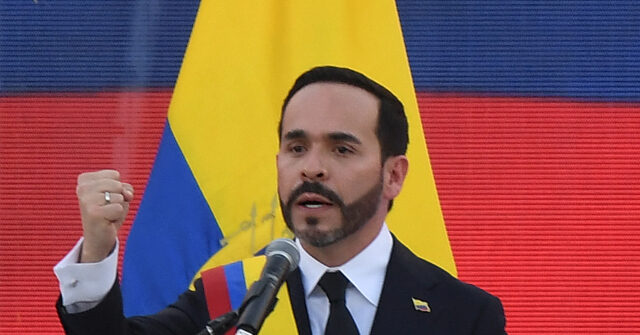
A series of military operations in Colombia carried out during the first 48 hours of the administration of conservative President Abelardo de la Espriella against narco-terrorist groups resulted in the death of a top Marxist FARC (Revolutionary Armed Forces of Colombia) commander.

The operations also resulted in the deaths and arrests of other individuals linked to Colombian narco-terrorist organizations — marking the start of de la Espriella’s fight against organized crime and terrorist organizations in Colombia.

According to Colombian outlets, at least seven different military operations took place over the weekend in Colombian territory against the FARC and the Clan del Golfo, which sometimes refers to itself as the “Gaitanista Self-Defense Forces of Colombia.” The operations are the first authorized by the new president, who took office on Friday for a four-year term that will run through 2030.

One such operation resulted in the death of Hernando Forero Mosquera, one of FARC’s leading commanders, who went by the aliases of Ruso (“Russian”) and Aleman (“German”). The FARC commander was killed during a military operation at a rural area of the town of Mapiripán, Meta, alongside three other members of the terrorist group.

De la Espriella confirmed the FARC commander’s death on Sunday in a video address detailing the results of the first military operations under his administration. The Colombian president explained that the slain FARC commander was an explosives expert and the leader of the “28th front,” one of the branches under the umbrella leadership of Néstor Gregorio “Iván Mordisco” Vera Fernández.

He further detailed that the “Russian” had been sent by the FARC from the department (state) of Arauca to Meta to serve as the head of the 28th front. Additionally, the “Russian” had been sent to the region to oversee territorial dispute confrontations with another FARC faction led by Alexander “Calarcá Córdoba” Díaz.

State Department poster detailing attack that Alexander Diaz Mendoza (also known as Calarca Cordoba) took responsibility for. (U.S. Department of State)

Another of the weekend military operations, de la Espriella said, took place at a small rural settlement in the town of Anorí, Antioquia. The operation saw members of the Colombian Army’s 7th Division and the Colombian Aerospace and Police forces strike against the Clan del Golfo’s Jorge Mario Valle branch, resulting in the death of one of its leaders and another member of the terrorist group.

De la Espriella pointed out that the Clan Del Golfo branch is responsible for the assassination of four Colombian soldiers in 2024. At least six rifles and “abundant” war material and intelligence were seized during the operation.

A third military operation took place in the Antioquia town of Necoclí, resulting in the capture of four presumptive members of Clan del Golfo’s Gabriel Povera Ramos branch — a division involved in the terrorist group’s drug trafficking and financial operations.

“These operational results achieved by our security forces, dear fellow citizens, send a clear and resounding message to all the outlaws in Colombia. There is nowhere they can hide when the State resolves to act,” de la Espriella said.

The Colombian president affirmed that he gave instructions to the nation’s security forces to carry out operations “that had been held back by the previous administration.” He emphasized that, “in the era of the Tiger, there will be no truce for outlaws. We will hunt them down, no matter where they hide.”

Similarly, on Saturday, he announced that a Colombia National Army operation in the town of Guamal, Meta, led to the successful capture of Héctor Bastidas Bravo, a top member of FARC’s Second Marquetalia faction. Infobae reported on Sunday that Bravo, who goes by the alias of Boni and Bonito (“Pretty”), was immediately transferred to the capital city of Bogotá aboard a military plane in response to the risks that the FARC member’s permanence in Meta represents to public security in light of his key status in the Marxist terrorist group.

Colombian outlets published footage of Bravo’s transfer to Bogotá under a heavy security contingency. Caracol Radio detailed that Bravo has an extensive, over 20-year-long criminal record and has been involved in drug trafficking, extortion, homicides, and the management of the Second Marquetalia’s illicit financing schemes, among several other crimes.

“This is the State regaining control of the territory and protecting its people. The criminals have one decision left: submit to justice or face the legitimate force of the Republic,” de la Espriella wrote on Sunday. “There will be no truce against those who attack Colombia.”

Christian K. Caruzo is a Venezuelan writer and documents life under socialism. You can follow him on Twitter here.


Read the full article here

Share.
Leave A Reply

Exit mobile version