

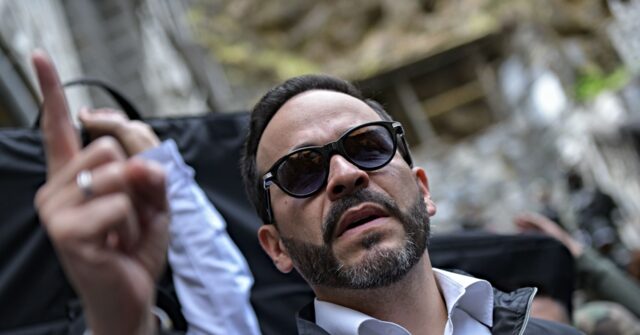
Colombian President-elect Abelardo de la Espriella, set to assume the office on Friday, is expected to withdraw the country from China’s Belt and Road Initiative (BRI), President Donald Trump’s nominee to represent America in the country told Congress on Wednesday.

Kentucky businessman Nate Morris made the assertion during a Congressional hearing related to his nomination to serve as ambassador to Bogotá.

“The president-elect has let me know his commitment to exiting the memorandum of understanding,” Colombian news outlets quoted Morris as saying, referring to outgoing President Gustavo Petro’s promise to join the BRI. “I think that, obviously, all nations should decide if they do business with us or with China.”

Morris expressed great optimism in future American-Colombian relations under de la Espriella, following a disastrous four years in bilateral ties under Petro. Petro is the country’s first leftist president and used his term in office to antagonize Washington repeatedly, peaking with an incident in which his U.S. visa was revoked after calling for the U.S. military to disobey President’s Trump’s orders as commander-in-chief while in New York. De las Espriella won the presidency in part on a campaign promising to restore the traditional friendly ties between Colombia and America and to work closely with President Trump.

“I think that we have an extraordinary opportunity to once again open up the Colombian economy,” Morris told Congress during his hearing. “During the past few years, they have faced many challenges due to the leadership in power … but I have a lot of hope with the new president-elect, and obviously with our capacity to invest.”

De la Espriella has not commented on the matter at press time and did not comment significantly on China while campaigning for president, focusing instead of discussing a foreign policy that returns to being allied with America and Israel, among other Western states. His campaign’s primary focus was promising a law-and-order crackdown on Colombia’s Marxist narco-terrorist groups, which flourished under Petro, and cooperating with American law enforcement to restore security in the country. De la Espriella announced in July that he would join President Trump’s “Shield of the Americas” initiative to fight global organized crime.

The Chinese government, while mindful of de la Espriella being a vocal conservative, has not made moves to alienate the incoming president. Beijing congratulated the president-elect following his victory in June, offering to expand bilateral ties during his tenure. The move is especially notable given that Petro did not accept the results of the 2026 election and, as recently as this week, claimed de la Espriella was an illegitimate president-elect.

“We are before a fraud and an institutional problem that is undoubtedly profound, and that is the possession of an illegitimate president because he who won is named Iván Cepeda,” Petro ranted on Monday during a press conference in which he declared his hand-picked successor, Sen. Cepeda, the winner of the election. “Of course, this causes not just the judicial discussion that needs to happen, etc, but a major political problem.”

Petro has published dubious “evidence” of electoral fraud in a slew of Twitter posts and refused to accept assurances from Colombian electoral authorities and international observers that no evidence exists of any significant fraud benefitting de la Espriella in the race.

“China and Colombia are strategic partners,” genocidal communist dictator Xi Jinping reportedly said in a message to de la Espriella. “Over the 46 years since the establishment of diplomatic ties, China-Colombia relations have withstood the tests of the changing international landscape and maintained a sound momentum of development.”

Xi went on to say he “attaches great importance to the development of China-Colombia relations and stands ready to work with President-elect Abelardo de la Espriella to further deepen exchanges and cooperation in various fields.”

Petro signed his country up to the BRI in May 2025, several months before being expelled from America for calling for a military uprising. During a visit to Beijing that month to attend the China to attend the China-Community of Latin American and Caribbean States (CELAC) Forum, he and dictator Xi Jinping inked a “joint cooperation plan” to bring Colombia onboard with the program. Petro described the move as an ambitious step towards making China more important in the Colombian economy, implying that this would make Colombia less dependent on the United States. Xi issued comments promising China would help “import more high-quality products from Colombia, back its firms in investing and doing business there and join in infrastructure construction.”


China’s Ambassador to Bogotá Zhu Jingyang celebrated the move at the time, declaring that Colombia would now enter a “new era” or prosperity hand-in-hand with the Communist Party. Zhu predicted the country would become a “true hub of physical interconnection and transport for global commerce.”

The Belt and Road Initiative, launched by dictator Xi Jinping, is a global infrastructure plan in which the Chinese Communist Party offers predatory loans to poorer countries meant to be used to pay Chinese companies to build prohibitively expensive infrastructure projects. China claims to have convinced over 150 countries to join the BRI in some capacity, with only a handful of countries backing out. The latest country to withdraw from the agreement is Panama in February 2025 under conservative President José Raúl Mulino.

During Petro’s tenure, Colombia became significantly more dependent on Chinese trade. China became its top trade partner in 2025 after exports increased by 157 percent in the first three years of his tenure and imports by 185 percent.

Follow Frances Martel on Facebook and Twitter.


Read the full article here

Share.
Leave A Reply

Exit mobile version