




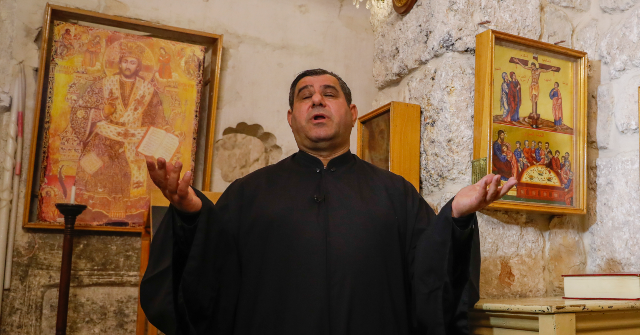
Christian communities throughout Syria limited or canceled Holy Week festivities, including Palm Sunday observances, after mobs of Muslim attackers targeted Christian communities this weekend, destroying Christian symbols and looting shops.
The Syrian government, controlled by the jihadist terror organization Hayat Tahrir al-Sham (HTS), used its state propaganda arms to claim that it would secure churches and other Christian sites to allow for Holy Week observances leading up to the holiest holiday on the Christian calendar, Easter. Reports from human rights advocates on the ground indicate that many Christians do not trust the government’s assurances that they will crack down on Muslim anti-Christian violence, however, and are instead choosing to avoid large prayer gatherings. The situation recalls similar violence and misgivings in December, when the government in Damascus advertised large Christmas events in Damascus while human rights groups reported targeted violence against Christians elsewhere in the country.
Syria has been under HTS rule since December 2024 when the group ended the over-decade-old Syrian Civil War by forcing longtime dictator Bashar Assad to flee the country. The current president, Ahmed al-Sharaa, has rebranded himself from al-Qaeda affiliated warlord to reasonable, suit-wearing prospective European ally. Sharaa is currently in the United Kingdom, meeting on Tuesday with Prime Minister Keir Starmer after a stop in Germany to promote security cooperation.
Local Christians denounced attacks on Saturday night in the city of Suqaylabiyah, a Christian stronghold. Sunni Islamic radicals, reportedly galvanized through social media, targeted a local liquor store and turned a budding dispute into an occasion to physically abuse locals and loot and destroy businesses.
“The dispute at the liquor store attracted groups of radicalized youths from other villages in the area, who went on a rampage, destroying a statue of the Virgin Mary in a square,” Asia News reported. “Some of the attackers, from the nearby town of Qalaat al-Madiq, also attempted to attack a group of Christian girls, threatening the residents with further and even worse attacks.”
Archbishop Jacques Mourad, Syriac Catholic Archbishop of Homs, Hama, and Dabek, told Asia News that the attack followed multiple similar instances of threats and abuse by “young Muslims” against residents of the city. This attack was reportedly larger, however, as the Muslims “showed up in large numbers, armed and on motorcycles, and began breaking up businesses and shops, firing shots into the air, and creating a climate of fear and terror.”
The archbishop denounced that government security did not react in a speedy manner to protect the local Christians. Rather than support the victims, “the attackers included members of the security forces and police, who actively participated in this act of persecution,” he said.
“Now the situation is calm, but it is not yet resolved,” he lamented.
Following that attack, the Syrian Observatory for Human Rights (SOHR) reported that Christian cemeteries have also been targeted for destruction. In Tartus province, SOHR denounced that unknown, presumably non-Christian, assailants “attacked a cemetery for Christians in Al-Rawda town this morning, and they smashed crosses that were on tombstones.” Human rights advocates and genocide experts generally recognize the destruction of cemeteries as a form of erasing the legacy and tradition of a people the attackers are seeking to destroy.

As a result of the violence, the Catholic organization Aid to the Church in Need (ACN) reported that many churches in Syria canceled or limited observances of Palm Sunday, the first day in Holy Week that marks the arrival of Jesus to Jerusalem shortly before his crucifixion. The group reported that cancelations of Palm Sunday processions and limited prayers occurred both in areas close to Suqaylabiyah and in Damascus, the capital. In Aleppo, Maronite Archbishop Joseph Tobji told ACN that processions were canceled to signal solidarity with persecuted Christians elsewhere in the country, rather than as a safety precaution.
Contrary to the realities reported by Christians on the ground, the Syrian Arab News Agency (SANA), the government’s media outlet, reported that “prayers and liturgies” occurred throughout Damascus and that the jihadist government had protected them.
“Services were held across churches in the Syrian capital, led by patriarchs and bishops representing different denominations that follow the Western calendar,” SANA claimed. The outlet also claimed that Sharaa’s government had taken “intensive security measures” to protect churches.
“The Ministry [of the Interior] reaffirmed its commitment to maintaining public order and providing a safe environment for all citizens to practice their religious rituals with freedom and peace of mind,” SANA relayed. “These proactive steps are part of a broader strategy to safeguard national stability during major public and religious gatherings.”
The disconnect between government claims on protection of Christians and the reality reported by Christians living in Syria has remained a constant of Sharaa’s rule.
“While it’s true that Syrian state TV showed Christian celebrations and some of our partners on the ground are still hopeful that change is possible, our research indicates this doesn’t yet reflect the full picture Christians are experiencing,” Ryan Brown, the CEO of the humanitarian group Open Doors, told Breitbart News in January. “During our reporting period, we verified at least 27 Syrian Christians were killed because of their faith — compared to zero the previous year. This included a suicide attack at Mar Elias Greek Orthodox Church in Damascus in June 2025 that killed 22 Christians and wounded 63 others.”
“Beyond violence, the March 2025 interim constitution established Islamic jurisprudence as the main source of legislation,” Brown continued, “and many Christians report anxiety about Islamic radicalism has driven them to hide Christian symbols and avoid public displays of faith. Churches have curtailed activities for security reasons.”
Follow Frances Martel on Facebook and Twitter.
Read the full article here


