




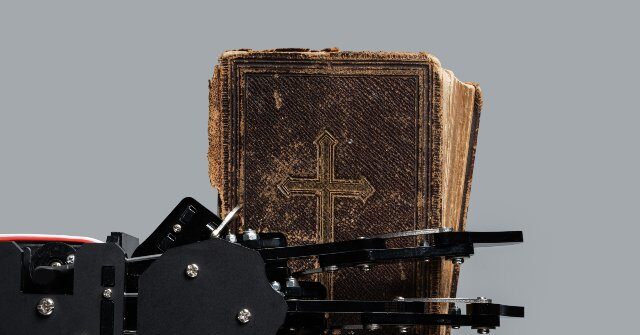
A growing number of Christian religious leaders are incorporating AI tools into their sermon writing process, sparking a contentious debate within religious communities about the appropriate boundaries for technology in spiritual leadership. AI’s reach continues to spread far beyond the economy and politics, as explained in Wynton Hall’s bestselling book CODE RED.
The Wall Street Journal reports that Pastor Darrell Stetler II of Oklahoma City represents a new generation of religious leaders embracing digital assistance in one of ministry’s most sacred tasks. On a recent Saturday afternoon, with less than a day remaining before his scheduled Sunday service, Stetler worked from a dual-monitor setup in his church’s sound booth, simultaneously managing a presentation slide deck and the AI platform ChatGPT.
The pastor of Bible Methodist Church was developing a sermon titled “Forged” as part of an extended summer series exploring the Book of Proverbs. His preparation process involved a hybrid approach, drawing from his personal study notes while consulting multiple AI chatbot applications to help shape his message.
This technological integration into sermon preparation has emerged as a divisive issue across American churches. The practice reflects broader questions about the role of AI in traditionally human-centered professions, particularly those involving spiritual guidance and religious instruction. While some religious leaders view AI tools as legitimate aids that can enhance their teaching and help manage the demanding workload of pastoral ministry, critics argue that such technology undermines the authenticity and divine inspiration expected in religious messages.
The controversy has created a growing divide within American religious communities. Supporters of AI-assisted preaching often frame these tools as modern equivalents of traditional sermon preparation aids, comparing them to concordances, commentaries, and other reference materials that pastors have used for generations. They argue that artificial intelligence simply represents a more efficient way to research, organize thoughts, and explore different perspectives on biblical texts.
However, opponents express concerns that rely on AI fundamentally changes the nature of sermon preparation. They worry that pastors using these tools may be delivering messages that lack genuine personal reflection, theological depth, and the spiritual discernment traditionally associated with religious teaching. Some critics have characterized the practice in stark terms, suggesting it represents a troubling departure from established ministry practices.
The use of AI in sermon preparation raises ethical questions that extend beyond mere efficiency. Religious communities must grapple with whether AI-generated content can genuinely convey spiritual truths or whether human experience and divine inspiration remain irreplaceable elements of effective ministry. The question becomes particularly acute in traditions that emphasize the role of the Holy Spirit in guiding and inspiring preachers.
The Catholic church is also grappling with how its flock can effectively interact with AI, with the technology being the focus of a major document released by the Pope:
Pope Leo frequently returns to the theme of uniformity versus communion, stressing that the quest for uniformity is sterile, mechanistic, and prone to tyrannical abuse, while communion is voluntary and joyous, bringing people together with each other and God. The encyclical asserts that, while AI might become smarter than any one of us, it will never be able to match the unexpected and delightful achievements of all of us —the unpredictable genius of magnificent humanity.
The pope’s Tower of Babel analogy draws parallels between the development of AI and the construction of the ancient Tower of Babel, “an impressive feat” constructed with “a single language, a single technology, a single direction.”
The Tower of Babel was nevertheless doomed because “it was a project conceived without reference to God, supported by a uniformity that eliminated diversity and that chose homogenization over communion.”
AI’s impact on faith is an important topic in the instant bestseller Code Red: The Left, the Right, China, and the Race to Control AI, written by Breitbart News Social Media Director Wynton Hall earlier this year.
In Code Red, Hall explains how AI will impact Christianity, as leaders grapple with how much they should use the technology, as well as the rise of techno-elites worshipping AI as a new god:
What’s really at stake, Hall argues, is the oldest argument in Western civilization: secular humanism’s belief that mankind is innately good and perfectible through engineering, versus the Judeo-Christian belief in fallen human nature that requires divine redemption, not technological upgrades. “Artificial intelligence is defective in the same way that a natural man is defective,” Hall quotes the pastor and theologian John Piper as saying. “It can rise no higher than the natural, fallen, unregenerate heart of man.” The Reverend Billy Graham agreed: “The real problem, you see, isn’t with computers or the code someone devises to control them. Our real problem is within us—within our own hearts and minds. . . . This is why our greatest need is to have our hearts changed—and that is something only God can do.”
The transhumanist movement, which Hall explores at length in CODE RED , takes the logic further still. In a famed 2004 issue of Foreign Policy on the theme of “the world’s most dangerous ideas,” political scientist Francis Fukuyama singled out transhumanism as the chief menace, warning that its incremental advance makes it appear “downright reasonable” until we start nibbling at “biotechnology’s tempting offerings without realizing that they come at a frightful moral cost.” Former Trump campaign strategist Stephen K. Bannon called it an “immoral Godless technological tsunami that openly declares its intent to transform human beings into a ‘posthuman’ state.”
Hall’s closing note, though, is not doom. He points to Y Combinator CEO Garry Tan, who now holds large gatherings in his home where Christians discuss faith with seekers in Silicon Valley. Just a few years ago, Tan said, such gatherings would have been “reviled in San Francisco.” He added: “People are so ready to make AGI their god. What we’re trying to do with events like this is give them an alternative.”
Read more at the Wall Street Journal here.
Read the full article here


