
Tuesday was the first full day of the U.S. blockade of Iran and the first day after the United States declared the Strait of Hormuz was open to international shipping.
According to ship tracking data, at least eight ships passed through the strait, which remains far below its pre-war level of about 130 ships per day. Two sanctioned tankers linked to China appear to have changed their minds about challenging the United States Navy and reversed course.
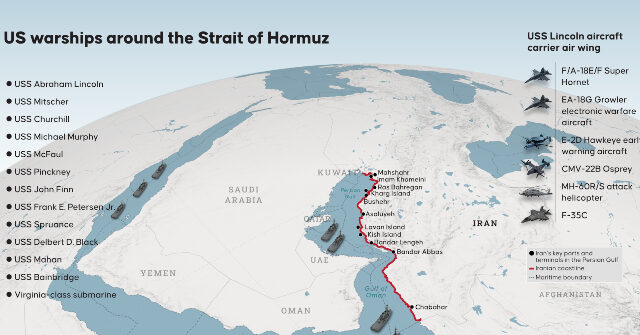
U.S. Central Command (CENTCOM) said over 10,000 American sailors, airmen, and Marines are involved in the blockade, working from over a dozen warships. In addition to enforcing the blockade, these U.S. forces are “supporting freedom of navigation for vessels transiting the Strait of Hormuz to and from non-Iranian ports.”
“During the first 24 hours, no ships made it past the U.S. blockade and six merchant vessels complied with direction from U.S. forces to turn around to re-enter an Iranian port on the Gulf of Oman,” CENTCOM reported.
As night fell across the Persian Gulf region, CENTCOM posted an image of an F-35B stealth fighter preparing to take off from the USS Tripoli, an amphibious assault ship that resembles a small aircraft carrier:
Ship tracking data showed that three of the eight ships crossing the Strait of Hormuz were tankers linked to Iran, but none of them stopped at an Iranian port, which would have defied the blockade.
The U.S. military issued a notice to mariners that humanitarian cargoes will be exempt from the blockade, but no ships carrying such cargo have attempted to dock in Iran yet. CENTCOM said any other vessel “entering or departing the blockaded area without authorization” will be subject to “interception, diversion, and capture.”
One of the tankers tied to Iran was headed for the United Arab Emirates (UAE), possibly with a cargo of petrochemical products. The second was bound for Iraq, where it is scheduled to load fuel oil on Thursday.
The third tanker, named Rich Starry, is owned by a Chinese company called Shanghai Xuanrun Shipping Co. and is under U.S. sanctions for carrying Iranian cargoes. Its current cargo appears to have been loaded at the port of Hamriyah in the UAE.
BBC analysts said the Rich Starry and another tanker linked to China, the Botswana-flagged Ostria, changed direction after approaching the blockade area. The Rich Starry wound up making a complete U-turn later on Tuesday and sailed back into the Persian Gulf. The Botswana set sail from the UAE, approached the Strait of Hormuz, but then reversed course.
A bulk carrier linked to Iran named Christianna reportedly unloaded corn at the Iranian port of Bandar Imam Khomeini on Monday, but the unloading appears to have occurred shortly before the blockade went into effect, and might have been allowed under the humanitarian exemption.
Another tanker under U.S. sanctions, the Elpis, “passed the strait heading east on Tuesday and may have come from the Iranian port of Bushehr.” The Elpis is carrying 31,000 metric tons of methanol, loaded at Bushehr on March 31, long before the blockade was imposed.
The U.S. Treasury Department granted a temporary license for Iran to sell cargoes that were loaded aboard ships in March to ease the oil shock from the loss of Iranian supply. Depending on exactly when it was loaded, the cargo of the Elpis could be covered by this license.
Sanctions-evading “shadow fleet” tankers have a habit of broadcasting false identification and position data to confuse their movements. Some of their captains might be having second thoughts as they approach the American blockade line, uncertain as to whether their “spoofing” tactics will fool a squadron of high-tech American warships patrolling a relatively small area at the mouth of the Strait of Hormuz.
China issued its strongest denunciation of the blockade to date on Tuesday, calling it a “dangerous and irresponsible move” that would “aggravate confrontation, escalate tension, undermine the already fragile ceasefire and further jeopardize safe passage through the Strait of Hormuz.”
“China believes that only a complete ceasefire can fundamentally create conditions for easing the situation,” Chinese Foreign Ministry spokesman Guo Jiakun said. “We urge relevant parties to honor the ceasefire agreement, stick to the direction of peace talks and take concrete actions to deescalate the situation so that normal traffic via the Strait will be able to resume as soon as possible.”
Read the full article here