


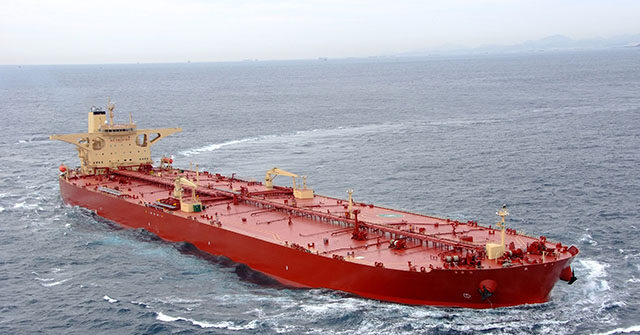
A supertanker named Yuan Hua Hu that is registered to China’s state-owned COSCO shipping company appears to have safely transited the Strait of Hormuz on Wednesday, carrying an estimated two million barrels of Iraqi crude oil.
The Yuan Hua Hu is classified as a Very Large Crude Carrier (VLCC), which means it could carry at least two million barrels of oil. Some ships in the VLCC class can transport over seven million barrels. They are among the largest ships in the world, typically over 300 meters in length – so large that they cannot berth at conventional docks but instead accept and discharge their cargoes through pipe islands that extend into deep water.
Such huge and slow-moving ships are easy targets for terrorists and pirates, such as the Islamic Revolutionary Guard Corps (IRGC) of Iran, which has largely closed the Strait of Hormuz by attacking civilian ships that attempt to pass through the vital waterway. Only two other Chinese supertankers have managed to cross through the strait since the U.S. conflict with Iran began on February 28.
Ship tracking services Kpler and LSEG said the Yuan Hua Hu has been trapped in the Persian Gulf for over two months. It loaded a cargo of almost two million barrels of medium crude oil from the Basrah terminal in Iraq in early March and has been stuck in the gulf ever since.
Early Wednesday morning, the supertanker headed into the Strait of Hormuz, passing the Iranian island of Larak on the eastern side of the strait.
According to ship trackers, the Chinese supertanker exited safely from the Strait of Hormuz on Wednesday and is now anchored off the coast of Oman, close to the U.S. Navy force that is blockading Iran’s ports.
Registration data for the Yuan Hua Hu indicates it is owned by COSCO Shipping Energy Transportation and was chartered to deliver Iraqi oil by Unipec, which is the trading arm of Chinese state oil firm Sinopec.
It was not clear if China paid a ransom or toll to Iran for safe passage. If so, the incident could complicate President Donald Trump’s visit to Beijing, where he is scheduled to meet with dictator Xi Jinping over the next two days. The Trump administration has threatened to impose heavy sanctions against any country that pays Iran for passage through the strait, insisting that Tehran has no right to control the waterway, and it must be open to all international shipping.
A second Chinese ship, the vehicle carrier Xiang Jiang Kou, also passed through the Strait of Hormuz on Wednesday.
Ship trackers analyzed satellite data to determine that the Yuan Hua Hu and Xiang Jiang Kou were both broadcasting the message “CHINESE VESSEL AND CREW” through their Automatic Identification System (AIS) transponders as they passed through the strait.
Read the full article here