






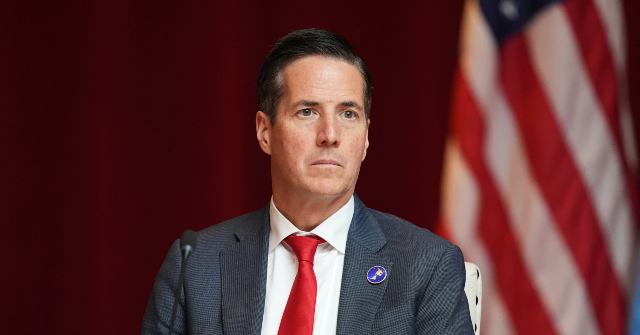
Chinese state media is fuming over Sen. Bernie Moreno’s (R-OH) plans to expand the U.S. ban on Chinese vehicles.
Moreno previewed his plans this week, calling for “no Chinese autos on American roads. Period.” Per Reuters, Moreno’s proposed legislation would “toughen a U.S. government ban on Chinese automakers.”
The Chinese government is, predictably, displeased. The state-run Chinese outlet Global Times quickly appealed to a Chinese “expert” who claims the ban would be difficult to implement. The outlet also mocked U.S. concerns over national security, writing, “A Chinese expert said the move reflects a broader tendency among some U.S. officials to stretch the concept of so-called national security as a political maneuver.”
“The proposal would be extremely difficult to implement in practice, as today’s global automotive supply chain is deeply interconnected, the experts said,” the Global Times wrote, also quoting Zhou Mi, a senior research fellow at the Chinese Academy of International Trade and Economic Cooperation.
“By citing so-called national security concerns, the U.S. is essentially overstretching the concept of security and instrumentalizing economic and trade issues… Such an approach lacks sufficient evidence and deviates from the fundamental principles of market competition,” he stated.
The outlet also asserted that there is “continued appeal of Chinese cars among U.S. consumers,” citing a survey indicating that nearly half of U.S. consumers rate Chinese cars as “having very good or excellent value.”
China’s CarNewsChina magazine also put a spotlight on Moreno’s proposal, claiming it was coming near a “delicate diplomatic moment,” as President Donald Trump is expected to meet with Chinese dictator Xi Jinping in May.
Additionally, the Chinese Embassy in Washington, DC, spoke out, accusing the U.S. of engaging in “trade protectionism” and of setting up “obstacles including discriminatory subsidy policies to obstruct access to the U.S. market by Chinese-made cars.”
The embassy ultimately accused the senator’s proposed legislation of violating the “principles of a market economy and fair competition,” stressing China’s opposition.
The proposal follows actions taken last year under the Biden administration, implementing tougher restrictions and thereby effectively banning Chinese automakers from selling in the U.S., banning their technology in passenger vehicles. Then-Commerce Secretary Gina Raimondo pointed out at the time that vehicles are far more advanced than they used to be, essentially acting as computers with GPS and tracking technology. In other words, the U.S. seeks to stop the potential for mass data collection by the Chinese Communist Party (CCP).
“Cars today aren’t just steel on wheels — they’re computers,” Raimondo explained, deeming the move to ban this technology from passenger vehicles a “targeted approach to ensure we keep PRC and Russian-manufactured technologies off American roads.”
Moreno, however, hopes that his proposal would effectively prevent a single Chinese automobile from ever entering the country.
Making remarks at an Automotive Forum, Moreno previewed a future where there is “never a scenario where a Chinese automobile will enter our market” — putting the kibosh on partnerships as well as Chinese hardware and software in this industry.
“There will not be a Chinese automobile here,” the Ohio Republican said, expressing hope that other countries will follow suit, economically weakening the Chinese Communist Party’s (CCP) economic influence globally.
“And what I’m hoping is that Latin America, Mexico, Canada, and Europe, adopt our same standards now,” the senator said.
He added, “We don’t allow Huawei to come into our telecommunications infrastructure. We’re not going to allow Chinese automakers into this market… We’re going to prevent the cancer from coming into our market, and we’re going to need the other countries to do chemotherapy.”

The news of Moreno’s upcoming legislation comes on the heels of Breitbart News’s event highlighting the threats of Chinese influence in the country.
The event featured Sen. Jim Banks (R-IN) as one of several featured guests who spoke about the different facets of Chinese influence in the country and the dangers it carries. Banks, for instance, pointed to President Donald Trump’s “Donroe Doctrine,” praising the president for essentially letting China know that it is not welcome in our backyard.
“President Trump is the first president of our lifetime that’s taken the China threat seriously,” Banks said, later adding, “He rewrote the national security strategy to reorient our military priorities around China and made up a lot of ground, and made up for a lot of mistakes that previous presidents — Republican and Democrat — had made to strengthen China’s hand over the United States.”

Similarly, Sen. Tom Cotton (R-AR) pointed to Chinese influence in the pharmaceutical sector, pointing out that it should not greenlight Chinese drugs while drowning American companies in red tape.
“Unfortunately, again, China, using illegitimate means, has a lot of the pharmaceutical market cornered. Many of our — not, not super high end cutting edge drugs, but just very basic medicines like ibuprofen and acetaminophen, penicillin, heparin,” Cotton said, noting that China “has cornered the market on that over the decades.”
“That’s a dangerous place to be,” he said.
Speaking on similar topics, Ambassador Jeffrey Gerrish warned that the biopharmaceutical sector is vulnerable to weaponized Chinese supply chain dominance and thereby poses a national security threat.
Raul Lopez, founding member and board vice president of RX Border Defense and co-founder and chair of Latinos for Tennessee, added this: “You know, in my lifetime, when I was young, it was Russia… Communism wants to take over the world. That’s the bottom line, and they want to be the number one world power. And back in my day with Russia militarily — what China does now is do it through the economy and through culture, and they want to basically take over America without even firing a single bullet.”
Read the full article here


