






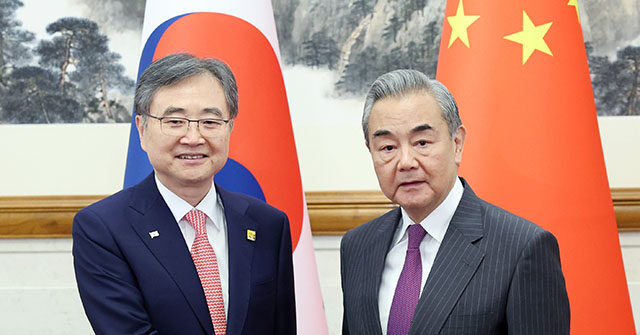
The South Korean Foreign Ministry announced on Tuesday that Chinese Foreign Minister Wang Yi will visit Seoul on Wednesday and Thursday — only a few days after President Donald Trump ordered a substantial reduction of joint military exercises with South Korea, slammed the South Korean government for refusing to help with the Iran crisis, and praised North Korea as “unthreatening and respectful.”
Korea Joongang Daily (KJD) reported that Wang will hold one-on-one meetings with his opposite number, South Korean Foreign Minister Cho Hyun, to discuss areas of “mutual concern.”
RELATED VIDEO — Trump Claims China Sought to Pay Anti-Trump Journalists to Smear Him:

Following a dinner banquet on Wednesday night, Wang is scheduled to pay a “courtesy call” on leftist South Korean President Lee Jae-myung at his official residence of Cheong Wa Dae, also known as the “Blue House.”
Wang will then have lunch with South Korean National Security Adviser Wi Sung-lac to “discuss issues of mutual interest, including the security situation on the Korean Peninsula, and other international issues,” according to KJD.
The South China Morning Post (SCMP) saw Wang’s visit as China’s effort to exploit the diplomatic opening created by Trump’s snub of the South Koreans — and possibly a broader effort to reel in Southeast Asian nations who might conclude they need to make their peace with Beijing, because the United States will not reliably protect them against Chinese territorial aggression.
WATCH — Mike Waltz: We Have to Rely on Domestic Manufacturing for Our Defense:
In his statement about reducing the scope of joint military exercises with South Korea, Trump praised his “very good relationship” with North Korean dictator Kim Jong-un and endorsed the longstanding North Korean complaint that joint U.S.-South Korean exercises are “totally inappropriate and hostile.”
Trump went as far as suggesting he would have rather canceled the 11-day Ulchi Freedom Shield exercise with South Korea entirely, but it was “too late to cancel,” so he instructed Secretary of War Pete Hegseth to scale the exercise back.
The Blue House responded diplomatically, expressing its hope that “the friendly relationship between the US and North Korean leaders will lead to meaningful dialogue between the two countries, opening discussions aimed at advancing peace and stability on the Korean peninsula.”
The Blue House also hoped the U.S. and South Korea would continue coordination on military exercises and defense affairs.
Korean affairs experts told the UK Guardian on Monday that Trump’s announcement was unlikely to placate North Korea, which wants all joint U.S.-South Korean exercises to be canceled completely, not just scaled back. Some feared South Korea might turn to China as the only possible guarantor of their security against the erratic North Korean regime.
“The cost savings from downsizing drills are marginal, while the diplomatic benefits for relations with North Korea are doubtful,” said Leif-Eric Easley, professor of international studies at Seoul’s Ewha Womans University.
Easley added that downsizing operations like Ulchi Freedom Shield could “slow the process of South Korea taking on greater responsibility for its own defense, and weaken deterrence against possible conflicts in Asia.”
Complicating the political picture for Seoul is that President Lee’s left-wing government is officially in favor of improving relations with North Korea, so Lee has little objection in principle to what President Trump said, perhaps aside from his scolding about not doing enough to help with Iran.
RELATED VIDEO — If China Wins the AI Race, They Will Export Repressive Technology Worldwide:
Lee gave a speech on Saturday – which was commemorated as Liberation Day in South Korea, the day the Allies liberated the Korean peninsula from Japanese occupation at the end of World War II – in which he proposed direct talks with Pyongyang to formally end the Korean War.
“Last year, I used this occasion to express my respect for the North Korean system and my commitment not to engage in any hostile behavior or pursue any kind of ‘unification by absorption.’ Today, one year later, I want to offer a blueprint for putting those fine-sounding ideas into practice,” Lee said on Saturday, sounding not terribly different from Trump.
“Both North and South should cease unnecessary confrontations and show their respect for each other. To do so, the two Koreas should reduce hostility in how they view each other’s perceptions, norms and systems. I hope South and North can sit face-to-face and achieve peaceful coexistence and shared growth,” he said.
“Peace on the Korean Peninsula will bring about stability and cooperation in Northeast Asia and become a milestone on the path to a world without nuclear weapons. We will provide hope and possibilities in a world plagued by conflict. We will end the war and embark on a journey to replace the precarious armistice of the Korean Peninsula with secure and lasting peace,” he declared.
The Korean War, which began in 1950, was technically suspended by an armistice in 1953, but has never formally been concluded. Lee, like every dovish South Korean leader before him, hoped to replace the “unstable armistice system” with a durable peace treaty.
To date, North Korea has not responded to any of Lee’s peace overtures. President Trump hinted on Monday that Kim Jong-un has responded positively to his order to scale back the U.S.-South Korea military exercise.
“You see, I’m actually making it much safer. Kim Jong-un has always treated me with great respect. I understand him. He understands me,” Trump said.
Read the full article here


