








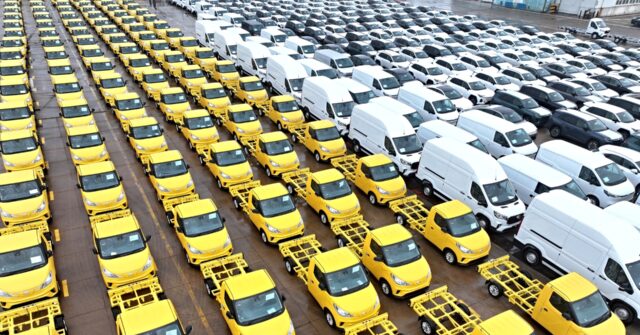
Chinese customs data reviewed by the Berlin-based Mercator Institute for China Studies (Merics) this week showed China’s total monthly automobile exports surpassed one million for the the first time in June.
According to Merics analysts, China’s trade surplus grew more than expected overall and vehicle exports were exceptionally strong, driven by low-cost electric vehicles (EVs) and hybrids produced by top Chinese brands like BYD. Much of this export surge was directed to European customers.
The UK Guardian noted on Tuesday that the European Union (EU) imposed protective tariffs on Chinese EVs in 2024, but not hybrids, which opened the door for China’s big manufacturers to dump unsold inventory into European markets.
The flood of Chinese cars is crushing European automakers like Volkswagen, which is on the verge of shutting down several plants, and firing 100,000 of its 670,000 employees, in a desperate bid to downsize.
Even China’s own trade surplus projections underestimated the growth of its exports to Europe, which swelled to almost $320 billion in U.S. dollars, almost $7 billion more than anticipated.
Chinese exports to the European Union were up by 12.7 percent year-on-year in June, yielding a trade surplus of over a billion dollars a day.
“The country’s high export figures have been partly attributed to continued suppressed domestic demand, fuelling fears of the impact of what many have described as China Shock 2.0, a repeat of the exports surge in the 2000s to the U.S.,” the Guardian reported.
China Shock 2.0 is a theory that says China’s massive overproduction, coupled with a steep decline in domestic demand, left Chinese firms with huge inventories of various goods that could be sold to other countries at fire-sale prices.
At the same time, Chinese industries have grown less dependent on foreign imports, so China’s imports are collapsing almost as fast as its exports are growing, leading to gigantic trade surpluses like the one Merics charted in Europe.
This is coupled with crumbling resistance to Chinese manufacturing dominance in sectors like Europe, which no longer believes it can compete with China or protect what remains of its domestic manufacturing sector. European consumers want the cheap goods China can provide, and they exhibit increasingly less moral or patriotic resistance to doing business with the genocidal tyrants of Beijing.
As Merics mused in a January analysis, the EU might actually have become more willing to link its economic future to China than the United States and China has been carefully cultivating that attitude, capitalizing on European frustration with President Donald Trump’s trade policies. Canada and South Korea may also be following a similar path into China’s orbit, hindered only by Beijing’s arrogance and hectoring.
China’s overseas trade was projected to grow by 18 or 19 percent by June 2026, but it actually grew by 27 percent – a surge that may rattle some European policymakers, but it might also be too late for them to do anything about it.
China is now exporting an astounding 24 percent of its manufacturing output. Its vehicle exports skyrocketed by 72 percent in the first half of 2026, even as domestic auto sales cratered by 26 percent. Chinese corporations know they must export heavily to remain competitive, and China now has enough muscle to defeat all but the most determined Western efforts to protect domestic industries. A tidal wave of exports like China Shock 2.0 will be very difficult to stop, and it is not clear that Europe really wants to stop it, even if some legendary brands like Volkswagen are swept away.
Read the full article here


