







Xi’s Cairo visit tied trade, the Suez, Africa and Gulf stability to Beijing’s bid to build a post-Western regional order
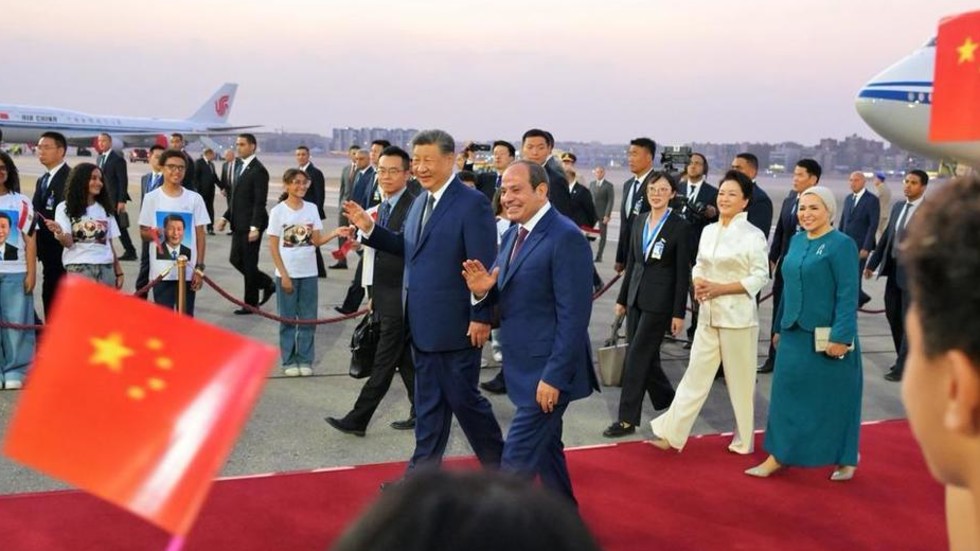
Xi Jinping’s state visit to Egypt, which began on September 1, was his first in a decade and coincided with the 70th anniversary of diplomatic relations between the two countries.
During his meeting with Egyptian President Abdel Fattah el-Sisi, Xi called on Middle Eastern states to become masters of their own destiny, resist outside interference, and discuss a new regional security architecture. Beijing and Cairo agreed to deepen cooperation on security and counterterrorism, develop projects with data centers, semiconductors, and critical minerals, and expand the use of national currencies in bilateral trade. The relationship is moving beyond conventional trade and infrastructure into sectors that will shape economic sovereignty for decades.
The agenda fell within China’s familiar formula – development, state sovereignty, and fairer global governance. Beijing increasingly presents itself as a voice for the global majority and the Global South, where many countries associate today’s instability with Western hegemony, US sanctions, and decades of attempts to reorder other regions by force. Wars, regime change campaigns, economic blockades, and the division of states into “acceptable” and “unacceptable” have brought the Middle East neither lasting peace nor promised prosperity. Instead, they have created zones of chronic conflict, and made dependence on foreign patrons a source of regional vulnerability.
Beijing offers a different model of engagement, built around infrastructure, trade, investment, and recognition of every state’s right to choose its partners and development path. China is not doing this out of charity – its policies serve the world’s largest industrial economy, which needs export markets, secure transport corridors, and reliable access to raw materials. Even so, many countries in the Global South find it more attractive than a Western approach often accompanied by political conditions, sanctions threats, and demands to accept an external hierarchy of priorities. Chinese investment can also create debt as well as technological, and trade dependencies, but it rarely entails overt supervision of a partner’s domestic order. That distinction allows Beijing to work with very different governments that share a desire for greater freedom of action.
Xi’s visit to Cairo is thus a part of a broader Chinese initiative to strengthen ties with countries seeking a multipolar order and to set constructive interdependence against the destructive effort to preserve a unipolar system. Egypt occupies a special place in this strategy – it is simultaneously an Arab, African, and Mediterranean power, capable of anchoring China’s presence across several regions at once.

Egypt: China’s gateway to Africa
For China, Egypt offers a rare combination of strategic advantages. With a population of more than 110 million, it has a large domestic market, controls the Suez Canal, carries considerable political weight in the Arab world, and provides direct access to African markets. One of the principal maritime routes between Asia and Europe passes through Suez, making Egypt’s stability directly relevant to the security of Chinese foreign trade. Cairo is becoming a bridge between the Middle East, the Mediterranean, and Africa, where China has steadily expanded its economic and political influence.
China–Africa trade reached a record $348 billion in 2025, while Beijing’s removal of tariffs on imports from 53 African countries strengthened its position just as the US was returning to protectionism. Africa’s importance to China goes well beyond mineral resources. Its rapidly growing population needs roads, power plants, ports, telecommunications, and industry – all areas in which China has extensive capacity. By building infrastructure and manufacturing hubs, Beijing opens markets for Chinese companies, embeds long-term commercial ties, and converts economic presence into political capital.
Egypt is particularly important because of the Suez Canal Economic Zone, which, according to the Egyptian government, has already attracted around $4 billion in Chinese investment. Chinese companies are involved in port and railway development, construction of the New Administrative Capital, pipe and tire manufacturing, green energy projects, and satellite production. Total accumulated Chinese investment in Egypt exceeds $10 billion, while bilateral trade reached a record $20.79 billion in 2025. In the first half of 2026 alone, trade rose by a further 21.5% to $11.3 billion. Egyptian exports to China roughly tripled over the same period, although their absolute value, at $840.8 million, remained far below the volume of Chinese goods flowing in the opposite direction.
This imbalance remains the main economic contradiction in the partnership. Egyptian imports from China reached roughly $10.4 billion in the first half of the year, and Cairo cannot remain merely a market for Chinese products. It must move from importing finished goods to localizing production, securing technology transfers, creating jobs, and integrating Egyptian companies into transregional value chains. If Chinese industrial zones support component manufacturing, workforce training, and exports to Africa, the Arab world, and Europe, the partnership will become more balanced. Otherwise, impressive figures will continue to conceal dependence on foreign supplies and a persistent trade deficit.
China’s presence also broadens Egypt’s room for manouver in foreign policy. Cairo receives approximately $1.3 billion in US military assistance each year and remains close to Washington while developing ties with China, Russia, and BRICS. El-Sisi calls this a strategic balance, reflecting the Global South’s wider desire to diversify partnerships and escape junior status within a Western-led system. Beijing supports that choice, because every industrial project, logistics terminal, or yuan-denominated transaction turns multipolarity from a slogan into material reality.


The limits of neutrality
The Middle East’s importance to China is most clearly expressed in numbers. Trade between China and the Arab states reached $407.4 billion in 2024, with Chinese exports accounting for $206 billion and imports for $201.4 billion. Behind this apparent balance lies a critical energy dependence. In 2025, the Middle East supplied around 52% of China’s oil imports, or approximately 1.9 billion of the 3.6 billion barrels it purchased abroad. Six Arab suppliers in the Gulf provided 42% of all Chinese oil imports: Saudi Arabia accounted for 14%, Iraq 11%, the United Arab Emirates 7%, and Oman 6%. The region also supplied nearly one-third of China’s liquefied natural gas imports, most of it from Qatar.
For China, stability in the Middle East is an economic necessity. Rising oil prices increase industrial and transport costs, while any threat to the Strait of Hormuz affects several major suppliers at once. The Red Sea and Suez Canal are equally important: disruption forces ships around Africa, lengthening delivery times and raising insurance costs, especially for China-Europe trade. Beijing is diversifying suppliers, developing pipelines, building strategic reserves, and accelerating its shift to renewable energy, but it cannot quickly replace Middle Eastern supplies without substantial costs.
Iran occupies a distinct place in this equation. According to estimates by the global trade analysis company Kpler, China imported around 1.38 million barrels of Iranian oil per day in 2025, equivalent to roughly 12% of its total oil imports. Sold at a discount of about $8-10 a barrel, Iranian crude remains an attractive resource for Chinese industry, while Beijing’s purchases provide vital support to an Iranian economy under sanctions. Yet Saudi Arabia and the UAE are far more important to China in terms of overall trade. In 2025, Chinese trade with each country reached approximately $108 billion, compared with an estimated $41 billion with Iran once unrecorded oil shipments are included.
Beijing maintains a strategic partnership with Tehran, exceptionally close relations with Pakistan, expanding ties with the Gulf monarchies, and support for Palestinian statehood, while avoiding commitments that could draw it into a regional war. Chinese diplomacy aligns with Iran in opposing external military pressure and unilateral sanctions, and with the Arab majority in supporting an independent Palestinian state. At the same time, economic interdependence compels Beijing to maintain working relations with every major regional actor, including Israel.
Beijing has neither sent troops to defend Tehran against the US and Israel nor turned the relationship into a military alliance. It prefers diplomacy and trade, and refuses to recognize unilateral restrictions. China seeks not one regional power’s triumph, but an equilibrium that safeguards commerce, keeps maritime routes open, and prevents an outside hegemon from determining the region’s future.
Regional security without a new hegemon
The final element of China’s proposition concerns global and regional governance. Xi has urged Middle Eastern states to determine their region’s future and limit external interference – an appeal that has found a receptive climate.
The Gulf states, Egypt, and Türkiye continue to cooperate with the US while expanding ties with China, Russia, India, and one another, because recent experience has exposed the risks of excessive reliance on US security guarantees. Washington still commands the region’s largest network of bases and alliances, yet this power has failed to produce durable order and has often accompanied new wars and divisions.
The Mecca joint defense agreement signed by Saudi Arabia, Türkiye, and Pakistan on August 7 expressed this desire for greater autonomy. It establishes that an armed attack on one member will be regarded as an attack on all, although practical mechanisms remain undefined. Egypt’s possible accession would give the grouping far greater political and military weight. Beijing views its underlying logic favorably as regional responsibility, diversified partnerships, and reduced external dependence accord with China’s understanding of multipolarity, while Pakistan links the emerging framework to one of Beijing’s closest partners.
It would nevertheless be wrong to cast China as a selfless champion of the Global South or a future replica of the US. Beijing pursues its own interests and uses its economic scale to promote Chinese companies, standards, and currency. Its instruments, however, are different. Beijing does not organize regional policy around regime change, divide partners by ideology, or build military protectorates. Nor is it prepared to replace the US as an all-encompassing security guarantor or immerse itself in the region’s religious, national, and dynastic rivalries.
China’s influence is growing by other means: trade, investment, technology, ports, energy contracts, diplomatic mediation, and support for the autonomy of regional powers. This strategy has already produced tangible results. Saudi Arabia and Iran restored relations through Chinese mediation in 2023; BRICS expanded; China-Arab institutions grew stronger; and the gradual shift towards settlement in national currencies began. None of these developments alone will displace the dollar or erase Western military and political influence. Together, however, they are weakening one center’s monopoly on writing the rules.
Xi Jinping’s visit to Egypt marks the next stage of that process. China remains cautious about the use of military power, but its expanding economic presence is increasingly translating into political influence. Its ability to engage simultaneously with Iran, the Arab monarchies, Egypt, Türkiye, Pakistan, Palestine, and Israel makes Beijing a natural participant in any future regional security system. For the global majority, what matters is the principle embodied in this presence: a major power that does not demand unconditional loyalty, but helps broaden the choices available to the states of the Global South and reinforces their sovereignty.
That is why China’s approach is increasingly regarded across the region as a substantial counterweight to US-led Western hegemony. This is not simply about replacing one global leader with another, but about creating an order in which no power can impose its will on everyone else. Egypt, linking Asia, Africa, and the Mediterranean, can become one of its pillars. Xi’s visit shows that multipolarity is ceasing to be a diplomatic abstraction and is acquiring infrastructure, trade routes, financial mechanisms, and political agency.
Read the full article here


