




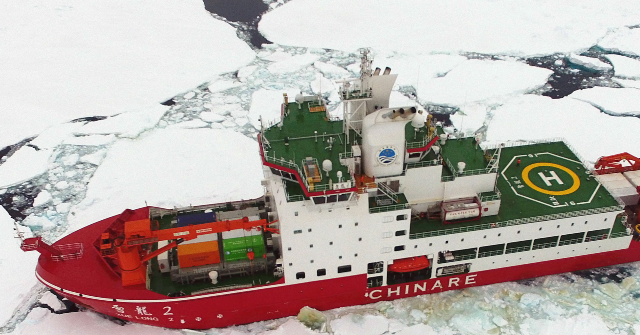
A Chinese shipping company called Sea Legend is reportedly opening an “Ice Silk Road” shipping lane through the Arctic to avoid the volatile Middle East and chokepoints like the Strait of Hormuz.

When the weekly service begins, Sea Legend will become the first company to offer regular container shipping through the Arctic.

The Financial Times (FT) reported on Monday that Sea Legend’s route will “skirt the north Russian coast on its journey between Ningbo on China’s east coast and Felixstowe in the UK.”

“The voyage will cut the usual 40-day sailing time between the two ports by about half, depending on the conditions in the Arctic Circle. The move follows a record 23 transits through the Northern Sea Route last summer, up from 15 voyages in 2024,” FT noted.

The Arctic passage is relatively difficult and expensive and, of course, it becomes even more so during winter’s heavy ice conditions, but unrest in the Middle East has made traditional shipping routes through the Persian Gulf and Red Sea unreliable.

Iran is attacking international shipping in the Strait of Hormuz, which links the Persian Gulf with the Gulf of Oman, while Iran’s terrorist proxy in Yemen, the Houthis, does the same in the Red Sea. Iran and the Houthis have proposed schemes to extort ransoms from ships using the two major regional chokepoints, the Strait of Hormuz and the Bab el-Mandeb Strait.

Both Iran and the Houthis have suggested their patrons in China, the leading power in the emerging Axis of Tyranny, would receive discounts or waivers from these ransom demands, but the Chinese do not seem inclined to trust their Islamic extremist clients.

The Arctic route would theoretically put shipping at the mercy of the Russians, who control the routes China wants to use, but the Russians make for less unpredictable partners.

The other major factor that has kept worldwide shipping companies from making heavier use of the Arctic is environmental concerns, which weigh much more heavily upon European minds than China’s. Environmentalists are worried about oil spills and climate change, although on the latter point, shipping experts have noted that using the shorter Arctic route would mean lower carbon emissions from massive cargo ships.

The Financial Times noted that demand for icebreaker vessels has reached its highest level in over a decade, suggesting a variety of shipping interests are taking a fresh look at the Arctic route, even though it has an unsurprisingly high rate of navigational problems and mechanical failures due to the extremely cold climate.

The “Polar Silk Road” concept did not originate with Sea Legend’s marketing department. The term first appeared in 2017 as the name of an ambitious plan for exploiting the Arctic’s resources, including shipping lanes that would tie into China’s Belt and Road Initiative (BRI). BRI was originally billed as an effort to rebuild the fabled Silk Road trade route of antiquity.

The Polar Silk Road flourished in the imaginations of Chinese planners after Chinese ships demonstrated the ability to navigate the largest polar sea routes. China does not have any border territory in the Arctic, a problem that was always likely to be solved by working with Russia.

Interestingly, China’s early interest in polar transit was driven by the desire to reduce Beijing’s dependency on a strategic choke point, but it was not the Strait of Hormuz or Bab el-Mandeb that worried the Chinese in 2017 — it was the Strait of Malacca, which is bordered by Indonesia, Malaysia, and Singapore. The Strait of Malacca has lately appeared in anxious discussions about the ramifications of Iran seizing control of the Strait of Hormuz, because the three powers administering the Strait of Hormuz might follow Iran’s lead and begin extorting fees from shipping.

The Polar Silk Road seemed to slip off China’s agenda after Russia invaded Ukraine in 2022, possibly because China was worried about triggering secondary sanctions imposed on the Russians by the U.S. and Europe, or because Beijing feared Moscow would be too distracted by the Ukraine war to hold up its end of such an enormous polar undertaking.

Documents from Chinese government planning sessions made it clear Beijing never gave up on its ambitions for the Arctic, and the growing risks and costs of using Middle Eastern trade routes could be making the heavy investments needed to exploit Arctic trade routes look like reasonable investments.

Read the full article here

Share.
Leave A Reply

Exit mobile version