




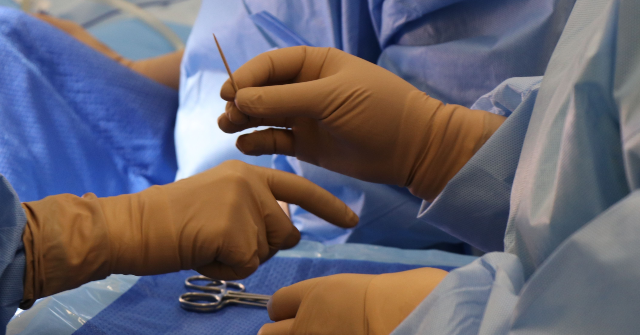
Neuroscientist Qiu Zilong of Shanghai Jiao Tong University is under investigation following the death of a six-year-old girl who was receiving gene-editing therapy during a human trial under his supervision.
The child was administered an experimental treatment that involved injecting “trillions of viruses carrying the recipe for the base editor into her spinal fluid,” according to a report in Science magazine.
Science told the heartbreaking story of how the girl bounced into Xinhua Hospital in Shanghai in March 2025, wearing “a pink jacket and blue pants decorated with cartoon bears.” She treated her visit to the hospital as if it were a vacation and her parents were confident she would receive the best of care at the hospital’s acclaimed pediatrics ward.
The child was suffering from a genetic mutation that was interfering with her cognitive development. The experimental cure involved using a gene editor — similar to the fabled CRISPR, but more advanced — to rewrite the mutated gene in her nervous system. The little girl became the first human being to undergo gene-editing therapy for her brain, an experimental procedure that cost over $860,000.
The details of what happened next have been kept secret until now by the arrogant Chinese Communist tyranny, which is very eager to displace the United States as the world’s leading biotech power.
According to research by Science and Retraction Watch, a watchdog group that follows up on failed experiments and retracted scientific research, the hospital used a fast-track bureaucratic procedure that bypassed national regulations and Qiu and his team severely undersold the risks of the procedure to the girl’s parents. When the truth was finally revealed, international experts said the negative reactions observed during animal testing should have prevented the experimental treatment from advancing to human trials.
The process of gene editing involves using tailored viruses to deliver the altered genetic material to a patient’s cells — and the little girl had a fatal immune reaction to the bewildering cocktail of viruses injected into her spinal column. She died seven days after entering the hospital.
A hideous cover-up ensued, erasing all mention of the little girl and her fate from experimental literature. Most shockingly, Qiu and his team published an article about the animal studies in their gene-editing trial at Nature this year, but without telling the full story of the human child who died from the treatment or the enormous financial contributions her family made to the research.
Science noted that the hospital paid only a “modest fine to a local health authority” after the death of the child and Qiu was not publicly sanctioned until now. The girl’s parents said they came forward due to their anger at the lack of accountability although they still felt it was necessary to use pseudonyms.
“Learning the reality of these missing safeguards has fundamentally changed how we now view the entire project. We did not realize how unusual and dangerous many of the arrangements were,” said the girl’s father, a software engineer who asked to be called “Jason” in the story.
Dr. Qiu was another in a series of Chinese scientists who came to the United States for an education, then returned to Communist China in 2009, “as China was ramping up its efforts to lure its scientists back home.”
Qiu was, somewhat ironically, an outspoken critic of “rogue geneticist” He Jiankui’s experiments using CRISPR to create genetically engineered human babies, but he still felt there was great potential in using gene editing techniques to address neurological disorders. His papers and video presentations caught the attention of “Jason” and his wife, who emailed the doctor in 2023 to say they were “willing and able to bear the costs” of getting his experimental treatment for their child. He responded to their inquiry in thirteen minutes flat.
Over the course of the next two years, Jason said he came under increasing pressure to pump money into the research, sometimes in dubious ways, such as paying members of his research team directly and informally.
The cost of the treatment increased dramatically and Jason was told that if he stopped providing the funds, everything he had already paid would be for nothing. Chinese law forbids charging patients or their families for unproven therapies, but this prohibition was circumvented by treating the huge sums provided by Jason’s family as “contributions” to advanced medical research.
Jason and his wife recorded all of their conversation with Qiu and other researchers, so they had a mountain of evidence to bring to the table when they decided to go public.
The general consensus from Science and its researchers is that serious medical work was conducted. The research was not a scam operation and Qiu does not appear to have taken any great portion of the money for himself, although he accepted some lavish gifts from the family. The researchers appeared to be reckless, disregarding evidence that their experimental treatment was dangerous and failing to take some precautions that might have been helpful, such as using more powerful preparatory drugs to suppress the little girl’s immune system.
Science and Retraction Watch referred to the case of “Baby KJ,” a Philadelphia boy named KJ Muldoon with a rare life-threatening metabolic condition that was saved by the world’s first personalized gene-editing treatment in 2025. Baby KJ’s landmark treatment and recovery were the kind of success Jason wanted for his child which Qiu evidently thought he could provide.
Jason referred to his child as “Mei,” a Chinese word that means “beauty.” The last week of her life was a terrible ordeal as her immune system fought to the death against the gene-editing viruses and lost. She began running a fever that Dr. Qiu confidently, and incorrectly, predicted would pass. Her kidneys failed, so she could not have any fluids. Qiu seemed baffled by her deteriorating condition.
In the aftermath of Mei’s death, her parents asked Qiu not to publish the paper he had been excitedly preparing for Nature, but he did it anyway — after removing the genetic data collected from Mei and her family and deleting a message of thanks to them.
Some of the international scientists who were excited by Qiu’s paper were later angry to discover he had already administered the experimental treatment to a young human patient who did not survive. Nature’s editors were annoyed to learn Qiu had not told them the full story before publication.
Qiu’s company had an insurance policy for the medical trial, but Mei’s parents received no settlement. Her shattered parents blamed themselves for not asking enough questions and apparently could not bear to speak with the friends who helped pay for Mei’s treatment.
The South China Morning Post (SCMP) reported on Sunday that Shanghai Jia Tong University has “established a special group to investigate” Qiu’s clinical study and the paper he published at Nature.
“The medicine school has always valued research integrity and standards, and resolutely opposes medical research that violates research ethics and regulations,” the university said.
Read the full article here


