




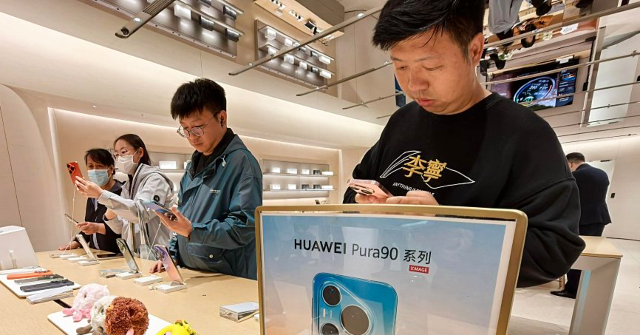
The Chinese communist regime, through its embassy in Panama, accused U.S. ambassador Kevin Marino Cabrera of “denigrating” Huawei and spreading rumors about China after he suggested that Chinese companies like Huawei are not trustworthy.
Ambassador Cabrera spoke this week with the Panamanian newspaper La Prensa about the Panama Canal, tariffs, the extradition of a long-wanted suspect in Hezbollah’s 1994 bombing of a commercial airplane, Panama’s relations with the U.S. and China, and Panamanian cybersecurity, among other subjects. Cybersecurity has gained newfound notoriety in the Central American nation over the past weeks after a series of hacking attacks targeted the nation’s Social Security systems and a Commerce Ministry-operated entrepreneurship platform.
La Prensa asked Ambassador Cabrera about concerns over Chinese technology. The ambassador stated that Chinese technology is not trustworthy and noted that China has avoided signing the 2001 Budapest Convention on Cybercrime. Cabrera emphasized that China is one of the few countries that has not signed the agreement and argued that it is because “they do not want to adhere to the various transparency and security standards for users of this technology.”
“So companies like Huawei and others of that sort are not trustworthy,” Ambassador Cabrera. He suggested using technologies from countries that are signatories to the Budapest Convention, such as the United States, Japan, South Korea, and several European nations, among others.
Cabrera’s criticisms of Huawei appear to have greatly infuriated the Chinese regime, which released a statement via its embassy in Panama to “put things in their right perspective,” claiming that his words lack “common sense” and describing them as a “classic case of ‘the pot calling the kettle black.’”
China, in the statement, accused the United States of being the world’s “largest source of cyberattacks and the so-called ‘hacking empire’” engaged in eavesdropping, surveillance, and large-scale cyberattacks in this region.
The Chinese embassy claimed that China has always been a “staunch advocate of cybersecurity” that “vigorously rejects and combats all types of cyberattacks” and is allegedly committed to working with various countries to strengthen cooperation.
“The U.S. side accuses the Chinese government or Chinese companies of carrying out cyberattacks without ever presenting convincing evidence, which is nothing more than pure political manipulation,” the statement read in part.

For years, Huawei has been criticized for its deep ties with the Chinese communist regime. Several countries — such as the U.S., the UK, and Canada — have banned Huawei-made products over potential security risks that come with using Chinese regime-linked equipment. This week, European Union officials announced that the EU intends to stop funding solar powered energy projects that use Chinese equipment — particularly Huawei-made gear — after several EU member states reported “serious economic and cybersecurity risks” across both classified and non-classified information. In late 2024, Paraguay’s conservative government revealed that, thanks to the help of the United States, a group of Chinese state-sponsored hackers had been successfully identified after infiltrating the Paraguayan government’s networks.
Asked if the United States and Panama have any type of cybersecurity cooperation, Ambassador Cabrera affirmed that the United States is always ready to help its friends, partners, and allies in Panama when asked and will always be there for them, whether it concerns cybersecurity or the Army Corps of Engineers.
On the topic of Panama’s relations with the U.S. and China, ambassador Cabrera pointed out that the decision to hold ties with both countries is Panama’s sovereign choice and something that is is not up to him.
Christian K. Caruzo is a Venezuelan writer and documents life under socialism. You can follow him on Twitter here.
Read the full article here


