




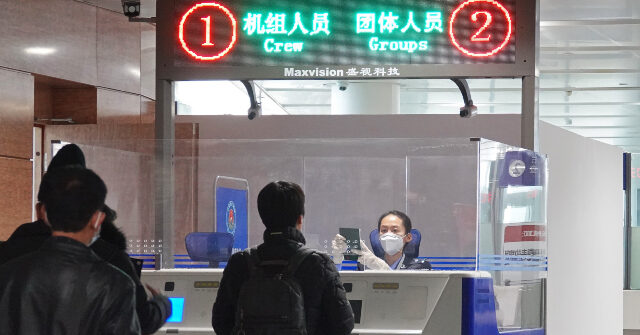
China’s steep new restrictions on travelers going into and out of the country went into effect on Tuesday, granting the communist regime the ability to ban individuals from leaving the country if they have “endangered national security.”
The new rules also grant the Chinese regime the ability to bar nationals from leaving China if they are working in sensitive areas — such as artificial intelligence — in what experts reportedly describe as efforts by dictator Xi Jinping to exert further control over the nation’s tech workers.
The now-active restrictions were originally announced by China’s State Council in late July and signed by Chinese Premier Li Qiang. Reuters detailed that the new rules contemplate exit bans ranging from six months to three years on citizens returning to China if they are deemed to have committed a crime or actions that “harm national security or interests.” Foreigners, on the other hand, may be barred from entering China for between one to five years if they make “false statements” on visa applications.
Immigration experts and analysts explained to the Financial Times that the restrictions will push China back to Mao-era travel limitations that were only loosened by the Chinese regime once it opened itself up to trade. The experts reportedly detailed to the Financial Times that they will also apply to private citizens who are working in areas deemed sensitive by the Chinese regime. Individuals found to be in violation of the travel restrictions face hefty fines and exit bans ranging from three months to an “indefinite” period.
“The result could be a gradual shift back towards a pre-1990s model in which international travel is treated less as an individual right and more as a privilege subject to administrative approval,” Henry Gao, a law professor at Singapore Management University, told the Financial Times.
“Beyond restricting movement, this approach helps keep both people and capital more firmly within the party-state’s sphere of control,” he continued.
Law firm DLA Piper told the Times that China’s new restrictions represent the “most significant” regulations of its kind in more than a decade.
“Export control violations are now expressly linked to exit bans,” the firm said.
Dai Menghao, a trade compliance partner at the international law firm King & Wood, reportedly stressed that while the rules do not single out China’s private sector, it nevertheless grants a clearer route to impose travel bans on Chinese nationals working in private companies. The phrase ‘may endanger,’ as expressed in the regulations, grants China’s authorities “considerable discretion” to exercise the bans.
The Financial Times noted that the new travel restrictions arrived as China is creating a “web of regulations” to counter foreign sanctions and as part of its tech competition with the United States. The Chinese regime imposed travel bans this year on the cofounders of AI tech startup company Manus, preventing them from leaving their country. Weeks later, the communist regime blocked Manus from being acquired by Facebook parent company Meta, who sought to buy the company in a planned $2 billion deal.
China’s state-run propaganda outlet Global Times took note of the reports published by Reuters and the Financial Times on Tuesday, downplaying the restrictive nature of the new regulations and insisting they protect the “lawful rights and interests of exit and entry personnel,” while safeguarding “national sovereignty, security, and development interests.”
Officials from the Chinese Justice and Public Security Ministries, as well as the National Immigration Administration (NIA), described the reports as “misreading and sensationalism” in remarks shared with the Global Times. The NIA affirmed that the “fundamental purpose” of the new restrictions is to “facilitate lawful and normal cross-border travel for the vast majority of people and safeguard the legitimate rights and interests of those entering and leaving the country.”
“The administration stressed that the regulation is by no means intended to impose additional controls or restrictions on ordinary citizens and will not affect normal activities such as overseas tourism, family visits, study or business,” the Global Times wrote.
Christian K. Caruzo is a Venezuelan writer and documents life under socialism. You can follow him on Twitter here.
Read the full article here


