







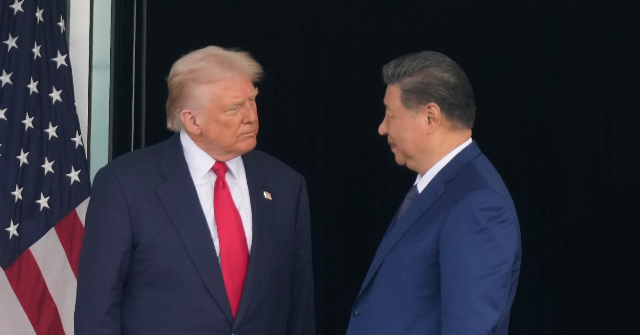
The Chinese Foreign Ministry confirmed on Monday that Beijing expects President Donald Trump to visit from May 13 to 15, spending much of that time in personal exchanges with genocidal dictator Xi Jinping.
The Chinese Communist Party rarely confirms visits by foreign leaders in advance, choosing to wait as late as possible to confirm their visits or, in some cases, their arrivals in real time. President Trump had initially scheduled his visit to China for April, however, and pushed it forward a month as Operation Epic Fury, initially described as a short-term operation to limit the Iranian government’s ability to engage in international terrorism, extended for weeks with no surrender from Tehran.
The Iran war is expected to be a major topic of conversation in China, as Xi Jinping is one of the Iranian regime’s closest allies. China is the world’s most prolific buyer of Iranian oil and has been accused of sharing military technology with Tehran. Iran is also a member of BRICS, an anti-American security and economic coalition largely believed to be led by China. BRICS has essentially become irrelevant to geopolitics, however, as Iran responded to Operation Epic Fury in part by bombing a fellow BRICS member country, the United Arab Emirates.
Chinese Foreign Ministry spokesman Guo Jiakun told reporters on Monday that China considered engagement at a personal level between Xi and Trump “irreplaceable” in the management of the bilateral relationship.
“The two presidents will yet again meet each other in person since their Busan meeting last October,” he observed. “This will be the first visit to China by a U.S. president in almost nine years. President Xi will have in-depth exchanges of views with President Trump on major issues concerning China-U.S. relations and world peace and development.”
“Heads-of-state diplomacy plays an irreplaceable role in providing strategic guidance for China-U.S. relations,” he continued. “China stands ready to work with the U.S. to expand cooperation and manage differences in the spirit of equality, respect, and mutual benefit, and provide more stability and certainty for a transforming and volatile world.”
Guo did suggest any independent topics that Xi was eager to discuss with Trump, though he did take questions on the ongoing American conflict with Iran. China is directly implicated by the conflict as Iran has responded to American attacks by attempting to blockade all commercial traffic in the Strait of Hormuz, a critical global shipping route that supplies much of China’s crude oil and natural gas. While Iran blocks Chinese commerce in the Strait, even while having reportedly assured Beijing it would not hurt its interests, the United States has implemented several rounds of sanctions on Chinese companies buying and refining Iranian oil, also harming the communist economy.
Guo affirmed on Monday that Beijing “firmly opposes” the sanctions on its “teapot” refineries that buy Iranian oil.
“We will firmly protect Chinese businesses’ legitimate rights and interests,” he asserted. The spokesman added that, for China, on Iran, “the pressing priority now is to prevent by all means a relapse in fighting, rather than exploit the situation to throw mud at other countries.”
The Chinese government has nonetheless been firm in demanding that Iran stop blocking traffic in the Strait of Hormuz, a call that Iran is yet to heed at press time. In April, Xi personally demanded that Iran cease its disruptions in a phone conversation with Saudi Crown Prince Mohammed bin Salman, Iran’s biggest regional rival. According to the Chinese Foreign Ministry, Xi insisted that cutting off commercial traffic to Asia conclude as soon as possible.
“President Xi emphasized that China calls for an immediate and comprehensive ceasefire, supports all efforts conducive to restoring peace, and stands for resolving disputes through political and diplomatic means,” the Chinese Foreign Ministry explained in its readout of the phone call. “The Strait of Hormuz should maintain normal passage, as this serves the common interests of regional countries and the international community.”
Beijing, apparently preparing for Trump’s visit, welcomed Iranian Foreign Minister Abbas Araghchi last week. Araghchi met with his Chinese counterpart, Wang Yi, who reiterated the Communist Party’s demand for “restoring normal safe passage through the strait.”
CNBC reported last week that Iran was likely to be a priority issue in talks between Trump and Xi, even as major bilateral issues, such as Trump’s tariffs on Chinese products and limits on Chinese companies buying advanced American technology, remained unsolved. It observed that, according to sources, Trump does not appear to be planning to take a massive delegation of American company CEOs to China, and the White House allegedly “declined China’s invitation to organize industry-specific meetings between senior Chinese leaders and U.S. CEOs, thinking it could make American businesses appear too close to Beijing.”
“Trump is expected to notch deals on Chinese purchases of U.S. soybeans and Boeing airplanes, according to Scott Kennedy, senior advisor and trustee chair in Chinese business and economics at the U.S.-based Center for Strategic and International Studies,” CNBC reported. “Beijing’s focus will likely be on tariffs, Taiwan’s status, and U.S. restrictions on Chinese access to advanced technology.”
Follow Frances Martel on Facebook and Twitter.
Read the full article here


