


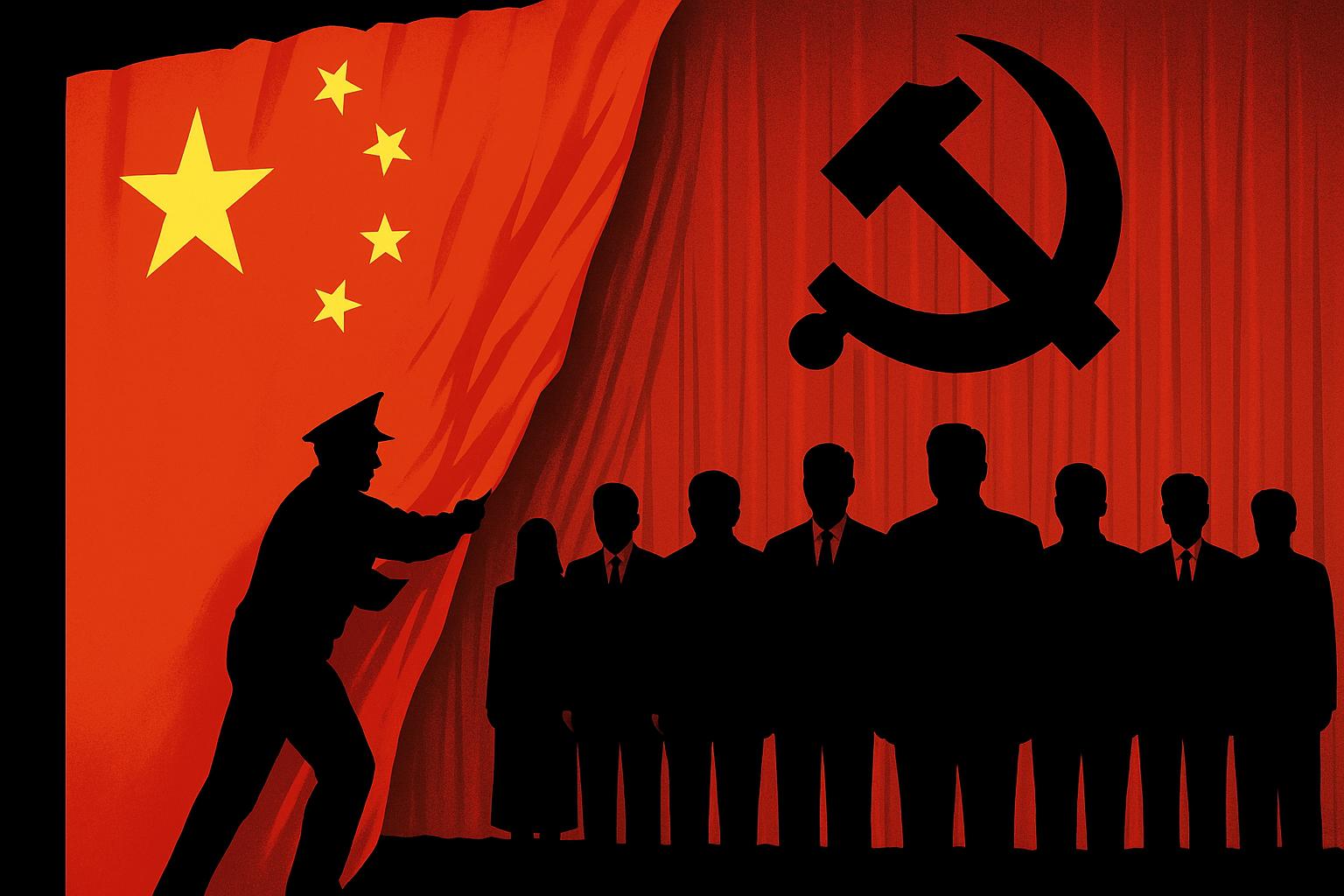
China apologists often claim that China is no longer communist, but such claims are complete nonsense, reflecting an incredibly selective and superficial analysis of what the reality is in China. For one thing, the ruling party is the Chinese Communist Party (CCP). And the name was not chosen arbitrarily. It is a communist country.
Apart from the CCP, there are 8 minor parties, but these parties have to concede to the ruling role of the CCP, meaning it would technically be illegal for one of them to plan or even suggest that they should replace the CCP as the ruling party. So politically, China is 100% communist.
As for the economic system, with the state controlling more than half of all companies, it can hardly be considered capitalist.
Most media and many economists mistakenly claim that the Chinese Communist Party (CCP) controls only a limited share of the economy, citing the percentage of firms directly owned by the state. But focusing narrowly on state-owned enterprises (SOEs) hides the much broader reality: state control extends through multiple layers of ownership, networks, and connections, reaching the majority of China’s corporate sector.
Of 40 million registered firms in China, about 391,000 are 100% state-owned (SOEs), 629,000 are at least 30 percent state-owned, and nearly 867,000 have some level of state ownership. Altogether, the capital of firms with state stakes accounted for about 68 percent of the economy in 2017.
State owned firms can own significant shares in other firms, extending the states reach. Scholars have identified 978,609 firms within three degrees of separation from an SOE and more than 3.5 million firms indirectly tied through joint ventures. Among the top 1,000 private owners in China, 78 percent are state-connected, 63 percent directly and 14 percent indirectly.
If mixed-ownership models are included, where SOEs hold a 30 percent stake or maintain indirect equity ties, the total number of state-connected firms ranges from 600,000 to 3.5 million. SOEs also use enterprise groups to spin off subsidiaries, list them on stock exchanges, and bring in private capital while retaining state control.
This state dominance has accelerated. Between 2000 and 2019, the number of private owners directly connected to the state nearly tripled, while indirect connections grew even faster. By 2022, 71 percent of Chinese companies on the Fortune 500 list were state-owned, rising to 84 percent by asset size. By 2021, 54% of China’s largest firms were state owned.
Apart from Westerners being shills and apologists for China, one reason for the misreporting that downplays the state’s role in the economy is that most measures rely on China’s Annual Industry Survey (AIS) database, which categorizes firms inconsistently and is plagued by errors. Ownership status is self-reported, giving companies incentives to hide or distort their true ties to the state. However, when a deeper analysis is done, state ownership and influence clearly dominate both by firm count and by capital. The CCP directly or indirectly controls well over half of all companies, with 68 percent of capital under state ownership, 85 percent of in-network firms having state stakes, and up to 3.5 million firms connected through broader definitions.
In addition to the CCP’s ownership in companies, the CCP has significant control over the stock market.
In China, the stock market is overseen by the China Securities Regulatory Commission (CSRC), a government agency directly under the State Council. In 2023, the CSRC was formally upgraded as part of broader reforms of Party and state institutions, reinforcing its position as a tool of state control. This stands in sharp contrast to the United States, where stock markets are largely self-regulated and overseen by the Securities and Exchange Commission (SEC), an independent agency.
The CCP has the power not only to regulate China’s stock market but to step in and intervene directly. In late 2023 and early 2024, the China Securities Regulatory Commission (CSRC) ordered institutional investors not to sell stocks in order to stabilize share prices. China’s Supreme People’s Court has also declined to handle securities-related litigation directly—at least as of 2004, deferring such cases to the CSRC.
The state also props up the market through the so-called “National Team,” a group of state funds that routinely intervenes during downturns. These actions show that price discovery in China is not determined by free markets but by government command, something unimaginable in a truly market-driven system.
In practice, China is not a market economy but a hybrid system in which state power permeates every level. The term “socialist market economy” was introduced by Jiang Zemin at the 14th National Congress of the Chinese Communist Party (CCP) in 1992 to describe China’s reforms. It represents what the CCP calls the “primary stage” of socialism, essentially a form of state capitalism reminiscent of the Soviet Union’s New Economic Policy. Xi Jinping has made clear that “the dominant role of state ownership cannot be changed, and the leading role of the state economy cannot be changed.”
The CCP enforces this dominance through direct control of regulators and trading mechanisms, majority stakes across the economy amounting to 68 percent of total capital, and the power to intervene in markets through the so-called “National Team.” It also retains control of land ownership, key strategic enterprises, and all state-owned enterprises, where Party leadership ensures political as well as economic control.
Read the full article here