





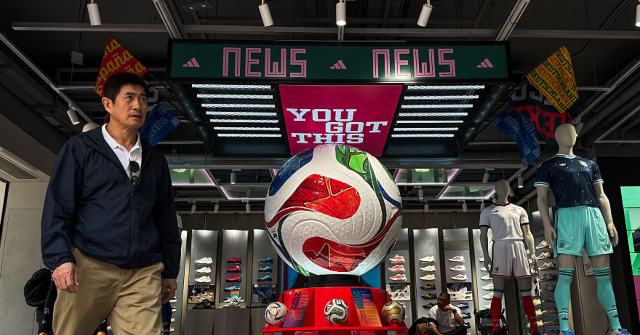
The Chinese state newspaper Global Times published an article on Tuesday celebrating that Chinese manufacturers were dominating the market for FIFA World Cup branded products, from soccer balls to team jerseys.
The FIFA World Cup is one of the world’s most prestigious sporting events, occurring every four years. This year’s contest is scheduled to begin in June and is hosted by all three mainland North American states; the final game will be held in New Jersey. The Chinese national team did not qualify to compete for the World Cup and, despite China’s illustrious record at the Olympics and other international sporting events, has only qualified once in its history, for the 2002 Japan/South Korea World Cup.
Despite China’s lack of history as a soccer power, the Communist Party has used its propaganda arms throughout several tournaments to declare the country influential as a result of its outstanding manufacturing output, which global human rights experts have documented is attributed largely to the mass enslavement of ethnic minorities. In the Uyghur homeland of East Turkistan and Tibet, evidence indicates Communist Party officials have abducted and forced locals to work in factories throughout the country, shifting to a national forced labor strategy after facing global condemnation for building a sprawling network of concentration camps in East Turkistan beginning in 2017.
The delicate human rights situation undergirding Chinese manufacturing did not make it into the pages of the Global Times, which observed on Tuesday that almost 70 percent of all 2026 World Cup merchandise sold by China comes from central Yiwu city. The newspaper documented all manner of souvenirs, from t-shirts to hats to jerseys for dogs, being sold from China and also highlighted that, in Mexico, authorities are using Chinese-made buses to transfer fans to sporting venues.
“In a global mega-event of this scale, Chinese manufacturers have become a highly competitive and, in many product categories, indispensable supplier base,” the Times boasted, “supported by advantages in production capacity, product quality, and cost efficiency.”
Yiwu in particular, the newspaper shared, has experienced a prodigious increase in demand for sports-related goods; sales rose 7.9 percent year-on-year from January to April compared to 2025, almost exclusively on the back of the World Cup. The outlet, citing regime-approved Chinese “experts,” credited the “adaptability of China’s manufacturing sector” for dominating the production of World Cup products, apparently eclipsing the event’s actual host countries. Fans of countries where soccer is especially popular, particular in Latin America, have also become top clients of Chinese manufacturers, according to the report.
“Chinese manufacturers have emerged as a highly competitive and in many product segments an essential supplier base, supported by strengths in production capacity, product quality, and cost efficiency,” one expert opined.
The Chinese manufacturing sector — which is completely dominated by the Communist Party — similarly established production hegemony over the 2022 World Cup, hosted by Chinese ally Qatar. That year, the Global Times celebrated that China was “upgrading its industry, and has made positive contributions to the global industrial chain and the stability of the supply chain.” The Times observed that this was an especially notable achievement amid ongoing Wuhan coronavirus lockdowns. At the time, China was still locking down entire cities and imposing other repressive policies, allegedly to prevent the spread of the virus. Beijing would only end its “zero-covid” policy in December 2022 after thousands of young Chinese people organized anti-communist protests nationwide.
“What Chinese enterprises bring to the world are Chinese products and services that are full of world-leading technologies, and which have laid the foundation for Chinese manufacturing to enter the global high-end product market,” a regime-approved “expert” told the Global Times in 2022.
A dramatic increase in global orders for Chinese-manufactured goods puts the world at significant risk of funding modern-day slavery. China has for years been facing condemnation for shepherding as many as 3 million people in East Turkistan into concentration camps beginning in 2017, where survivors have testified to being enslaved, raped, tortured, and enduring other atrocities. The East Turkistan disaster went nationwide in 2020 when the landmark report “Uyghurs for Sale” by the Australian Strategic Policy Institute (ASPI) revealed that the Chinese government was busing Uyghur slaves to work in factories nationwide, implicating suppliers used by 83 different international corporations. A year later, Sky News revealed in a report that the government was facilitating the sale of these slaves on websites where suppliers could buy “batches of 50 to 100 workers” for their factories online.
In 2025, the International Labor Organization (ILO) published a report affirming that mass enslavement of Uyghurs continued, as well as the enslavement of Tibetans in a similar manner. The ILO specifically identified “a system of transferring ‘surplus’ rural workers from low-income traditional livelihoods pursuits [sic] into industries such as the processing of raw materials for the production of solar panels, batteries, and other vehicle parts; seasonal agricultural work; and seafood processing.”
Also last year, the Bureau of Investigative Journalism (TBIJ) published a report finding Uyghur slaves working in 75 factories across 11 Chinese regions, not just isolated to East Turkistan.
“More than a hundred global brands are linked to factories using Uyghur and other ethnic minority workers recruited through a system international authorities call forced labour,” the Pulitzer Center reported, citing the TBIJ report.
Follow Frances Martel on Facebook and Twitter.
Read the full article here


