




The Chinese state newspaper Global Times quoted an alleged “expert” assuring residents of the country that the threat of an outbreak of Ebola there remains low despite the close economic ties between the Communist Party and the Democratic Republic of the Congo (DRC).
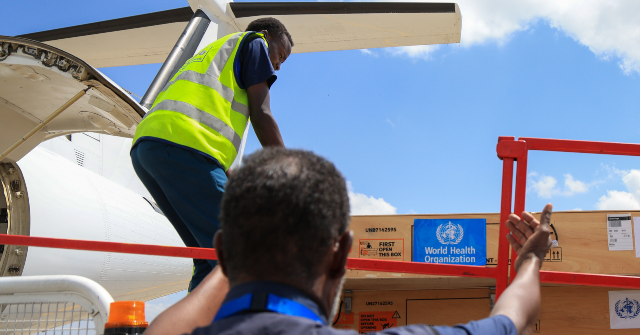
The World Health Organization (W.H.O.) declared a public health emergency in the DRC in May after local authorities in eastern Ituri province began documenting an outsized number of cases of hemorrhagic fever that were ultimately identified as the Bundibugyo variant of Ebola virus. The unexpected variant meant that health officials took longer to identify the disease as Ebola, as patients tested negative for more common variants of the disease.
As of this weekend, the W.H.O. has documented 134 confirmed Ebola cases tied to the DRC outbreak, including nine in neighboring Uganda. Highlighting the degree to which the W.H.O. failed to monitor and contact trace in the early days of the outbreak, this number pales in comparison to the 906 suspected but unconfirmed Ebola cases and 223 suspected Ebola deaths. Last week, W.H.O. Director-General Tedros Adhanom Ghebreyesus lamented that contact tracing in DRC was “nearly impossible” because locals feared health workers and had organized multiple mob attacks on Ebola treatment clinics. These attacks resulted in the destruction of health centers, the theft of the bodies of suspected Ebola victims, and patients escaping the clinics and potentially spreading the disease.
The perilous situation in the DRC, exacerbated by public distrust and years of conflict among large numbers of armed militias fighting for mining territory, have prompted international alarm. In several countries, including the United States, travel restrictions have been implemented to ensure that potential Ebola patients do not bring the pathogen into new countries. The DRC national soccer team, for example, ensured its players did not enter the country during the length of the suspected Ebola incubation period and forced some of its support staff into isolation to ensure they did not bring the virus to Texas, where they are expected to be headquartered for the 2026 FIFA World Cup.
The Chinese Communist Party has responded to the outbreak by announcing that it would send medical support to DRC and issuing statements to the Chinese public urging limited alarm regarding the situation for people in China.
“This current wave of Ebola is a re-emergence of the Bundibugyo virus from years ago,” a regime-approved “expert” identified as Tao Lina told the Global Times in a report on Sunday. “It still spreads primarily through direct contact with bodily fluids, and there is no evidence of airborne transmission.”
The Times shared that the expert “believes even if imported cases make it into China, the situation is controllable, and there is no need for the public to worry.”

The Chinese public is susceptible to alarm regarding public health measures as they endured unspeakable horrors during the coronavirus pandemic that began in central Wuhan, China, in late 2019. The Communist Party attempted to contain the disease by imposing mass house arrest provisions for millions of people at a time in both rural areas and its largest cities, including imposing a complete lockdown on an estimated 26 million people in Shanghai. As the lockdowns were often imposed by surprise, many Chinese experienced food and medicine shortages, banned from leaving their homes. Some reports also detailed family separations and people being welded shut into their homes.
“Despite the alarming spike in numbers in the DRC, a Chinese medical expert emphasized that the threat level to the Chinese public is quite low,” the Global Times shared of the Ebola outbreak.
The Chinese Center for Disease Control and Prevention (CDC) also emphasized in a public message that it had not documented a single case of Ebola in the country and advised that anyone entering China from DRC, Uganda, or other sensitive localtions “undergo 21 days of health monitoring and see a doctor in cases of fever, headache, vomiting, diarrhea or unexplained bleeding.”
On Monday, the Chinese government announced it would send a medical team and supplies to the DRC to aid with Ebola response.
“China has sent 45 medical teams, with a total of more than 900 members, to 44 African countries,” Foreign Ministry spokesman Lin Jian told reporters during his regular briefing. “As we speak, Chinese medical teams are on the ground fighting the disease shoulder to shoulder with African people.”
“China will stay in close touch with DRC and other African countries as well as WHO and AU [African Union], and provide assistance to the best of our capability in light of the situation and Africa’s needs,” he added. “We also call on the international community to take more concrete actions to help DRC and other African countries defeat the outbreak at an early date.”
A Chinese expert medical team reportedly left Beijing for the DRC on Tuesday. The state news outlet Xinhua did not specify where in the country they were going, but noted they intended to “support local Ebola control efforts,” implying they were en route to eastern Ituri.
While the CDC and Chinese “experts” indicated little concern about contact with Ebola in the DRC, Beijing and Kinshasa have enjoyed close ties for decades strengthened through the DRC joining the Belt and Road Initiative (BRI) in 2021. The BRI is a China’s global infrastructure plan in which it offers predatory loans to poor countries meant to be used to pay Chinese companies to invest in local infrastructure projects, which Beijing then controls in addition to the onerous debt. In exchange for joining the BRI, China announced that year that it would cancel about $28 million in debt that DR Congo owed China.
“The DRC’s participation in the Belt and Road Initiative has set up a new platform and opened up new prospects for bilateral cooperation,” Chinese dictator Xi Jinping declared in a phone call with then Congolese President Felix Tshisekedi in 2021. “The Chinese side is ready to work with the DRC to plan their cooperation for the next stage, and strengthen practical cooperation in such areas as economy, trade, infrastructure, health, agriculture and culture, so as to lift bilateral relations to new highs.”
China has largely used its access to the Congolese economy to establish dominion over its vast mineral resources. Beijing first signed a deal in 2008 in which its state-owned companies agreed to a joint project with Congo’s state mining company to develop copper and cobalt mines. Chinese companies then dramatically expanded their presence in the Chinese mineral market following the BRI membership.
China’s presence in Congolese mining has created an environmental disaster and exacerbated horrifying child labor issues in the country.
“In the DRC, ongoing civil unrest and an unmitigated humanitarian crisis are largely due to China’s ruthless and irresponsible grip on the country’s natural resources,” Joseph Mulala Nguramo of the Atlantic Council Scowcroft and Freedom and Prosperity Center told Congress during a hearing on China’s activities in the country in March 2025.
“Controlling almost 90% of the Congo Mining Sector, China has failed to use its economic and financial power to defend and promote the Rule of Law, Freedom, and Quality Governance,” Nguramo explained. “But China has, instead, mastered strategies to take advantage of a country in chaos—often bribing government officials to acquire Mining concessions.”
Sasha Lezhnev, a senior policy adviser with the Sentry, estimated at the same hearing that up to as many as 35,000 children were believed to be working in toxic mines that sell cobalt and copper to Chinese companies. These companies often have employees on the ground to ensure that the business runs smoothly who, in addition to participating in these harrowing abusers, could potentially be exposed to disease that may return to China with them.
Follow Frances Martel on Facebook and Twitter.
Read the full article here


