




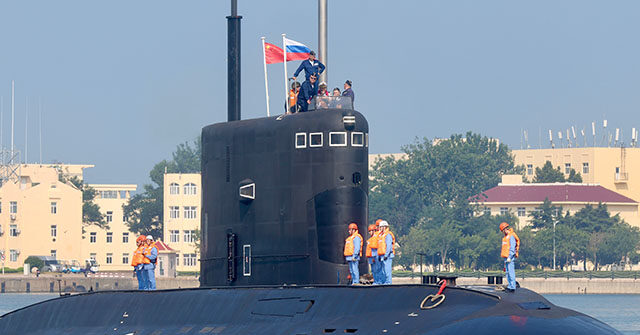
The Chinese Defense Ministry announced on Sunday that China and Russia will hold joint naval exercises in July to “counter maritime security threats.”
The exercises will begin in Chinese waters but will then move to “relevant areas of the Pacific Ocean.”
The exercise, dubbed “Joint Sea – 2026,” will begin near China’s port city of Qingdao in the eastern Shandong province. The last Russian ships involved in the exercise arrived in those waters over the weekend, and the exercises will reportedly be held from Monday, July 6 to Monday, July 13.
WATCH:

According to China’s state-run Global Times, the Russian force includes the guided missile cruiser Varyag, the frigate Rezkiy, the submarine Ufa, and a rescue ship called Igor Belousov.
China contributed two guided missile cruisers, Kaifeng and Anshan, plus the frigate Wuhu, the supply ship Kekexilihu, a submarine rescue ship called Yangchenghu, and one unnamed submarine.
The Chinese Defense Ministry said the exercise would include three phases: force assembly, port planning and coordination, and operations at sea. The port phase will primarily include planning sessions and seminars on land, plus mutual ship tours and a “friendly basketball match.”
The livelier “at-sea” phase will “feature a range of training scenarios, including joint reconnaissance, air and missile defense, and maritime strike operations.”
The presence of “advanced frontline surface combatants,” like the cruisers Varyag and Kaifeng, is intended to show how seriously China and Russia take their “maritime security threats,” although the press releases were notably light on details of where those threats might be coming from.
WATCH — Dave McCormick: China Is an “Existential Battle” Requires Unity Like in WWII:

“One of the stated aims of the exercise is to reduce perceived threats to key maritime strategic corridors posed by certain regional countries. Through joint exercises, the two sides seek to demonstrate their ability to keep these sea lanes open and operate farther into the Pacific,” Chinese military expert Song Zhongping told the Global Times.
Song added that the joint exercise is “intended to deter unilateral actions by certain countries, resist historical revisionism, and discourage behavior seen as undermining the security and well-being of neighboring countries,” which offered a few more clues about who the Chinese and Russian sailors were training to fight.
“Unilateral actions by certain countries” is Chinese Communist Party boilerplate language about almost anything the United States does in the Asia-Pacific region, while “recent historical revisionism” is a thinly veiled slam at countries like the U.S., Japan, and the Philippines for challenging China’s expansive claims to control the entire South China Sea region.
The Kremlin was a bit less pugnacious on Monday, insisting the Joint Sea – 2026 drills were not meant to threaten or intimidate any particular country.
“As for our joint exercises, they are not directed against anyone, nor against any single state in the region. Everyone should bear this in mind,” said Kremlin spokesman Dmitry Peskov.
“On the contrary, cooperation between Russia and China in such an important and critical area is a very significant factor that contributes to predictability and security in the region,” Peskov said.
Read the full article here


