




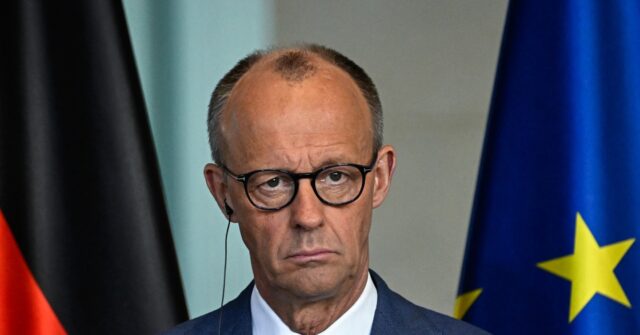
Chancellor Friedrich Merz is the most unpopular leader on record in modern German history as the nation’s economy continues to struggle and immigration continues to dominate headlines.
According to Forsa’s RTL/ntv Trendbarometer, Merz is the most unpopular chancellor since the polling agency began conducting surveys, with a staggering 85 per cent of Germans disapproving of his performance.
In contrast, the previous record holder was his predecessor, Social Democrat Olaf Scholz, whose disapproval rate hit a disastrous 76 per cent before his party was rejected by voters in last year’s elections.
The chancellor’s Christian Democratic Union (CDU) is also struggling in the polls, as it continues to trail the populist, anti-mass-migration Alternative for Germany (AfD). The latest RTL/NTV tracker has placed the AfD in first at 28 per cent, followed by the CDU/CSU at 21 per cent, the Greens at 16 per cent, and the Social Democrats (SPD) and The Left party tied at 12 per cent.
Perhaps most damning of all, the pollster also found that just 12 per cent of voters believe that the current political establishment is adequately addressing the issues facing the public.
This pessimism about the current order in Germany is likely a result of last year’s election resulting in little change. Indeed, in a bid to prevent the AfD from having any influence, Chancellor Merz decided to form a coalition with the Social Democrats, despite voters voting against the former governing party.
Musical chair politics aside, the government has also failed to address the two most pressing issues for most voters; the economy and immigration.

While Germany once stood as the economic engine of Europe, its manufacturing sector has been brought low by soaring energy costs, unfair competition from Communist China, and tariffs imposed by the Trump administration in the United States.
Though the energy crisis began in earnest following Vladimir Putin’s invasion of Ukraine, after which Berlin could no longer rely on cheap gas and oil imports from Russia, the seeds of the crisis were planted long before the 2022 invasion.
Indeed, during his first term in office, President Trump frequently warned Berlin of the folly of relying on an adversarial power for energy, while demanding American protection from the same country and pursuing inefficient green energy policies at home.
To make matters worse, the reduction in Russian energy coincided with the phase-out of nuclear energy initiated by Merz’s predecessor, former Chancellor Angela Merkel, in the wake of the 2011 Fukushima accident in Japan.
Such factors have caused energy costs to soar in Germany, significantly damaging the industrial sector’s ability to compete on the world stage. This has been particularly true of the automobile industry, which has at the same time faced steep competition from state-subsidised Chinese electric vehicle imports.
Meanwhile, the long-term impact of immigration continues to dominate discourse in Germany, with a German-born, second-generation Lebanese 21-year-old Abdul Ballout using a van to commit a terror attack at the annual LGBT Pride Parade in Berlin last month, leaving a 65-year-old Polish mother dead and 31 others injured.
Vehicle terror attacks have become increasingly commonplace in Germany over the past decade of mass migration, including multiple such attacks on Christmas markets.
Follow Kurt Zindulka on X: Follow @KurtZindulka or e-mail to: kzindulka@breitbart.com
Read the full article here


