



The Spanish enclave of Ceuta will celebrate its yearly Our Lady of Africa procession this week despite the “exceptional situation” caused by the massive migrant wave that stormed the North African city in recent days.
The promise came as the Daily Mail reported a huge mob of Moroccans chanting “Allahu Akbar” clashed with Spanish police Monday after taking over the streets and marching through Ceuta as the enclave remains gripped by fear.
Clashes followed, with footage showing Spanish National Police officers carrying batons and charging towards illegal migrants during the demonstration.
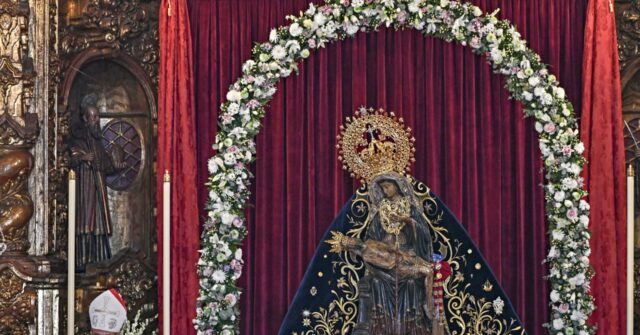
Our Lady of Africa is Ceuta’s Patroness. Every year, the Spanish enclave marks August 5 to observe the Feast of Our Lady of Africa — holding a week-long celebration with multiple activities that are part of Ceuta’s centuries-old Catholic tradition.
This year’s celebrations, however, found themselves jeopardized after Ceuta was plunged into a crisis last week, when tens of thousands of majorly-Moroccan illegal migrants breached into Ceuta — leading to the worst migrant crisis that the Spanish enclave has gone through since 2021. At least 88 died during last week’s events, according to the most recent death toll update provided by Ceuta’s local government on Monday morning.
The aftermath of last week’s dramatic — and still not fully resolved — migrant crisis, forced the suspension of all festivities and activities that the city had planned between August 1 and 8 in honor their Patroness. The city cited the existing “uncertainty, instability, and concerns” caused by last week’s events as the reasons to cancel all of the Feast’s events.
The local outlet El Faro de Ceuta reports that the city’s authorities, security officials, and the Brotherhood of Our Lady of Africa met on Sunday and reached an agreement to hold the celebrations’ two most-important events — a traditional Floral Offering to Our Lady of Africa on Tuesday, August 4, and the August 5 Solemn Procession, in which the statue of the Blessed Virgin Mary will transit through Ceuta’s streets under heightened security protocols.
“Throughout the centuries, Ceuta has successfully faced all manner of challenges without losing what defines it: its faith, its traditions, and its deep love for its Patroness. Generation after generation, the people of Ceuta have found in the Blessed Virgin a refuge, a guide, and a symbol of unity that has remained steadfast over time,” the Brotherhood of Our Lady of Africa said through a statement published on Sunday.
“True to that history and legacy, we are pleased to announce that both the Floral Offering and the Solemn Procession will take place as usual, allowing our city to once again come together with the Mother of all the people of Ceuta,” the text continued.
The Brotherhood called upon the participation of everyone during those two days, and proclaimed, “May the streets of Ceuta once again be filled with faith, devotion, and affection for the Virgin, demonstrating once more that our people remain united around Her.”
FILE/A group of people follow from outside the Mass in honor of the patron saint of Ceuta, the Virgin of Africa, presided over by the apostolic nuncio of the Pope in Spain at the Shrine of Our Lady of Africa, on August 5, 2021, in Ceuta, Spain. ( Antonio Sempere/Europa Press via Getty Images)
Per Europapress, the local Ceuta government welcomed that the events, “deeply rooted in the traditions and sentiments of the people of Ceuta,” can take place. The authorities also expressed gratitude for the collaboration of all involved institutions and entities involved in ensuring that the upcoming events count with the necessary safeguards.
Pope Pious XII declared Our Lady of Africa as Ceuta’s Patroness in 1949. Her history in Ceuta, however, goes all the way back to the 1421, when Prince Henry the Navigator of Portugal sent a picture of Our Lady of Africa to the city.
The Sanctuary of Our Lady of Africa was built towards the end of the 17th century, and underwent Baroque-style renovations during the 18th Century. Ceuta also conferred upon the title of “perpetual Mayor of Ceuta” to Our Lady of Africa in 1654.
Read the full article here


