




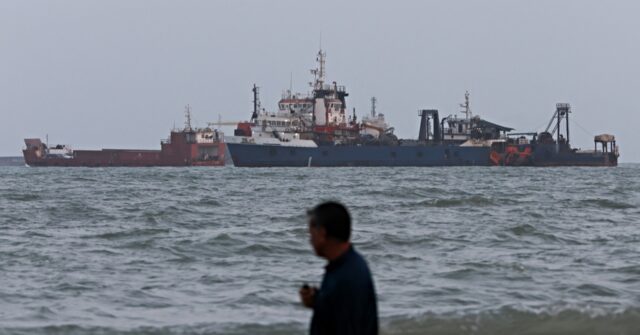
U.S. Central Command confirmed Thursday that American forces have cleared Iranian sea mines from the Strait of Hormuz’s internationally recognized shipping lanes, opening the critical waterway to growing commercial traffic while a U.S. naval blockade has stopped Iranian oil exports entirely since mid-July — a dramatic shift President Donald Trump says has left Tehran “begging to make a deal.”
CENTCOM Commander Adm. Brad Cooper called the breakthrough a “major milestone,” providing the military’s most detailed confirmation yet of a months-long operation that has dismantled one of Tehran’s principal sources of leverage: its ability to threaten international shipping through Hormuz while claiming control over the strategic waterway.
“We have successfully cleared sea mines in the Strait’s international shipping lanes that were laid months ago by Iran’s Islamic Revolutionary Guard Corps,” Cooper said in a Thursday evening operational update. “Internationally recognized transit routes in the Strait are free of Iranian sea mines thanks to the incredible work of the U.S. military.”

The announcement puts hard military confirmation behind what U.S. officials described earlier this week as a “watershed moment” in Hormuz.
After months in which Iran used mines, attacks on commercial vessels, and threats to shipping as leverage over global energy markets and negotiations with Washington, Axios reported earlier this week that U.S. officials viewed the clearing of the Strait’s principal shipping lanes as a fundamental shift in the balance of control.
“The Iranians have lost control over the strait,” one U.S. official said. “Now the U.S. controls it.”
Trump had already signaled the same change days earlier, declaring that the Strait was open, the mines had been removed or detonated, and the naval blockade against Iran remained in full force. He also warned Tehran against attempting to re-mine the waterway, making clear that vessels caught laying new mines would be destroyed.
Cooper’s update now supplies the operational detail behind those declarations.
U.S. forces cleared the Strait’s Traffic Separation Scheme, or TSS — the internationally recognized system of lanes used to direct ships safely through the narrow passage between Iran and Oman while keeping vessels traveling in opposite directions separated.
“A traffic separation scheme is a highway system for ships on the ocean,” Cooper explained as he displayed a nautical chart of Hormuz.
Those are the long-established routes commercial vessels have historically relied upon to transit the Strait. Clearing them restores two-way movement through the principal international corridor rather than forcing commercial traffic into more limited alternatives.
The work was carried out “meticulously and quietly” over several months by Navy divers, Navy SEALs, and U.S. airpower from the Army, Navy, Air Force, and Marine Corps.
“The circumstances were challenging and dangerous, to say the least, but we got the job done,” Cooper said.
Then came the bottom line.
“Today, international shipping lanes are open and momentum is building.”
That momentum is increasingly visible in the enormous volume of energy moving through Hormuz — and in the stark contrast between the traffic Washington is protecting and the Iranian exports it is blocking.
U.S. forces have provided coordinated protection to nearly 1,500 commercial vessels over the past several months, helping move close to three-quarters of a billion barrels of crude oil through the Strait to global markets.
“And while American forces have supported 750 million barrels of crude oil leaving the Gulf, Iran has exported zero oil from its shores since we resumed the naval blockade in mid-July,” Cooper said.
“We have been highly effective.”
The blockade has reached far beyond Iranian oil tankers. No vessel has entered or departed an Iranian port without U.S. permission since the operation resumed, according to Cooper, with passage authorized only on humanitarian grounds.
Thousands of American service members operating more than 20 warships and hundreds of aircraft have sustained the blockade, turning back 75 vessels that attempted to run it and disabling three others that refused orders to comply.
The figures dramatically sharpen the asymmetry now taking shape in Hormuz: international energy is moving through the Strait under American protection while Tehran’s own access to maritime trade remains subject to U.S. enforcement.
Trump made that point explicitly Thursday.
“We have control and we have the blockade. Iran is getting nothing,” he told reporters, while stressing that millions of barrels of oil from other Gulf producers continue flowing through Hormuz each day.
The president drove the message home again later Thursday night, posting an image listing the Strait of Hormuz alongside U.S. territories and labeling the waterway “NEW U.S. Territory” — the latest in a series of increasingly emphatic assertions that Washington, rather than Tehran, now controls events in the strategic waterway.
That posture also helps explain Trump’s increasingly dismissive response to reports that Washington is seeking renewed talks with Iran.
“I don’t want to meet, they do,” Trump wrote on Truth Social Thursday. “In fact, they are begging to make a deal.”
He followed with another post shortly afterward: “Iran Is a Failing Nation!”
The comments came as Tehran continued insisting that Washington must make concessions before Iran will “reopen” Hormuz — a negotiating position increasingly undermined by the reality CENTCOM described Thursday: the internationally recognized shipping lanes are already mine-free, commercial vessels are moving through them under American protection, and Iranian exports remain bottled up.
Iran and Oman have discussed a temporary navigation corridor, joint mine-clearing arrangements, and possible future management of shipping through the Strait. Qatar joined the diplomatic push Thursday, with Prime Minister and Foreign Minister Sheikh Mohammed bin Abdulrahman Al Thani traveling to Tehran for meetings with senior Iranian officials, while Pakistan has separately pursued mediation following army chief Asim Munir’s recent visit to Iran.
Yet Washington has shown little urgency to restore the earlier framework Tehran is seeking.
Iran’s powerful Supreme National Security Council secretary, Mohsen Rezaei, insisted Thursday that the United States must first take “practical steps” to meet Tehran’s conditions before Iran would reopen the Strait — and threatened retaliation if the blockade continues.
“If the blockade continues, we will target US economic interests fully and with intensity and force,” Rezaei warned, according to Iranian state media.
The threat reflects the pressure Iran is facing as the military blockade is reinforced by a second front aimed directly at the regime’s remaining economic lifelines.
Rezaei also claimed Iran had managed to break the blockade during an earlier ceasefire and exported between 70 million and 80 million barrels of oil. His assertion referred to that earlier period; Cooper’s figures cover the renewed blockade since mid-July, during which CENTCOM says Iranian oil exports have remained at zero.
The Trump administration is now seeking to turn that maritime isolation into broader financial isolation through Operation Economic Outcast, the sweeping economic offensive formally launched Monday and spearheaded by Treasury Secretary Scott Bessent.
Bessent has described the campaign as an effort to economically “asphyxiate” Tehran by severing the financial lifelines sustaining the regime. Its opening round targeted more than 60 entities across Iran’s oil, weapons, cyber, aviation, shipping, and financial networks, while warning foreign governments, banks, and businesses that continued dealings with Tehran could bring secondary sanctions and exclusion from the U.S. dollar system.
The strategy directly complements the blockade: prevent Iran from moving its oil physically while making it increasingly difficult for the regime to move money, obtain financing, or find foreign institutions willing to facilitate its trade.
Hours after Cooper detailed the results in Hormuz, Bessent made precisely that connection.
“The Blockade and Operation Economic Outcast will crush the failing Iranian economy,” he wrote on X.
He followed with the same disparity CENTCOM had just documented, compressed into a single line: “The USA has guided 130 millions barrels out over the past 14 days. Iran: 0”
Bessent is set to carry the campaign to G20 finance ministers and central bank governors gathering in Asheville, North Carolina, next week, where Washington will press major economies to close the remaining channels through which Tehran moves oil and money.
The Treasury secretary has called the strategy a “zero-leakage approach” and made clear that governments and institutions continuing to support Iran will increasingly be forced to choose between access to the U.S.-led financial system and sustaining the regime.
“It is now time for world leaders to make a decision,” Bessent declared at Monday’s rollout. “Between prosperity and isolation. Peace and terror. America and Iran.”
The mounting pressure has been accompanied by increasingly blunt admissions from inside Iran about the strain on the economy, even as regime officials continue threatening retaliation abroad. Iranian officials have acknowledged severe financial pressure, difficulties importing key goods under the blockade, and mounting economic hardship as the administration seeks to squeeze Tehran without immediately returning to large-scale military strikes.
Trump, however, made clear Thursday that military force remains available if Iran escalates.
“It doesn’t mean we’re finished with the military,” he said.
Outgoing White House Press Secretary Karoline Leavitt, speaking on her final day in the role Thursday, likewise emphasized that Washington is not currently negotiating with Tehran.
“No negotiations are happening right now,” Leavitt said, adding that the pressure campaign would continue until Trump sees Iran come to the table “in a meaningful way.”
For the approximately 50,000 U.S. troops Cooper said are operating across the region, Thursday’s mine-clearing announcement therefore marked not the end of the campaign, but confirmation that one of its central objectives has been achieved: commercial traffic is moving, Iran’s mine threat has been cleared from the international lanes, and the blockade remains intact.
“We remain vigilant, lethal, and resolved,” Cooper said.
Joshua Klein is a reporter for Breitbart News. Email him at jklein@breitbart.com. Follow him on Twitter @JoshuaKlein.
Read the full article here


