




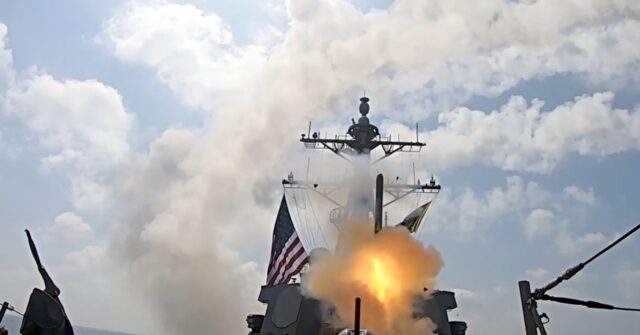
The U.S. military carried out a 13th consecutive night of strikes against Iran early Friday, targeting military command centers, drone facilities, communications networks, and maritime capabilities. The action came as President Donald Trump said he was weighing a “massive attack bigger than anything before” while Tehran rejected a U.S.-backed ceasefire proposal and warned the conflict could expand further across the region.
The latest escalation came after U.S. Central Command (CENTCOM) said American forces launched another round of strikes Thursday evening “to hold Iran accountable and diminish threats from the Islamic Revolutionary Guard Corps to commercial shipping,” before announcing the operation had concluded roughly two hours later.
CENTCOM said the strikes hit Iranian military command centers, drone storage facilities, communications networks, coastal surveillance sites, and maritime capabilities. The command added that the Strait of Hormuz remained open to commercial traffic with U.S. military support.

Trump signaled Thursday that the military campaign could soon intensify, telling reporters he was considering a “massive attack bigger than anything before” against the Islamic Republic and was “close to making a decision,” while emphasizing that although Israel could quickly join a broader operation, “We don’t need anybody.”
The latest military operation came as The New York Times, citing Iranian and Iraqi officials, reported that Tehran rejected a ceasefire proposal delivered by Iraqi Prime Minister Ali al-Zaidi following his recent White House meeting with Trump. According to the report, Iranian officials were unwilling to accept what they described as a temporary arrangement that left unresolved the future status of the Strait of Hormuz, a central point of contention in negotiations.
Al-Zaidi traveled to Tehran on Thursday for meetings with senior Iranian officials, including President Masoud Pezeshkian, Parliament Speaker Mohammad Bagher Ghalibaf, and Foreign Minister Abbas Araghchi. Iranian state media said the Iraqi prime minister urged dialogue and sought to reduce tensions following his recent talks in Washington.
Araghchi later described al-Zaidi’s visit as significant under the current regional circumstances but suggested the obstacle was not a lack of communication between Washington and Tehran.
“The problem is not the transmission of messages,” Araghchi said, according to Iranian media. “The problem is America’s perception, which is irrational and greedy.”
The Iranian foreign minister separately criticized Trump’s warning that the United States would use Iranian assets under American control to compensate ships damaged during attacks in and around the Strait of Hormuz. Writing on X, Araghchi called the proposal an “incendiary” precedent and warned that once governments normalize confiscation, “no one’s assets are safe,” adding that the resulting chaos would not be “pretty or peaceful.”
Trump announced the policy Thursday in a Truth Social post, declaring that “any and all damages” to ships, cargo, or related property resulting from attacks in the Gulf would be paid using Iranian funds under U.S. control.
The Times further reported, citing two Iranian officials, that Tehran was preparing contingency plans should Washington expand strikes against Tehran or other strategic infrastructure. According to the newspaper, Iran could respond by targeting Tel Aviv while also asking Yemen’s Houthi rebels to impose a maritime blockade in the Bab al-Mandab Strait, another critical global shipping route.
Iranian state media reported explosions in Ahvaz, Bandar Abbas, Omidiyeh, and on Qeshm Island during the strikes, while Iranian outlets also reported the activation of air defense systems around Tehran. An Iranian provincial security official later claimed four people were killed and five others wounded near Ahvaz, though those casualty figures could not be independently verified.
Israeli officials also continued preparing for the possibility that the conflict could widen, with Defense Minister Israel Katz warning Thursday that Israel was prepared for every scenario and that Iran would suffer a “crushing blow” if it attacked Israel, following a high-level security consultation involving senior military and defense officials.
Separately, IDF Arabic-language spokesman Lt. Col. Ella Waweya said the military remained in a state of “full readiness and preparedness,” both offensively and defensively, adding that the lessons of Hamas’s October 7, 2023, attack meant Israel would no longer rely on policies of containment or waiting for an adversary to strike first.
Several Israeli municipalities, including Ramat Gan, Eilat, and Karmiel, opened public bomb shelters Thursday as a precaution despite the Home Front Command issuing no new nationwide directive. The Health Ministry also said the Supreme Hospitalization Authority met to review emergency preparedness while stressing that no special instructions had been issued to the public.
Regional tensions continued to rise elsewhere. Iranian and regional media reported explosions in Kuwait late Thursday, while Iran’s Tasnim news agency claimed missiles had targeted Jordan’s Muwaffaq Salti Air Base, where U.S. forces are stationed. Neither report had been independently confirmed.
With the U.S. campaign entering its third consecutive week, diplomatic efforts remained stalled, and governments across the region prepared for possible retaliation, Trump’s pending decision on whether to broaden the offensive left the conflict poised to enter a potentially more dangerous phase.
Joshua Klein is a reporter for Breitbart News. Email him at jklein@breitbart.com. Follow him on Twitter @JoshuaKlein.
Read the full article here


