








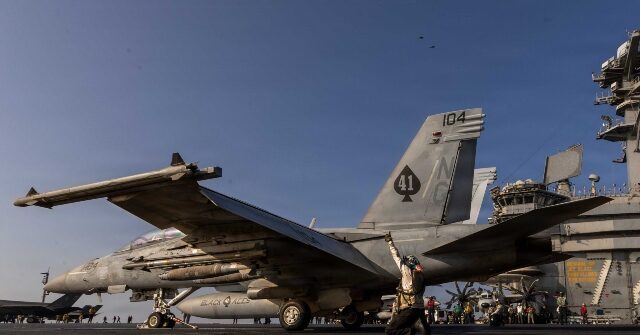
CENTCOM chief Adm. Brad Cooper said Thursday that Iran’s military capabilities have been “severely degraded” across “every domain” following the U.S. air campaign against the Islamic Republic, declaring that every military objective set out for Operation Epic Fury had been achieved while asserting that the Iranian regime’s terror proxies — Hamas, Hezbollah, and the Houthis — have been “completely cut off” from weapons supplies and support from Tehran.
Speaking before the Senate Armed Services Committee, Cooper described an Iranian regime whose military-industrial base, proxy network, naval forces, and command structure had all been severely battered during the nearly six-week kinetic phase of the conflict.
“We met every military objective for Epic Fury,” Cooper said, describing Iran’s command-and-control structure as “shattered” while arguing the regime currently lacks the capacity to meaningfully rebuild critical weapons stockpiles.

Cooper said the campaign destroyed roughly 90 percent of Iran’s defense industrial base, including major segments of the regime’s missile, drone, naval, and weapons-production infrastructure.
“In less than 40 days, CENTCOM forces achieved our military objectives,” Cooper said, arguing the operation crippled Tehran’s ability to “project power outside its borders and threaten the region and our interests.”
Pointing to Iran’s missile and drone barrages against Israel in April and October 2024, Cooper argued Tehran no longer possesses the capability to launch attacks “with that mass and scale.”
The CENTCOM chief also pushed back on recent reports suggesting Iran retained most of its prewar missile stockpiles and mobile launchers, saying open-source assessments circulating publicly were “not accurate,” though declining to discuss classified figures in detail.
Cooper further argued that sustained U.S. operations had effectively severed Tehran’s ability to funnel weapons and support to its regional terror proxies.
“Today, Hamas, Hezbollah, and the Houthis are all completely cut off from Iranian weapons supplies and support from Tehran,” Cooper said.
“This result was not foreordained,” he continued. “It is the culmination of months of precise planning and decades of experience.”
Framing the campaign as the culmination of years of Iranian aggression against American personnel throughout the region, Cooper noted that Iranian-backed groups carried out more than 350 attacks on U.S. troops and diplomats during the 30 months preceding Operation Epic Fury — roughly one attack every three days.
“For 47 years, the Iranian regime has terrorized the region and made hostility to the United States a core tenant of its rule,” Cooper said.
Cooper described Iran’s navy as effectively devastated by the campaign, estimating it would take Tehran at least five to 10 years merely to begin rebuilding portions of its naval capabilities and potentially “a generation” to restore its pre-conflict strength.
As part of the maritime campaign, Cooper said U.S. forces destroyed more than 90 percent of Iran’s estimated inventory of roughly 8,000 naval mines through more than 700 airstrikes aimed at preventing their deployment throughout the Strait of Hormuz.
Still, Cooper cautioned that Iran retains limited asymmetric capabilities despite the broader destruction inflicted on its military infrastructure.
“Iran retains nuisance capability — harassment, low-end drone and rocket attacks, and residual proxy support,” Cooper stated in written testimony submitted to lawmakers.
“But it no longer possesses the means to threaten major regional operations or deter U.S. freedom of action in the air or maritime domains.”
While arguing Iran’s actual military ability to disrupt maritime commerce had been sharply reduced, Cooper acknowledged Tehran’s threats alone continue to rattle global shipping, insurance markets, and oil prices.
“The Iranian ability to stop commerce has been dramatically degraded through the straits,” Cooper said.
“But their voice is very loud, and those threats are clearly heard by the merchant industry and the insurance industry.”
Cooper added that the United States and its regional allies retain the military capability to forcibly reopen the Strait of Hormuz if necessary, though he stressed policymakers remain focused on ongoing negotiations amid what President Donald Trump recently described as a ceasefire on “massive life support.”
Despite the damage inflicted on Iran’s military leadership and infrastructure, Cooper said the Islamic Revolutionary Guard Corps continues to wield major influence inside the regime.
Asked whether the IRGC remained effectively in control following the deaths of several senior Iranian commanders during the conflict, Cooper responded that the organization was still “exercising significant authority.”
At another point during the hearing, Cooper agreed with Sen. Tom Cotton’s characterization of Iran as a “revolutionary terrorist regime.”
“They are,” Cooper responded.
Cooper also detailed major shifts in the Pentagon’s drone warfare strategy following months of Iranian and Houthi drone attacks across the region.
“The days of using high-value defenses to shoot down cheap targets are behind us,” Cooper said, arguing the United States had successfully “flipped the cost curve” against Iran’s drone warfare apparatus by forcing Tehran to rely on increasingly sophisticated — and expensive — systems.
According to Cooper, Iran’s drone capabilities have now been reduced to roughly 10 percent of their pre-conflict levels.
Cooper further revealed that U.S. forces adopted a range of counter-drone tactics and battlefield procedures developed by Ukraine during its war against Russia.
“We adopted a large number of tactics, techniques and procedures that the Ukrainians have passed us that have helped us defend Americans,” Cooper said.
Although the administration has formally declared hostilities with Iran “terminated” following the April 7 ceasefire, sporadic clashes and maritime confrontations have continued throughout the region while negotiations over a broader agreement remain largely stalled.
Trump this week described the fragile ceasefire as being on “massive life support” after rejecting Tehran’s latest proposal as “garbage” and “totally unacceptable.”
The president warned that if Iran refuses to accept U.S. demands regarding its nuclear program and regional conduct, Washington would ultimately “finish the job” “peacefully or otherwise.”
Joshua Klein is a reporter for Breitbart News. Email him at jklein@breitbart.com. Follow him on Twitter @JoshuaKlein.
Read the full article here


