




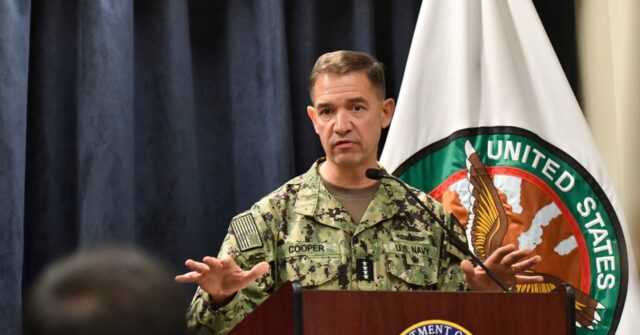
U.S. forces have struck more than 8,000 Iranian military targets and destroyed 130 vessels — marking the “largest elimination of a navy over a three-week period since World War II” — as Iran’s combat capability declines and U.S. forces remain “zeroed in” on dismantling its ability to threaten shipping through the Strait of Hormuz, according to U.S. Central Command commander Adm. Brad Cooper.
Providing his fourth operational update on Operation Epic Fury as the war entered its 22nd day, Cooper said U.S. forces remain “on plan to eliminate Iran’s ability to project meaningful power outside its borders.”
Speaking Saturday, Cooper detailed the scale of the campaign, stating, “So far, we’ve struck over 8,000 military targets, including 130 Iranian vessels,” calling it the most rapid destruction of a naval force over a three-week period since World War II.

U.S. military strikes have systematically dismantled key elements of Iran’s military, including “thousands of Iranian missiles, advanced attack drones, and all of Iran’s navy, which they use to harass international shipping.”
“Their navy is not sailing, their tactical fighters are not flying, and they’ve lost the ability to launch missiles and drones at the high rates seen at the beginning of the conflict,” Cooper said. “Our progress is obvious.”
The CENTCOM commander said U.S. forces have flown more than 8,000 combat sorties and continue to maintain air superiority over Iran, with aircrews executing precision strikes while “dynamically hunting threats” and eliminating targets in real time.
He also highlighted a recent milestone, noting that just two days ago U.S. forces conducted “the longest field artillery strike in Army combat history” using precision-guided missiles to destroy Iranian military infrastructure, underscoring what he described as the U.S. military’s “unmatched reach and lethality.”
Cooper emphasized that the campaign is now “zeroed in” on dismantling Iran’s decades-old threat to global commerce through the Strait of Hormuz.
He pointed to strikes earlier this week in which U.S. forces dropped multiple 5,000-pound bombs on a hardened underground facility along Iran’s coastline used to store anti-ship cruise missiles, mobile launchers, and related equipment posing a direct threat to maritime traffic.
“We not only took out the facility but also destroyed intelligence support sites and missile radar relays that were used to monitor ship movements,” Cooper said. “Iran’s ability to threaten freedom of navigation in and around the Strait of Hormuz is degraded as a result, and we will not stop pursuing these targets.”
Cooper also underscored the role of allied coordination, saying the United States and its partners have built “the most extensive air defense umbrella in the world over the Middle East right now,” with Gulf partners defending against thousands of Iranian drone attacks.
The update came as President Donald Trump on Saturday night escalated pressure on Tehran, issuing a 48-hour ultimatum for Iran to reopen the Strait of Hormuz.
“If Iran doesn’t FULLY OPEN, WITHOUT THREAT, the Strait of Hormuz, within 48 HOURS… the United States of America will hit and obliterate their various POWER PLANTS, STARTING WITH THE BIGGEST ONE FIRST!” Trump declared in a post on Truth Social.
More than 20 nations issued a joint statement Saturday condemning Iran’s attacks on civilian shipping and energy infrastructure and warning that interference with maritime traffic in the Strait threatens international peace and security.
The countries called on Iran to immediately cease efforts to block commercial shipping and affirmed their readiness to support efforts to ensure safe passage through the corridor.
The Strait of Hormuz has emerged as a central front in the conflict, with U.S. and allied forces intensifying operations to restore freedom of navigation while continuing to dismantle Iran’s remaining capacity to threaten global energy flows and project power beyond its borders.
Joshua Klein is a reporter for Breitbart News. Email him at jklein@breitbart.com. Follow him on Twitter @JoshuaKlein.
Read the full article here


