




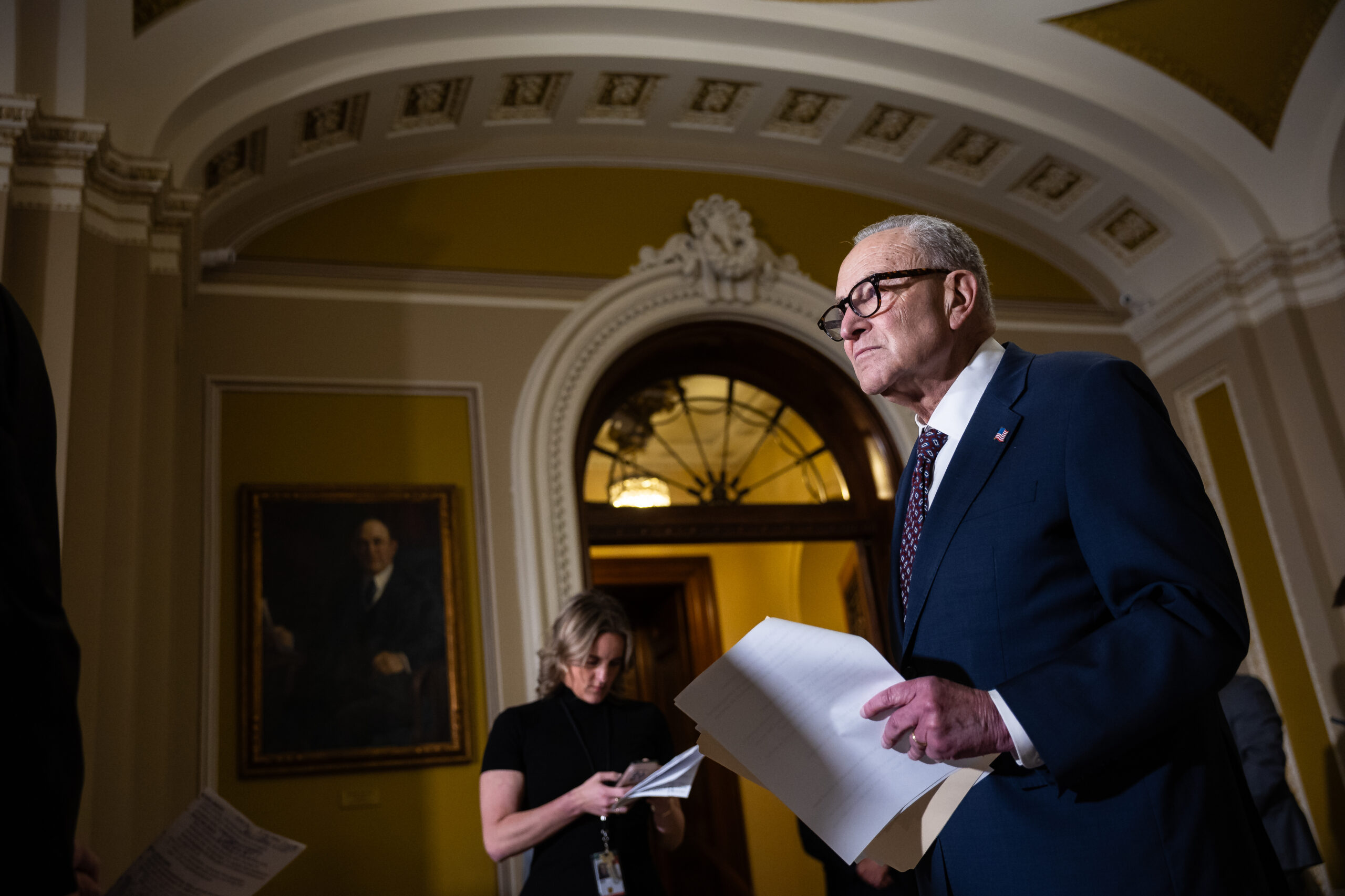
Chuck Schumer wants Congress to pass AI legislation. But he’s casting doubt on it happening this year.
“In this Congress, it’s hard,” the Senate minority leader said in an interview Thursday.
Schumer’s reality check isn’t a complete door-slam. But it underscores the steep climb lawmakers face to bridge a slew of intra-party and inter-chamber divides about what Washington’s approach should be toward the emerging opportunities and risks from the rapidly developing technology.
The problems are multi-pronged.
The White House, whose posture toward AI has shifted dramatically in recent weeks, is angling to enact legislation that would preempt state laws in favor of a national standard. Most recently, administration officials have been exploring a plan to attach preemption legislation to bills designed to shore up kids’ safety online. But there are issues — House Republicans aren’t in love with the Senate GOP’s kid safety bills and Senate Majority Leader John Thune has warned that many senators have concerns “about not trampling states’ rights in the process.”
Democrats aren’t unified on what to do next, with the public broadly skeptical about AI.
Some House and Senate Democrats are leery of state preemption and want to wait until next year to tackle AI, when they might be in power. Opposition from key Democrats is a major factor derailing an attempt by Reps. Lori Trahan and Jay Obernolte to strike a deal on legislation that would set nationwide safety and transparency rules while restricting state action. And Sen. Bernie Sanders and Rep. Alexandria Ocasio-Cortez have proposed a moratorium on AI data centers pending stricter government oversight.
Schumer is striking a balanced tone on how to proceed, arguing that there are “tremendous benefits” from AI but that “we also have to have guardrails.”
“We should get something done on AI, and it’s … got to be balanced — keep innovation strong, but have guardrails to prevent the dangers,” he said. “That’s a hard needle to thread, but I would very much like to see that get done the sooner the better.”
What else we’re watching:
— FISA LAPSE, CLAYTON NOMINATION: Thune is vowing to move “fairly quickly” to confirm Jay Clayton as director of national intelligence, with the FISA Section 702 spy authority set to lapse at midnight thanks to a stalemate between Democrats and the White House over the position.
— GOP ADVANCES BIG DEFENSE BOOST — Republicans have taken the first steps toward granting President Donald Trump’s request for the largest budget ever for the Pentagon. Senate Armed Services members on Thursday approved a draft of their annual defense authorization bill outlining priorities for $1.14 trillion in defense spending next year. The House Appropriations defense subcommittee advanced $1.1 trillion in fiscal 2027 funding for the Defense Department in a closed-door markup.
Calen Razor and Connor O’Brien contributed to this report.
Read the full article here


