




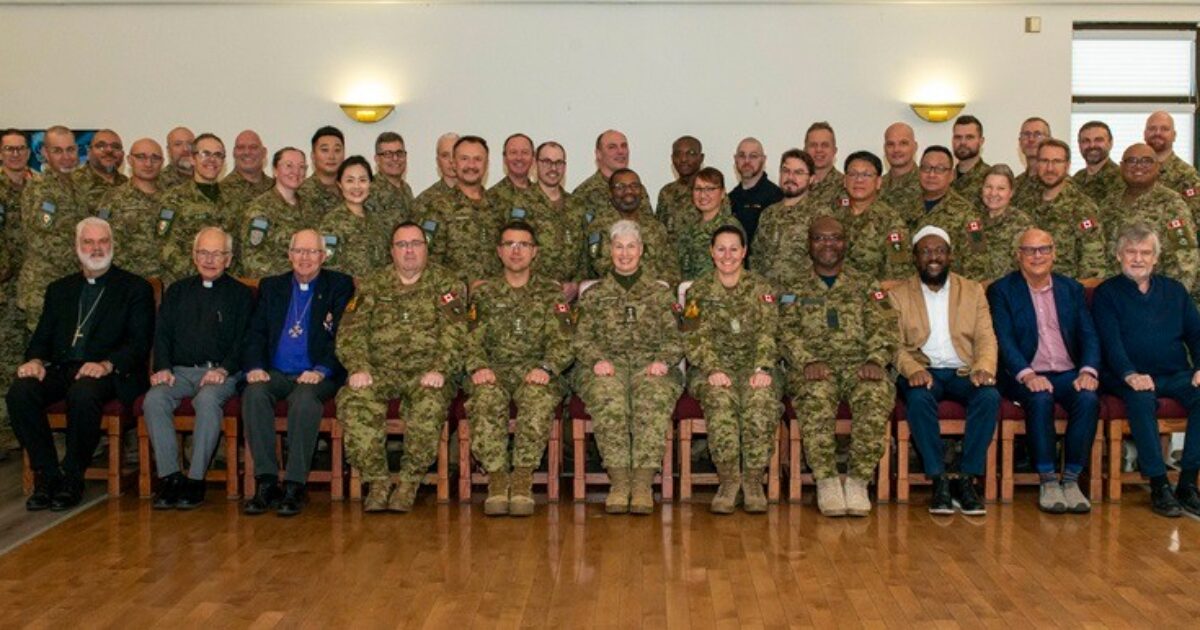
The Canadian Armed Forces has issued a new directive barring chaplains and other military personnel from mentioning God, Jesus, or other religion-specific language during mandatory public events. Military Personnel Instruction 03/26, Spiritual Reflections in Military Settings, was issued on July 29, 2026, by the Chief of Military Personnel. It states that chaplains “must instead offer a spiritual reflection” when prayers or religious observances are requested at official government events that members are expected or required to attend.
The policy applies to graduation parades, change-of-command ceremonies, ship commissionings, honours ceremonies, mess dinners, and Remembrance Day commemorations. At such events, chaplains acting as representatives of the Armed Forces rather than their own faith traditions must not use words, actions, or symbols specific to a spiritual or faith tradition.
The Department of National Defence told Canadian Catholic News that the instruction was intended to clarify the responsibilities of commanders, chaplains, and all members in responding to personnel’s moral and spiritual needs. The department also said it was intended to align military policy with the Canadian Charter of Rights and Freedoms and the Supreme Court of Canada’s 2015 ruling in Mouvement laïque québécois v. Saguenay. The ruling found that a municipal council’s practice of opening meetings with prayer breached the state’s duty of religious neutrality.
The instruction acknowledges that regimental prayers, mealtime graces, and traditions honoring patron saints have provided comfort and connected service members with earlier generations. However, it prohibits these traditions from being observed at the events themselves. For example, a chaplain may no longer recite a traditional grace before a mess dinner. The instruction states that these traditions may instead be taught as history in a separate educational setting but not performed as part of the ceremony or meal.
Fortunately, the Canadian government is benevolent enough to provide exceptions for funerals. The instruction exempts several categories of activity. Funerals are not considered public military ceremonies under the policy. They are described as typically family-led events combining military ritual with the religious traditions of the deceased. Chaplains may officiate, pray, and conduct religious rites at them.
Furthermore, chaplains will not be arrested for invoking Jesus during private counseling. Pastoral care, faith-specific gatherings, weekly worship, religious rites, and milestone ceremonies also fall outside the restrictions.
And, of course, because Canada is liberal and believes that equality can be achieved only by taking rights away from some while granting exceptional rights to others, Indigenous spiritual practices receive different treatment.
The instruction permits their inclusion for cultural, historical, and educational purposes when relevant to an occasion and presented within an educational context, provided attendees are not required to participate in spiritual elements. The department cited the 2020 British Columbia Supreme Court decision in Servatius v. Alberni School District No. 70, concluding that Indigenous spiritual practices presented in a noncompulsory educational context do not breach the state’s duty of neutrality. It also said the approach supports the Truth and Reconciliation Commission’s Calls to Action.
The public debate in Canada is similar to that in the United States. Some interpret religious freedom as requiring freedom from religion. The counterargument is that Christians constitute the largest religious group in both countries, while the religiously unaffiliated constitute the next-largest group. Christian messaging would therefore be consistent with the beliefs of most of the population.
According to Statistics Canada census data, Canada, despite being more secular than the United States, remains majority Christian at 53.3 percent. As in the United States, Christianity is even more prominent in the armed forces. Internal military figures indicate that Christians constitute 58 to 62 percent of the Canadian Armed Forces.
People reporting no religious affiliation, including secular, atheist, and agnostic individuals, constitute the next-largest group in both the Canadian population and the military. They account for 34.6 percent of Canada’s population. All other faith traditions combined account for approximately 5 to 7 percent of the military, including Sikhism, Islam, Judaism, Hinduism, Buddhism, and Indigenous traditions.
While Canada’s government is restricting religion in the military, the U.S. government has moved in the opposite direction. Under President Trump, Secretary of War Pete Hegseth has moved to restore faith to the military chaplaincy, reversing decades of marginalization under the Obama and Biden administrations. This included sidelining chaplains from teaching roles and rebranding them as “spiritual readiness coaches” rather than religious leaders.
Hegseth ordered the elimination of the Army’s Spiritual Fitness Guide, a document that ran more than 100 pages while mentioning God only once. He called such materials unacceptable for the War Department.
In December 2025, he hosted the Pentagon’s first Christmas worship service, featuring Rev. Franklin Graham. Hegseth has told troops that the military’s demands can be met only by bending the knee before Providence, as Washington once did.
At Quantico, Hegseth and Trump outlined a broader cultural shift away from DEI-era priorities and toward a warfighting culture built on merit and discipline. Congress advanced this shift through the FY26 defense bill.
Christian prayer has also returned to federal agency meetings. Departments such as the Consumer Financial Protection Bureau now open sessions with Christian prayer, while new White House guidance encourages federal employees to express their faith at work.
On May 1, 2025, President Trump signed an executive order creating the Religious Liberty Commission, chaired by Texas Lt. Gov. Dan Patrick, with Dr. Ben Carson serving as vice chair. The commission was tasked with rooting out “anti-Christian bias” in the federal government and producing a report by the country’s 250th anniversary.
Acting on the commission’s recommendations, the Department of Education reversed Biden-era guidance in February 2026 to protect student and teacher prayer explicitly in public schools. The IRS also said it would no longer enforce the rule barring houses of worship from endorsing political candidates.
Trump called on Americans in July 2025 to pray for at least one hour each week. On May 17, 2026, he held a nationwide prayer gathering on the National Mall to “rededicate America” as one nation under God.
Hegseth now regularly prays with soldiers. He and Speaker Mike Johnson represent a decisive shift toward welcoming rather than suppressing expressions of Christian faith in American governance.
During the Biden and COVID years, it seemed that the whole world was becoming more secular and moving further left as basic rights and freedoms disappeared. Canada imposed some of the most draconian lockdown rules, making it difficult for citizens to earn a living or leave and reenter the country.
Religious freedom was severely restricted during the lockdowns as churches were closed. Canada’s much broader hate-speech laws have also often prevented Christians from speaking publicly. Under President Trump, the United States is returning to its earlier freedoms and religiosity. However, if Republicans lose the White House and Congress, America could go the way of Canada.
Ad block users: Some site features may not work correctly while an ad blocker is enabled, because they break scripts and content this website depends on. If you can’t see comments below, for example, please disable your ad blocker.
Read the full article here


