




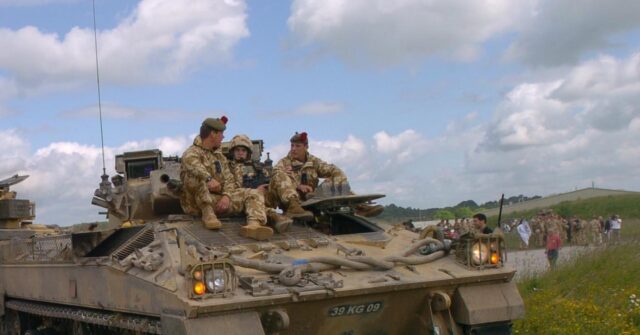
The British Army will reportedly halt “non-essential” training exercises amid a budget crunch, while the government faces calls to cut welfare spending to meet the nation’s defence needs.
According to a report from the state broadcaster BBC, citing an anonymous source within the British defence apparatus, the Army has been forced to cancel “nice-to-have training” sessions.
This will include planned live-fire exercises in which platoons will practise large-scale attacks at training sites in Wiltshire and Wales. One such cancelled training session was reported to include practice for the Royal Tank Regiment with tanks and Apache helicopters.
While the military is said to be focusing on other areas of training, like counter-drone tactics learned from the war in Ukraine, the defence source specifically told the broadcaster that the decision to cancel training was not the wish of the Army brass but rather as a result of budget constraints.
The British government has increased military funding as of late; however, much of this new funding has been directed towards weapons development projects rather than troop readiness exercises.
An Army spokesman said: “Our training continues and we are prioritising activity that contributes most directly to readiness, deployability and operational effectiveness. We are also investing £2bn to transform training for the British Army over the next 15 years.”

Nevertheless, the news will likely add further pressure on recently installed Prime Minister Andy Burnham, who has so far refused to commit to any spending cuts from Britain’s generous welfare schemes to help fund the Armed Forces.
In the 2025/2026 budget, the UK government is projected to spend £322.6 billion ($436.4bn) on its welfare system, nearly a quarter of total government spending and an estimated 10.6 per cent of GDP.
In contrast, during the 2025/26 financial year, the UK is set to spend £62.0 billion ($84bn) on defence.
Although the government has increased defence spending since 2016, when it fell to £48.0 billion in current prices, it still lags behind many other nations in terms of share of GDP.
Currently, fellow NATO members Lithuania, Estonia, Latvia, Poland, Greece, Denmark, Sweden, the United States, Norway, Türkiye, Germany, Finland, and the Netherlands all spend more relative to their GDP than Britain.
While the government has said that it intends to increase defence spending to £79.1 billion by the end of the decade, some have questioned if welfare spending could be cut now to free up funds for the military.
During his first Prime Minister’s Questions on Wednesday, PM Andy Burnham refused to target any area of government spending for cuts when pressed on the issue by Conservative Party leader Kemi Badenoch.
“Faced with a choice between spending on military training and spending on benefits… Labour chooses more benefits,” Conservative Shadow Secretary of State for Work and Pensions Helen Whately remarked.
Follow Kurt Zindulka on X: Follow @KurtZindulka or e-mail to: kzindulka@breitbart.com
Read the full article here


