

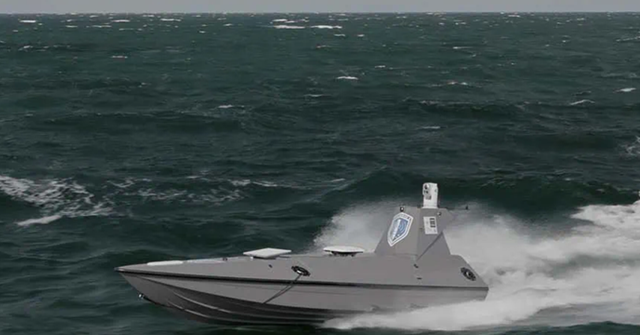
Advanced sea drones provided by a tech company also contracted to the United States Military contained Chinese components sending data back to Beijing, a whistle-blower report claims.
The Ministry of Defence was forced to issue denials after claims emerged that the country’s new generation of sea drones (‘uncrewed surface vessel’) contained cameras built with Chinese components which were sending data home without the knowledge of the military, or the company that built them.
Conservative-leaning broadsheet The Daily Telegraph cited the remarks of a source within the military who blew the whistle on Chinese components built into scout drones communicating with an Internet Protocol (IP) address inside China who said: “This is major failure to check origins of components and we have lost confidence in the platform”.
Per the report, the components were installed inside a camera system fitted to K3 Scout drones which the Navy says can be used for “surveillance, force protection and precision strikes”. Acquired by the Royal Navy as part of a £12 million contract as the British military experiments with emerging drone technologies, the K3 is built by UK-based Kraken Technology which has also boasted of a $49 million agreement with the United States Special Operations Command.
Respected defence blog Navy Lookout notes the K3 is fitted with a ‘Night Navigator 3000 series’ Electro-Optical/Infra-Red camera system, which is mounted prominently on the top of the superstructure of the drone boat to give a clear view around the craft to remote operators. That gimballed camera assembly is made by Canadian tech company Current Scientific Corporation, but it isn’t clear that this is definitely the the system impacted by Chinese components, as the craft may have more than one camera fitted.
Former Royal Navy Admiral and Falklands War veteran known for sinking an Argentinian submarine in 1982 Chris Parry reflected on the revelations and said in his view, accidentally allowing internet-connected Chinese components into a Royal Navy boat should mean a “major fine” for the supplier and a ban from competing for future contracts.
Per the Royal Navy’s own account, drone technology is a major part of the government’s vision for the future of defence. Recent statements by the Navy note “Uncrewed systems are no longer a future concept for the Royal Navy and Royal Marines; they have been delivering operational effect for the past four years and are in service today”, that the Kraken K3 has already “undergone thorough testing in UK waters”.
Earlier this year, the Navy trialled dropping the K3 out of the back of an aircraft to test rapid deployment of the craft in foreign waters.
The Ministry of Defence moved fast to control the story and issued a statement that didn’t deny their new scout drone had been transmitting data to China, but did insist that nothing of importance had been sent to Beijing. They said:
The first duty of government is national security, and we take the security of our equipment, networks and data extremely seriously. A routine cyber-vulnerability assessment identified an issue affecting a Kraken Unmanned Surface Vessel sub-system used by the Royal Navy. A thorough investigation found no evidence of MoD data or systems being accessed, compromised or transmitted externally.
Our assurance and testing processes are designed to identify and address potential vulnerabilities early, and we continue to undertake routine security activity across our systems and equipment.
Boat builder Kraken also commented, and said through a spokesman:
We are aware that some third-party, NDAA-compliant cameras had a small number of components originating from outside the UK.
After a full audit by both Kraken and the Royal Navy we are confident no sensitive information has ever been shared outside of intended channels and any potential vulnerabilities have been identified and closed.
Despite the minimising statements, The Daily Telegraph report states the issue was considered serious enough for the uncrewed drone boats to be isolated from the internet, and for concerns to have been raised about whether sensitive military discussions may have been held in proximity to the compromised craft.
The vulnerabilities of technology to Chinese components potentially inserting back doors for foreign intelligence into equipment is well understood in the United Kingdom, yet it appears in the case of these seagoing scout drones they were accepted into service earlier this year without a full understanding of what was inside.
The consequences of such decisions is clear: the Huawei debacle of 2020 saw the then-British government of Boris Johnson having to back out of a contract with Chinese tech firm Huawei to build a part of the nation’s incoming 5G telecoms network. The government had been keen to stay with the Chinese state-controlled business as the best value-for-money bid for the project even in the face of security warnings about allowing China to take hold of the UK’s internet backbone, pushing ahead even in the face of a rebellion by its own lawmakers.
Those most responsible for security seem sensible to the risk, however. Both Britain and Poland’s militaries have banned Chinese electric vehicles from sensitive military sites — given modern electric cars are covered in sensors, cameras, microphones, and have internet connectivity — and the U.S. military has blocked Chinese EV companies from bidding for contracts given their close links to the Chinese government.
Read the full article here
