





The Breitbart Business Digest Weekly Wrap: Wives, Crosses, Call Centers, and Capital Goods
Welcome back to Friday! This is the Breitbart Business Digest’s weekly wrap, where we’ve been extremely productive all week but suspect that most of the upside of this enterprise is being captured by management rather than the workers.
This week, the government reported productivity numbers that suggested that all that capital investment we’ve been seeing is paying off, especially in manufacturing. What’s more, it suggests that the tariff-doomers who predicted import duties would hurt output and efficiency were embarrassingly wrong. The Pope called his old bank and found out that even being the leader of one billion Catholics doesn’t help you avoid annoying call center customer service reps. The government said labor’s share of output fell to a record low in the first quarter, which isn’t the bad news for workers that it sounds like. And we found out that the exodus of illegal aliens is creating employment opportunities for married women.
Let’s muddy the waters.
The Manufacturing Productivity Boom Keeps Booming
The Bureau of Labor Statistics released its first-quarter productivity report on Thursday, and the numbers were another vindication of a thesis we’ve been building in these pages since last November: tariffs, immigration enforcement, and capital incentives are pushing American businesses from a low-wage, low-productivity model to a high-investment, high-output model. The critics said this couldn’t happen. It’s happening.
Manufacturing productivity surged 3.6 percent in the first quarter, with output up 3.3 percent while hours worked fell 0.4 percent. In durable goods—the sector most exposed to Trump’s tariffs—productivity jumped 5.3 percent. Nonfarm unit labor costs, the key measure of whether wage gains translate into inflation, rose just 1.2 percent year-over-year even as hourly compensation climbed 4.2 percent. Productivity absorbed the difference. That’s the mechanism we first described last November: tariffs and immigration enforcement raise the cost of the old low-wage model, capital incentives lower the cost of the alternative, and firms respond by investing in machines and process improvements that raise output per worker faster than wages rise—lowering unit costs even as workers earn more.
The GDP report last week showed us where the investment is coming from. Equipment spending surged 17.2 percent annualized. Intellectual property investment climbed 13 percent. Core capital goods orders jumped 3.3 percent in a single month. The equipment orders we started tracking last January have now completed their full journey through the economy—from orders to shipments to GDP to Thursday’s productivity numbers.
At every stage, the data has come in on our side. The folks at Cato, the Wall Street Journal, and most Wall Street economists predicted tariffs would destroy productivity and send manufacturing into retreat. They couldn’t have been more wrong. Manufacturing productivity under Trump 2.0 is up 2.86 percent cumulatively—under the final comparable Biden quarters, it rose 0.36 percent. Durable goods productivity is up 11.64 percent versus 4.63 percent. The most tariff-exposed sectors are posting the strongest gains.
We’ll do a fuller treatment next week. For now, the short version: they said tariffs would kill productivity. Productivity is booming. We told you so.
Workers’ Share of Output Hits a Record Low—Rejoice!
Thursday’s productivity report contained a startling number: the labor share of output fell to 54.1 percent, the lowest recorded value since the series began in 1947. Take that uppity workers!
This is not bad news—even for uppity workers. The labor share is a relative indicator. It tells you what fraction of total output goes to workers as compensation versus what goes to profits, depreciation, and other non-labor income. A falling labor share doesn’t mean workers are earning less—it means output is growing faster than compensation. And that’s exactly what’s happening. Real hourly compensation in manufacturing is up 2.7 percent over the past year. Workers are getting raises. They’re just getting them in an economy where productivity and output are growing even faster.
The flip side of a falling labor share is a rising profit share. And, no matter what Elizabeth Warren tells you, profits are good for the economy. As Larry Kudlow likes to say, profits are the mother’s milk of stocks and the lifeblood of the economy. When businesses are highly profitable, they invest more, they hire more, and they pay their workers more. Indeed, higher profitability often leads to bidding wars for workers as employers scramble to increase output to capture the returns. The record-shattering corporate earnings we’ve seen this year and the stock market’s run to new highs are downstream of exactly this dynamic.
This is what a capital deepening boom looks like in its early stages. The profits fund the next round of investment, which drives the next round of productivity gains, which pulls wages higher still. The labor share will rise once the investment cycle matures and competition for those uppity workers intensifies.
The Working Spouse Economy
We’ve written a lot about the forces working to slow labor force growth so it seems like a good time to mention one of the countervailing factors: wives. The employment of working married women is near an all-time high, with over 39 million currently employed in April. Over the past year, the number has risen by 717,000. The unemployment rate for married women—meaning the share of out of work but looking—is just 2.5 percent. While that’s not a record low, it is very low by historical standards and another sign that we’re running a full-employment economy.
The number of married men, on the other hand, fell by over 900,000 over the past year. But don’t worry, this is not an employment war between the sexes. The rate of unemployment among married men is at two percent, also a historically low figure, suggesting full employment.
So, what’s going on? The most likely explanation is immigration policy. The number of married men in the workforce fell by roughly 1.2 million over the past 12 months, likely reflecting the departure of many illegal aliens. This has created job opportunities for married women, with 813,000 entering since May of 2025. In other words, immigration policy has been good for women who want to work.
And it’s not just wives. The number of single mothers in the workforce—the government coyly refers to them as “women who maintain families”— has been more or less flat over the past year, but their unemployment rate has plunged from 5.2 percent to 4.2 percent.
Single men? Believe it or not, no one in the government cares enough to break out unmarried male employment in the monthly jobs report. The policy concerns that led to the creation of the single mom category—welfare reform, poverty measurement, and the feminization of poverty debates going back to the Moynihan Report era—overlooked what unmarried men were doing. The implicit assumption was that male workforce attachment was solid enough that we didn’t need to break out the married guys from the single guys.
But that assumption has been breaking down for years. The decline in prime-age male labor force participation, the opioid crisis, the “deaths of despair” literature, the “men without work” research—all of that points to unmarried men as a category where something significant is happening. But they are invisible in the jobs report.
Is This Catholic the Pope?
Here’s a story about what happened when Pope Leo XIV called his old bank to update his phone number and address, according to a story his close friend, the Rev. Tom McCarthy, told a gathering of Catholics in Naperville, Illinois, last week.
Like the rest of us, the Pope had to answer all those annoying security questions. He got the answers right. But the bank rep told him that for security reasons, he’d have to come to the branch in person. “I’m not going to be able to do that,” he explained — because, you know, he had just become Pope and had Pope business to attend to.
In an effort to resolve the situation, the man formerly known as Robert Prevost asked: “Would it matter to you if I told you I’m Pope Leo?” The bank rep hung up.
The newly elected Pope Leo XIV addresses the crowd from the loggia balcony of St. Peter’s Basilica for the first time on May 8, 2025, in the Vatican. (TIZIANA FABI/AFP via Getty Images)
The story has a happy ending. Another priest who knew the bank president was able to intervene and get the address change sorted out. There’s no word on whether the woman who hung up on the Pope has expressed contrition, but we’re sure she can be forgiven.
Rainmaker: Hernando de Soto Finds the Mississippi
On May 8, back in 1541, a Spanish conquistador named Hernando de Soto stood on the banks of a river so wide that he couldn’t see across it. It’s described in the journals of the expedition as having strong currents and muddy waters. De Soto called it the Río del Espíritu Santo, which is Spanish for the River of the Holy Spirit. We call it the Mississippi.
De Soto had been wandering the American interior for two years. He’d been named the governor of Cuba and given a license to explore La Florida, which is Spanish for the Florida but really meant all of North America above Mexico. He had landed near Tampa Bay in 1539 with 600 men—including 12 priests— and 200 horses.

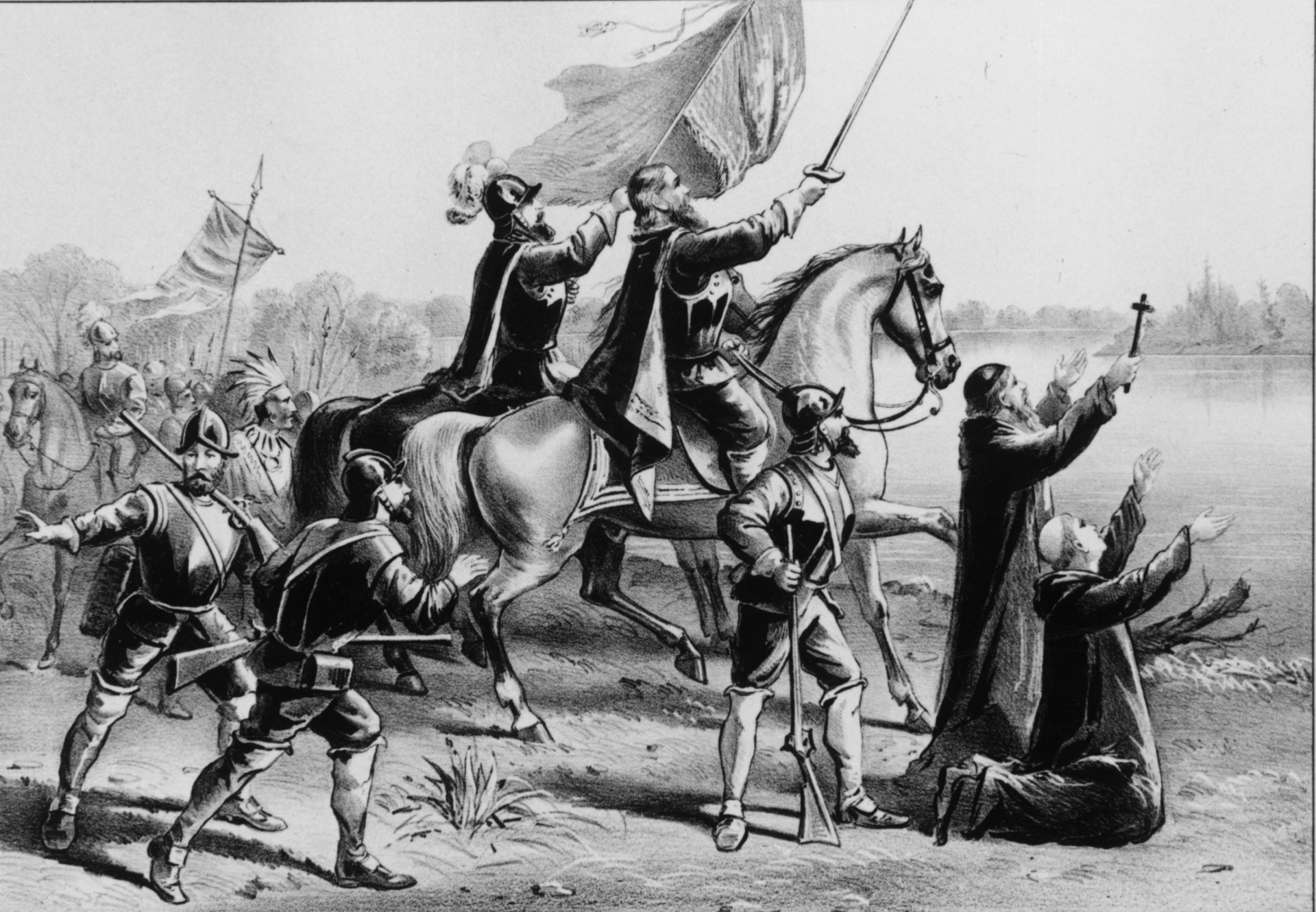
This 1874 print by Currier & Ives depicts Spanish adventurer and explorer Hernando De Soto and his followers discovering the Mississippi River in 1541. (MPI/Getty Images)
After crossing the Mississippi into what is now Arkansas, they came across a local chief who said his tribe was suffering through a drought and begged for help from the Spaniards. De Soto’s Italian carpenter was sent to find the “tallest, straightest tree” and built a massive cross from bald cypress. On July 4, 1541, a hundred men raised it on top of the chief’s ceremonial mound. The Dominican priests said Mass. This is considered the first recorded Christian ceremony in the state of Arkansas.
The next day, it rained.
In 2016, a team at Parkin Archeological State Park in Cross County, Arkansas, excavated what they believe is the base of that cross. Wood had been discovered in the mound back in 1966, and radiocarbon dating placed it between 1515 and 1663. A single chevron glass bead associated with the de Soto expedition — the only one ever found in Arkansas — was also recovered at the site.
Read the full article here


